
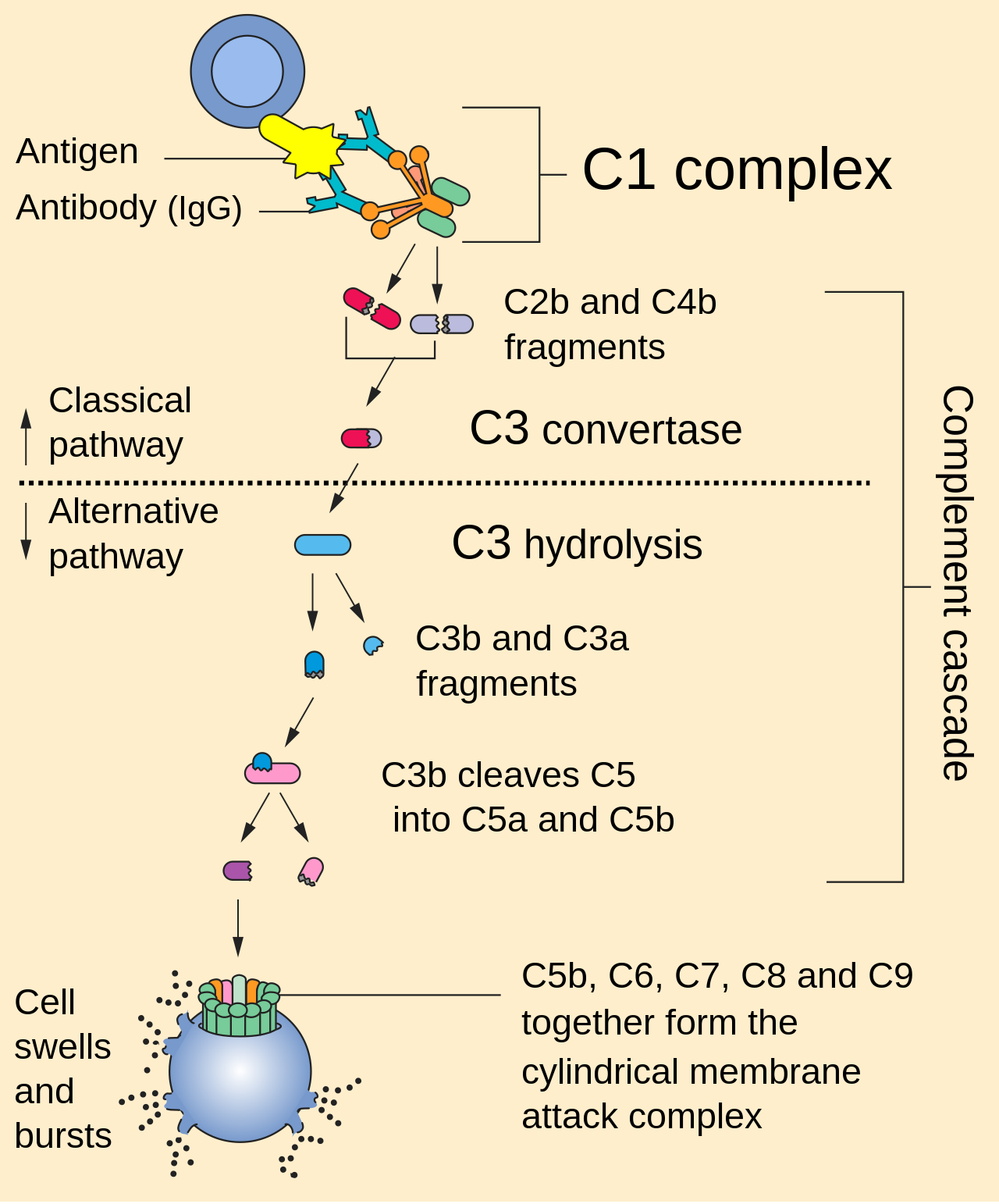
Complement Pathway
11.1 Transplantation #
11.1.1 Direct and indirect allorecognition #
A graft is rejected because donor MHC, and the peptides it carries, were never the MHC on which the recipient’s repertoire was selected. Direct allorecognition is recipient T cells binding intact donor MHC on donor cells, especially donor dendritic cells in the recipient’s nodes. Foreign MHC is read as if it were self MHC plus foreign peptide, at a frequency on the order of one T cell in a hundred, sometimes higher, so primary rejection is fast. Indirect allorecognition is recipient dendritic cells processing donor MHC as an ordinary foreign protein and presenting peptides on recipient class II. Frequencies are ordinary, antibody against donor HLA is readily driven, and that antibody binds graft endothelium and fixes complement. Chronic rejection depends heavily on this route. Minor histocompatibility antigens are polymorphic self peptides presented on shared MHC; male-specific H-Y peptides are the classical set, which is why HLA-identical siblings can still reject, more slowly. ABO antigens are on endothelium, and pre-formed IgM against the A or B structures a person lacks attacks an incompatible graft at once.
11.1.2 Tempo, matching, and graft-versus-host disease #
| Tempo | When | Main effector |
|---|---|---|
| Hyperacute | Minutes to hours | Pre-formed antibody and complement |
| Acute | Days to weeks | T cells, with or without new antibody |
| Chronic | Months to years | Indirect recognition, antibody, vascular remodelling |
HLA-A, HLA-B, and HLA-DR are the loci most often emphasised in matching, because they drive strong direct responses. A closer match means fewer foreign molecules on the graft. Graft-versus-host disease reverses the direction. It follows haematopoietic transplantation, when the graft contains mature donor T cells and the recipient cannot reject them. Those T cells attack recipient tissues that present antigen vigorously, classically skin, liver, and gut.
11.2 Tumours #
11.2.1 Antigens, editing, and evasion #
Burnet and Thomas proposed that lymphocytes survey for transformed cells. Immunoediting states the modern version in three phases: elimination of a nascent clone, equilibrium that holds and sculpts variants, and escape of a variant no longer controlled. Lasting immunosuppression is associated with more tumours, especially virus-associated ones. Neoantigens are peptides from mutations the thymus never saw, and viral proteins in virus-associated cancers are foreign for the same reason, so both are credible CD8 targets. Tumour-associated antigens are self proteins over-expressed or expressed in the wrong tissue, and tolerance makes responses to them weaker. Escape reuses ordinary mechanisms: loss of MHC class I, loss of the targeted antigen, and a microenvironment rich in TGF-β, IL-10, and regulatory T cells and poor in costimulators.
11.2.2 CTLA-4 and PD-1 #
CTLA-4 appears after activation, binds B7 more tightly than CD28, and removes B7 from the dendritic cell. Regulatory T cells express it constitutively. The brake is on signal 2, in the node, at priming. Allison and colleagues showed that blocking it lets an otherwise inadequate antitumour response proceed. PD-1 is high on T cells exhausted by chronic stimulation: still specific, poor at killing and dividing. Its ligand PD-L1 is induced by IFN-γ on inflamed tissue and on many tumours. Engagement recruits SHP-2 and dampens signalling from the T-cell receptor and from CD28. This brake acts in the tissue, on the effector. Blocking PD-1 or PD-L1 releases cells that already recognise the tumour; it does not create a new specificity. The two brakes are sequential, CTLA-4 at the start through B7 and PD-1 at the effector stage through PD-L1. Blocking either can injure normal organs, because the same molecules limit autoimmunity.
11.3 Vaccines #
11.3.1 What each type shows the immune system #
A vaccine moves the primary response to before natural infection, so that memory meets the pathogen. Passive antibody, such as maternal IgG or an antitoxin, protects at once and leaves no memory; a vaccine is active immunisation. An adjuvant supplies the pattern signal a pure protein lacks, so dendritic cells raise B7. Alum is the classical example and acts in part through the inflammasome.
| Type | What is shown | Response favoured | Immunological limit |
|---|---|---|---|
| Live attenuated | A limited infection; antigen made inside cells | CD8 and CD4, antibody, often durable memory | The host must contain an organism that is still alive |
| Inactivated | A dead organism; exogenous antigen | Antibody and CD4; CD8 only if cross-presented | No replication, so boosters are usual |
| Subunit | Selected proteins, sometimes as a genome-free particle | Antibody and CD4 against those proteins | Narrow; a pure protein may lack a pattern signal |
| Toxoid | A toxin made non-poisonous and still antigenic | Neutralising antibody | Stops the toxin, not necessarily colonisation |
| Conjugate | Polysaccharide covalently linked to protein | T-dependent response to the sugar, including in infants | The covalent link is the whole principle |
| mRNA | A transcript translated by host cells | Endogenous protein on class I, plus antibody | One or a few proteins, not the organism |
| Viral vector | A non-disease virus carrying the antigen gene | Intracellular synthesis of that antigen | Immunity to the vector can limit a later dose |
Measles vaccine and BCG are live attenuated; killed poliovirus vaccine is inactivated; hepatitis B surface antigen and human papillomavirus particles are subunits; tetanus and diphtheria vaccines are toxoids. Licensed mRNA coronavirus vaccines, and adenovirus or vesicular-stomatitis-virus vectors used against Ebola, are intracellular formats: host cells make the antigen.
11.3.2 Conjugates and herd immunity #
Capsular polysaccharides are TI-2 antigens. They are not presented on MHC class II, infants respond poorly, and there is no T-cell help and little memory. A conjugate attaches the sugar covalently to a protein carrier, often a toxoid. The B cell that binds the sugar internalises the particle, presents carrier peptides, and receives CD40 ligand and cytokines from a carrier-specific T follicular helper. That B cell can switch, mutate, and leave memory. The T cell never sees the sugar. Free polysaccharide mixed with free protein fails, because linked recognition needs one particle. Conjugates against Haemophilus influenzae type b and against pneumococcal and meningococcal polysaccharides are the licensed demonstration. Herd immunity is a consequence for transmission. If enough contacts are already immune, chains of person-to-person spread fail, and people who cannot respond are protected by their neighbours. The fraction required is not a universal constant. It is higher when each case infects more new people, it depends on how the population mixes, and it does not apply in the same way to infection from the environment or an animal reservoir.
11.4 Key terms, summary, and self-check #
Key terms. Direct allorecognition; indirect allorecognition; minor histocompatibility antigen; hyperacute rejection; graft-versus-host; immunoediting; neoantigen; CTLA-4; PD-1; PD-L1; toxoid; conjugate; adjuvant; herd immunity.
Summary. Direct recognition of intact donor MHC engages a large fraction of T cells and drives acute rejection; indirect presentation of donor peptides drives antibody and chronic injury. Graft-versus-host disease is that recognition by T cells inside a haematopoietic graft. Tumours are edited and then escape by losing antigen or MHC and by engaging CTLA-4 at priming and PD-1 on effectors. Vaccines differ by whether antigen is made inside a cell, supplied from outside, or linked to a carrier so that a carbohydrate receives T-cell help. Herd immunity is failed transmission when immune hosts are common enough.
Self-check.
1. Which form of allorecognition involves a high frequency of T cells, and why?
2. Why can HLA-identical siblings still reject a graft?
3. Why is graft-versus-host disease the reverse of ordinary rejection, and which transplant does it complicate?
4. Where does CTLA-4 act, where does PD-1 act, and what does each bind?
5. What does covalent linkage to a carrier give a polysaccharide that the pure sugar lacks? Why is herd immunity not one percentage for every infection?
