
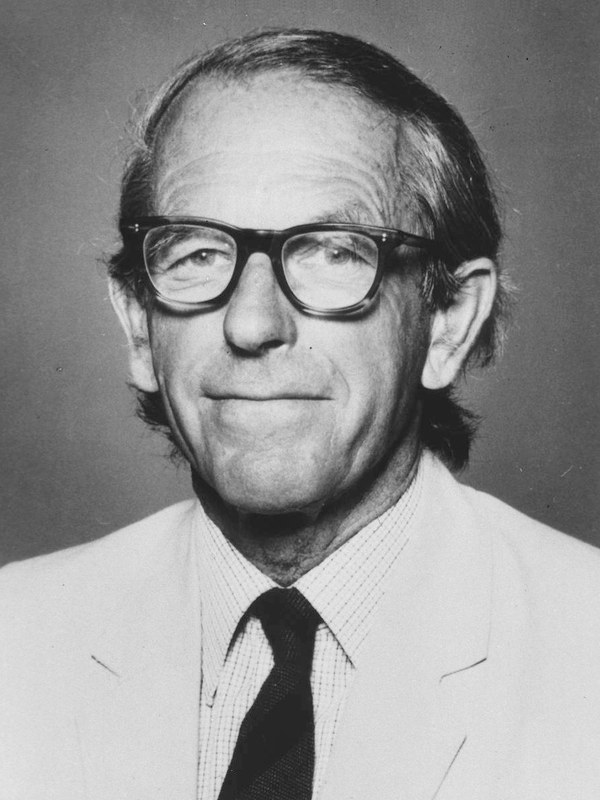
Frederick Sanger
Double Nobel Laureate in Chemistry (1958 & 1980); conclusively proved that proteins possess precise chemical sequences and invented dideoxy DNA sequencing.
Nobel Prize in Chemistry (1958)
Citation: “For his work on the structure of proteins, especially that of insulin.”
Significance: Sanger shattered the prevailing 1940s dogma that proteins were amorphous, indistinct colloids. By inventing Sanger's reagent (1-fluoro-2,4-dinitrobenzene / FDNB) and pioneering 2D paper partition chromatography, he determined the exact 51-amino-acid sequence of bovine insulin, establishing that every protein is a defined chemical molecule with a unique, genetically programmed linear sequence.
Nobel Prize in Chemistry (1980)
Citation: “For his contributions concerning the determination of base sequences in nucleic acids.”
Significance: Sanger invented the enzymatic dideoxy chain-termination method (Sanger Sequencing) using 2',3'-dideoxynucleoside triphosphates (ddNTPs). Lacking the 3'-OH group required for phosphodiester bond formation, ddNTPs randomly terminate DNA synthesis, enabling genomes to be decoded base-by-base. Sanger used this method to sequence the first complete genome in history (bacteriophage PhiX174, 5,386 bp in 1977) and the human mitochondrial genome (16,569 bp in 1981), creating the technological backbone of the Human Genome Project.
Through all my scientific life I have had the privilege of being able to do what I wanted to do: to spend my time at the bench doing research.
Curiosity & Historical Discovery Anecdote
The serendipity, obstacles, and fascinating human journey behind the discovery.
Frederick Sanger was famously humble and completely indifferent to academic titles or self-promotion. When Queen Elizabeth II offered him a knighthood, he politely declined because he didn't want to be addressed as 'Sir' ('A knighthood makes you different, doesn't it? And I didn't want to be different.'). He only accepted the Order of Merit (OM) in 1986 because it carried no title. Sanger described himself simply as 'just a chap who messed about in a lab.' In 1992, the Wellcome Trust founded the world-renowned Sanger Institute in Hinxton, Cambridge, named in his honor—which went on to sequence one-third of the entire human genome.
High-Yield Exam Focus (CSIR-NET, GATE, USMLE)
Core mechanisms, experimental controls, and recurring competitive exam questions.
1. Sanger's Reagent: 1-fluoro-2,4-dinitrobenzene (FDNB) reacts with uncharged N-terminal alpha-amino and epsilon-amino groups in mildly alkaline solution to produce yellow dinitrophenyl (DNP)-amino acids, surviving acid hydrolysis (6 M HCl, 110 deg C, 24 h). 2. Dideoxy Mechanism: 2',3'-ddNTPs lack BOTH 2'-OH and 3'-OH. DNA polymerase cannot synthesize the subsequent 5'->3' phosphodiester bond, causing obligate chain termination. 3. Bovine Insulin Architecture: 51 total amino acids across two polypeptide chains: A-chain (21 residues) and B-chain (30 residues). Chains are linked by two interchain disulfide bonds (CysA7-CysB7 and CysA20-CysB19) and one intrachain disulfide bond within the A-chain (CysA6-CysA11). 4. Sanger vs. Maxam-Gilbert: Sanger is enzymatic (uses DNA Polymerase I Klenow fragment or Sequenase); Maxam-Gilbert is chemical cleavage (DMS for purines, hydrazine for pyrimidines). Sanger requires far fewer toxic reagents and easily scales to automated capillary electrophoresis. 5. Historic Nobel Record: Sanger is one of only two individuals in history to receive two Nobel Prizes in Chemistry (1958 and 1980), alongside K. Barry Sharpless (2001 and 2022).
Landmark Scientific Breakthroughs & Molecular Mechanisms
Step-by-step scientific explanations of the discoveries that defined modern biology.
Complete Primary Amino Acid Sequencing of Bovine Insulin
Experimental Logic & Mechanism:
Developed fluorodinitrobenzene (FDNB / Sanger's reagent) to covalently label N-terminal alpha-amino groups. By combining partial acid hydrolysis, specific enzymatic digestions (pepsin, trypsin, chymotrypsin), and two-dimensional paper partition chromatography, Sanger mapped all 51 amino acids across the A and B chains and assigned their three disulfide linkages.
Invention of Dideoxy Chain-Termination DNA Sequencing
Experimental Logic & Mechanism:
Incorporated synthetic 2',3'-dideoxynucleoside triphosphates (ddATP, ddCTP, ddGTP, ddTTP) in four parallel in vitro enzymatic synthesis reactions alongside normal dNTPs and DNA Polymerase I. The absence of the 3'-hydroxyl group prevents phosphodiester bond formation, halting chain elongation at defined bases. Radiolabeled or fluorophore-tagged fragments are resolved by high-resolution denaturing polyacrylamide gel electrophoresis to read the sequence 5' to 3'.
Decoding the First Complete DNA and Organelle Genomes (PhiX174 & Human mtDNA)
Experimental Logic & Mechanism:
Applied the dideoxy technique to sequence the circular 5,386-nucleotide genome of bacteriophage PhiX174—the first entire DNA genome ever decoded, discovering overlapping genes. In 1981, his LMB team sequenced the 16,569-bp human mitochondrial genome, uncovering non-universal codon usage (UGA encoding tryptophan rather than stop) and proving mitochondrial autonomous genetics.
Development of 2D RNA Fractionation ("Wandering Spot" Technique)
Experimental Logic & Mechanism:
Pioneered radioactive P-32 labeling combined with specific ribonuclease digestions (RNase T1, pancreatic RNase) and high-voltage two-dimensional electrophoresis on cellulose acetate and DEAE paper. Tracing mobility shifts ('wandering spots') allowed determination of nucleotide sequences up to 120 bases, including 5S ribosomal RNA.
Biographical Journey & Intellectual Legacy
Chronological chronicle of early education, mentorship, research trials, and achievements.
Frederick Sanger was born in Rendcomb, Gloucestershire, England, the son of a medical doctor. Raised as a Quaker, Sanger adopted an austere, meticulous work ethic and lifelong pacifist convictions, registering as a conscientious objector during World War II.
He entered St John's College, Cambridge, in 1936, completing his degree in natural sciences and earning his Ph.D. in 1943 under Albert Neuberger on lysine metabolism. Remaining at Cambridge, he joined Albert Chibnall's laboratory, where he began pioneering work on determining the amino acid sequence of insulin.
Over a grueling 12-year period of benchwork, Sanger painstakingly assembled the sequence of bovine insulin, demonstrating that proteins possess an exact primary sequence. This monumental achievement earned him his first Nobel Prize in Chemistry in 1958 at the age of 40.
In 1962, Sanger moved to the newly established MRC Laboratory of Molecular Biology (LMB) in Cambridge. Shifting his attention to nucleic acids, he first developed methods to sequence RNA (such as 5S rRNA) before turning to DNA.
In 1977, Sanger unveiled the chain-termination 'dideoxy' method. Using this technique, his team sequenced the 5,386 base pairs of bacteriophage phiX174—the first entire DNA genome ever decoded. In 1980, he was awarded his second Nobel Prize in Chemistry (shared with Walter Gilbert and Paul Berg). Sanger retired in 1983 to tend his garden, leaving behind an immortal legacy that unlocked the language of genomes.
Landmark Publications & Primary Literature
Original monographs and communications that announced the breakthroughs to the world.
Ryle, A. P., Sanger, F., Smith, L. F., & Kitai, R. (1955). The disulphide bonds of insulin. Biochemical Journal, 60(4), 541-556.
Significance: Final landmark paper solving the complete covalent structure and disulfide arrangement of bovine insulin.
Sanger, F., Nicklen, S., & Coulson, A. R. (1977). DNA sequencing with chain-terminating inhibitors. Proceedings of the National Academy of Sciences, 74(12), 5463-5467.
Significance: The foundational paper introducing the revolutionary dideoxy chain-termination DNA sequencing method.
Sanger, F., Air, G. M., Barrell, B. G., et al. (1977). Nucleotide sequence of bacteriophage phi X174 DNA. Nature, 265(5596), 687-695.
Significance: First complete DNA genome ever sequenced in history (5,386 nucleotides).
Anderson, S., Bankier, A. T., Barrell, B. G., de Bruijn, M. H., Coulson, A. R., Drouin, J., ... & Sanger, F. (1981). Sequence and organization of the human mitochondrial genome. Nature, 290(5806), 457-465.
Significance: First complete human organelle genome decoded (16,569 base pairs), identifying mitochondrial gene arrangement and alternate genetic code.
Explore Related Lecture Notes on B10logy
Direct access to comprehensive textbook notes where these discoveries are analyzed in depth.