
6.1 Photoreceptors #
6.1.1 Pr, Pfr, lettuce, and de-etiolation #
Phytochrome carries phytochromobilin. Pr absorbs red near 660 nm and becomes Pfr. Pfr absorbs far-red near 730 nm and becomes Pr. Pfr is the active form. Daylight holds a substantial Pfr fraction. A canopy removes red more than far-red, Pfr falls, and many plants show shade avoidance: longer internodes, less branching, earlier flowering. Light-stable phyB reads that reversible response. phyA accumulates in the dark and mediates very-low-fluence responses and de-etiolation in continuous far-red, so a seed under a canopy can still germinate. The phyB test is repeatable: red induces, immediate far-red cancels, and the last flash decides.
Borthwick, Hendricks, and colleagues showed this with imbibed lettuce cv. Grand Rapids. Red promotes germination and far-red reverses it. Dry seed does not respond. A dark-grown seedling is etiolated: long axis, apical hook, closed yellow cotyledons. De-etiolation shortens the axis, opens the hook, and greens the cotyledons. In the dark, COP1 degrades the transcription factor HY5 and PIFs promote elongation. In the light, Pfr enters the nucleus, PIFs are degraded, COP1 is inhibited, and HY5 turns on the light-grown programme. Cryptochrome joins that route in blue light.
6.1.2 Cryptochrome and phototropin #
Cryptochromes are blue and UV-A receptors, flavoproteins related to photolyases but not repairing DNA. cry1 is the main receptor for blue-light inhibition of hypocotyl growth. cry2 contributes to flowering time. Both entrain the circadian clock. A cry1 mutant is long in blue light and still bends toward it.
Phototropins are a different blue-light receptor. LOV domains bind FMN, light makes a flavin–cysteine adduct, and the kinase fires. phot1 bends the seedling in dim blue light; phot2 is especially important for moving chloroplasts out of strong light. Phototropins also open stomata, through the pump of Chapter 1. They do not de-etiolate. UVR8 perceives UV-B. The separation to remember is phytochrome, cryptochrome, and phototropin.
6.2 Phototropism #
The study of Phototropism provides fundamental principles governing cellular architecture, molecular interactions, and physiological regulation.
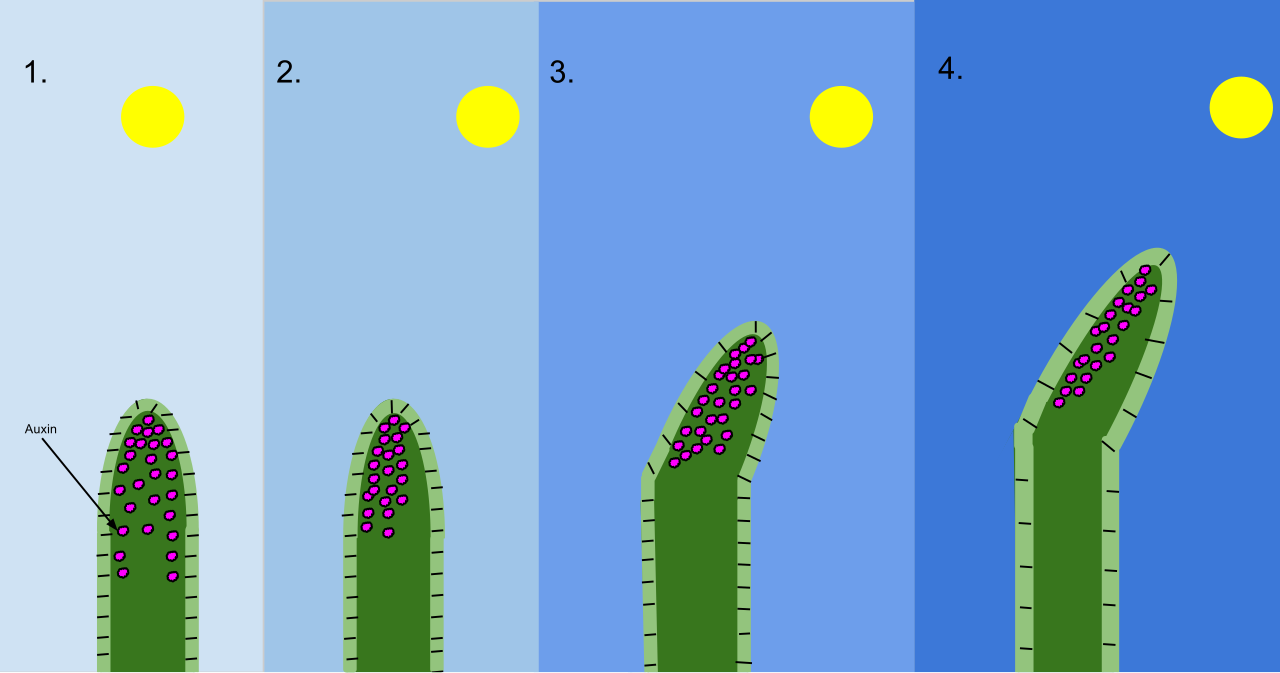
Phototropism
6.2.1 Cholodny–Went, updated #
The Cholodny–Went hypothesis says unilateral light redistributes auxin to the shaded side, that side elongates more, and the organ bends toward the light. The same redistribution was proposed for gravity. In coleoptiles the classical evidence is strong: the tip perceives the light, an auxin difference between the flanks has been measured, and a barrier between the flanks prevents curvature.
In the Arabidopsis hypocotyl, phototropin sets the gradient and PIN3, with PIN1 and PIN7, redirects efflux toward the shaded side. Auxin accumulates there and that side elongates. The change is in PIN placement, not in destruction of auxin on the lit side. A coleoptile perceives at the tip. A dicot hypocotyl perceives more widely.
Gravity uses the same logic. Sedimenting amyloplasts put auxin on the lower side. Shoots elongate there and bend up. Roots are inhibited by that concentration and bend down, using the PIN2 flow in the epidermis.
6.3 Photoperiodism and vernalisation #
6.3.1 Long days, short days, and the night that is measured #
Garner and Allard, in 1920, showed that Maryland Mammoth tobacco and some soybeans flower by day length, not by age or by photosynthetic dose. A short-day plant flowers when the night exceeds its own critical length: chrysanthemum, rice, cocklebur (Xanthium), Maryland Mammoth. A long-day plant flowers when the day exceeds its critical length: spinach, wheat, barley, laboratory Arabidopsis, which is quantitative and flowers eventually even in short days. Cocklebur is qualitative. Tomato and many maize cultivars are day-neutral. The critical value is not 12 hours. The class is which side of the species’ own threshold induces flowering.
Cocklebur needs an uninterrupted long night. A brief dim night break prevents flowering although the light is useless for photosynthesis. Red works, and immediate far-red reverses it, so phytochrome reads the break. A night break can promote a long-day plant. “Short-day plant” is the historical name for what is really a long-night plant. The leaf measures the night. One induced leaf can flower a plant held otherwise in non-inductive days.
6.3.2 Coincidence, and florigen as FT protein #
Bünning’s coincidence model says the clock sets a sensitive phase and light either falls in it or misses it. In Arabidopsis, CO mRNA peaks in the evening. On long days FKF1 removes CDF repressors, so that peak occurs in the light. CO protein is unstable in the dark, via COP1, and in the early morning via phyB. Cryptochrome and phyA stabilise it later in the day. Protein therefore accumulates only when the evening peak coincides with daylight, and CO induces FT in companion cells. Rice uses the homologues differently: Hd1 can promote flowering in short days and repress it in long days, and Hd3a is the FT relative.
Chailakhyan called the graft-transmissible leaf signal florigen. It is FT protein, moving in the phloem to the apex, where it joins 14-3-3 and the bZIP factor FD and induces APETALA1 and SOC1. The mRNA is not the signal that travels. Developmental Biology takes the ABC model from there. FT also integrates age, temperature, and gibberellin. TFL1 at the apex opposes FT and keeps the meristem indeterminate.
6.3.3 Vernalisation and FLC #
Vernalisation is the acquisition, during prolonged cold, of the ability to flower later. Winter cereals and many Arabidopsis accessions require it. Common laboratory genotypes do not: they lack a working FRIGIDA and do not keep FLC high, so they are a poor guide to the species. The plant does not flower in the cold. It becomes competent, and long days are a second gate. The apex perceives the cold, in dividing cells, because the memory is chromatin. Several weeks a little above freezing are typical. The number is not universal, and the process is not freezing tolerance.
FLC represses FT and SOC1. Cold induces VIN3, which helps Polycomb repressive complex 2 methylate histone H3 on lysine 27 at FLC. The mark is copied through later warm mitoses and reset in the next embryo, so progeny must be vernalised themselves. This is not an inherited acquired character. Longer cold raises the fraction of cells in which FLC is off. Wheat does not use FLC. Cold induces VRN1, VRN2 is repressed, and VRN3, an FT relative, can then respond to long days. The cold memory is shared. The gene names are not.
6.4 Key terms, summary, and self-check #
Key terms. Phytochrome; Pr; Pfr; phyA; phyB; de-etiolation; cryptochrome; phototropin; Cholodny–Went; night break; CONSTANS; florigen; FT; vernalisation; FLC.
Summary. Red makes Pfr and far-red makes Pr, and the last flash decides lettuce germination. phyB reads shade, phyA reads far-red, cryptochrome and phytochrome de-etiolate through HY5, and phototropin bends the seedling. Short-day plants measure a long night in the leaf. CO protein accumulates only if light hits the evening peak of CO, and FT protein moves in the phloem to the apex. Vernalisation methylates FLC through Polycomb. The mark holds through spring and is reset in the next generation.
Self-check.
1. Lettuce seed receives red, then far-red, then red. Does it germinate, and why does the last flash decide?
2. Which blue-light receptor shortens the hypocotyl, and which one bends it?
3. Why is a short-day plant more accurately a long-night plant, and what does a red night break do to cocklebur?
4. Where is FT made, what moves, and which protein at the apex opposes it?
5. What does prolonged cold do to FLC, and why must the progeny experience winter again?
—
—
—