
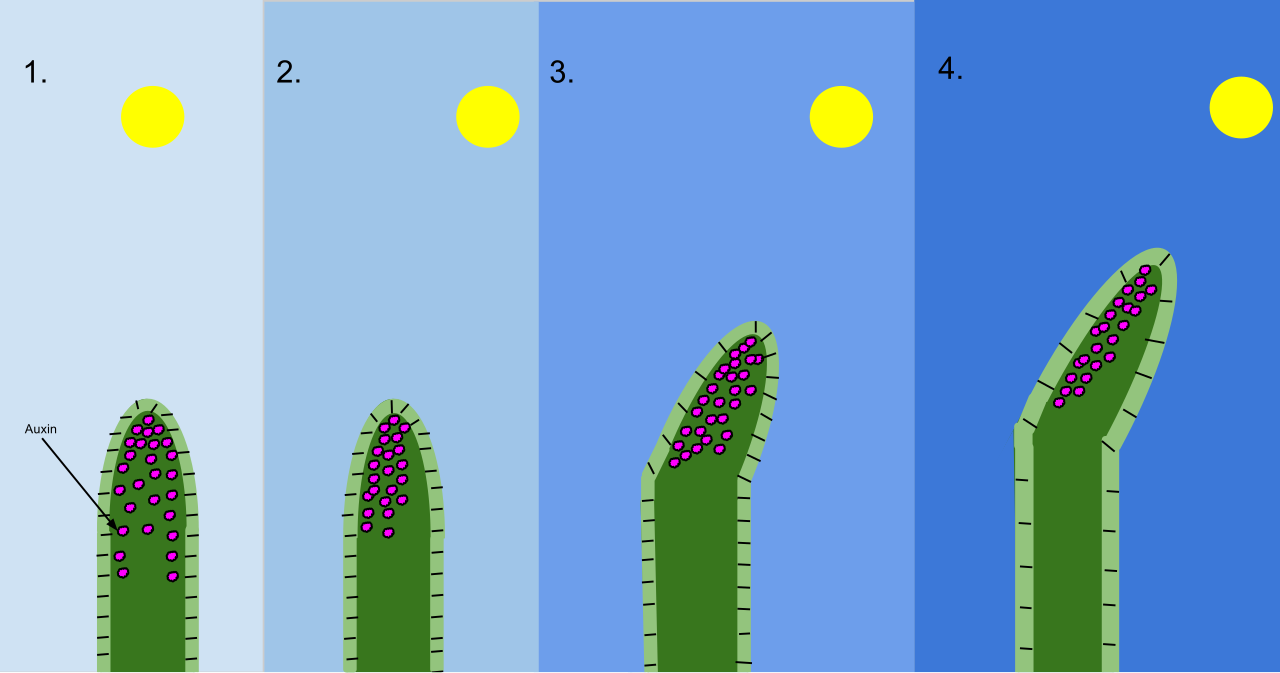
Phototropism
5.1 Auxin #
5.1.1 Effects, the coleoptile assay, and PIN proteins #
Indole-3-acetic acid is the principal auxin. It promotes shoot elongation, initiates lateral and adventitious roots, directs vascular differentiation, drives the tropisms of Chapter 6, and supports fruit growth where developing seeds are the source. A concentration that elongates a shoot often inhibits a root. Auxin from the apex is required for apical dominance: remove the apex and axillary buds grow; auxin on the stump can restore the suppression. The bud is not controlled by auxin alone. Strigolactone and cytokinin carry much of the repression and the release.
The classical assay used coleoptiles. Darwin showed that the tip perceives unilateral light and that a tip-less coleoptile does not bend. Boysen-Jensen showed that the stimulus crosses gelatin and not mica. Went, in the 1920s, let tips diffuse into agar and placed the agar on one side of a decapitated coleoptile in the dark. The coleoptile curved away from the block, and the angle measured the substance. Indole-3-acetic acid is the compound that survived the early chemical confusion.
Polar transport is cell to cell and, in the stem, basipetal. It is not phloem movement. Auxin is a weak acid, pKa near 4.8, so near wall pH 5.5 some is protonated and diffuses in. AUX1/LAX symporters also take up the anion. In the cytosol, near pH 7, it is trapped as IAA−. PIN proteins provide the exit, and their face sets the direction: basal PIN1 sends auxin toward the base of the stem. PINOID kinase and PP2A decide which face is used, and trafficking can move the proteins in minutes. In the root, auxin moves to the tip in the stele and back along the epidermis through PIN2.
5.1.2 Acid growth and its limits #
The acid-growth hypothesis covers the fast response. Auxin activates the plasma-membrane H+-ATPase within minutes. SAUR proteins inhibit the phosphatases that would switch the pump off, a 14-3-3 protein holds it on, and wall pH falls. Expansins already in the wall loosen cellulose–xyloglucan contacts at acid pH. Turgor then extends the cell. Acid buffers mimic the early elongation. Neutral buffers oppose it. Fusicoccin locks the pump on and elongates the tissue without auxin.
Acidification does not explain sustained growth. That needs new wall and transcription. The receptor is TIR1/AFB, an F-box protein. Auxin lets TIR1 bind AUX/IAA repressors, which are ubiquitinated and destroyed. ARF transcription factors then induce wall genes, expansins, and further SAURs. Both timescales are real. Some tissues elongate without a pH drop large enough to explain the whole rate. The hypothesis is incomplete.
5.2 Cytokinin #
5.2.1 Division, and the delay of senescence #
Cytokinins are adenine derivatives. trans-Zeatin and isopentenyladenine are the usual active free bases, released by LOG enzymes after isopentenyl transferases have modified adenine nucleotides. Kinetin, from autoclaved DNA, is not a natural hormone. It was the reagent that revealed the activity.
Skoog and Miller’s tobacco pith cultures are the classical system. High cytokinin relative to auxin favours shoots. High auxin relative to cytokinin favours roots. A balanced ratio keeps undifferentiated callus. Richmond and Lang showed the other classical effect: kinetin on a detached Xanthium leaf delays the loss of chlorophyll and protein. Cytokinin delays senescence and can make a treated spot a nutrient sink.
Cytokinin also maintains the shoot meristem and releases axillary buds. The receptors are histidine kinases (AHK2, AHK3, CRE1/AHK4). A phosphorelay through AHP proteins activates type-B ARR transcription factors, and type-A ARRs feed back negatively. Plants without the receptors have crippled meristems, which the culture result alone could not have shown.
5.3 Gibberellin #
5.3.1 Foolish seedlings and DELLA #
Bakanae, the foolish-seedling disease of rice, is caused by Gibberella fujikuroi, a Fusarium that overproduces gibberellins. Kurosawa showed that a cell-free extract of the fungus makes seedlings tall, thin, and pale. Plants make their own. Biosynthetic dwarfs of maize and pea are restored by an external supply, which is the evidence that the hormone is part of ordinary elongation. GA1 and GA4 are the usual active forms. GA20-oxidase and GA3-oxidase make them. GA2-oxidase inactivates them. Those dioxygenases are where feedback and the environment act.
The effects to remember are internode elongation, bolting, germination and the aleurone response of Chapter 8, and fruit growth, of which seedless grapes are the agricultural illustration. Gibberellin contributes to flowering in some long-day plants. It is not florigen. If a supplied gibberellin restores a dwarf, the block was probably in synthesis. If it does not, the plant is insensitive.
The receptor is GID1. Hormone binding creates a surface for DELLA proteins, an SCF ligase ubiquitinates them, and the proteasome destroys them. DELLAs had been restraining growth by holding transcription factors, including PIFs. A DELLA that cannot be degraded keeps restraining. Semi-dwarf wheats of the Green Revolution carry such Rht alleles, so stems stay short and lodge less. Semi-dwarf sd1 rice is different: a weak GA20-oxidase means less hormone, and the plant can still respond to an external supply.
5.4 Ethylene #
5.4.1 The triple response, and a receptor that restrains #
Ethylene is made from methionine via S-adenosylmethionine and ACC. ACC synthase is the main control point. Auxin induces it, so some consequences of an auxin treatment are ethylene responses. The gas diffuses away in air and accumulates under water. Neljubov, in 1901, described the triple response of dark-grown pea seedlings in illuminating gas: a short epicotyl, radial swelling, and an exaggerated apical hook. Arabidopsis does the same. The three parts are the definition.
Climacteric fruits — tomato, banana, apple, avocado — ripen with a respiratory rise and an autocatalytic ethylene burst. Grape, strawberry, and citrus do not. Ethylene promotes leaf senescence and, once auxin from the organ has fallen, abscission. In flooded roots it helps form aerenchyma. The etiolated hook is an ethylene structure.
The receptors, ETR1 and its family, sit in the endoplasmic reticulum and bind ethylene with a copper cofactor. They are negative regulators. Without the gas they keep CTR1 active, CTR1 prevents release of the EIN2 C-terminus, and the pathway stays off. Binding stops that restraint. EIN2’s C-terminus then stabilises EIN3 and EIL1. A receptor that is missing cannot activate CTR1, so the seedling shows a constitutive triple response in clean air. Dominant etr1-1 cannot bind ethylene and stays off: tall seedlings, late ripening. Loss of CTR1 is constitutive. Loss of EIN2 or EIN3 is insensitive.
5.5 Abscisic acid #
5.5.1 Stomata and seed dormancy #
The name abscisic acid points at abscission, which ethylene does more directly. ABA’s secure roles are stomatal closure, seed dormancy, the block on vivipary, and drought genes. It is made from carotenoids. Water deficit induces NCED, the cleavage that leads through xanthoxin to ABA. A later step needs a molybdenum cofactor, so a cofactor defect can give a wilty, ABA-deficient plant. ABA-glucose ester can be released faster than new synthesis. CYP707A hydroxylases inactivate ABA when the stress ends or a seed is ready to germinate.
The classical evidence is genetic. Tomato flacca and sitiens, Arabidopsis aba, and maize viviparous mutants wilt with stomata that will not close, and their seeds germinate too readily. Dormin and abscisin II are the same molecule. The guard-cell ion steps are in Chapter 1. The receptor core is PYR/PYL, inhibition of PP2Cs, and SnRK2 kinases, which phosphorylate SLAC1 and the bZIP factors ABI5 and AREB/ABF. ABI3, ABI4, and ABI5 maintain seed maturation. ABI3 is the Arabidopsis relative of maize Viviparous-1. LEA genes are among the targets Chapter 7 uses.
5.6 Brassinosteroids #
5.6.1 A steroid the plant cannot do without #
Brassinolide, the most active brassinosteroid, was isolated from oilseed-rape pollen. The classical bioassay was elongation and splitting of a bean internode. Plants that cannot make or perceive the hormone are severe dwarfs, with short thick stems, dark curled leaves, and weak fertility. Gibberellin does not rescue them, and brassinolide does not rescue a gibberellin dwarf. det2 blocks synthesis. bri1 blocks the receptor. Dark-grown biosynthetic mutants look partly de-etiolated. The hormone is not a photoreceptor.
BRI1, a leucine-rich-repeat receptor kinase, binds the hormone with BAK1. A phosphorylation cascade then inhibits BIN2. While BIN2 is active it phosphorylates BZR1 and BES1 and keeps them out of action. When BIN2 is inhibited, those factors enter the nucleus and change a large set of growth genes, and they also repress brassinosteroid synthesis. BRI1, BIN2, and BZR1/BES1 are the chain to remember.
5.7 Branching and defence signals #
5.7.1 Strigolactones, jasmonates, and salicylic acid #
Strigolactones are carotenoid-derived root exudates. They germinate the parasites Striga and Orobanche, which is how they were found, and they suppress shoot branching. max, rms, and dwarf mutants branch or tiller excessively, and grafting showed a signal moving up from the root. The same molecules stimulate arbuscular-mycorrhizal hyphae, so one exudate recruits a fungus and betrays the root to a parasite. D14 cleaves the hormone and, with the F-box protein MAX2, targets D53/SMXL repressors. That core is secure. They also reduce PIN1 at an axillary bud, and a bud that cannot export auxin grows poorly. How far transcription and PIN placement each go is still being divided. Apical dominance uses three hormones: auxin raises strigolactone and lowers cytokinin.
Jasmonates are oxylipins from linolenic acid: OPDA in the plastid, jasmonic acid in the peroxisome. JA-Ile is the active conjugate. It reports wounding and chewing insects, contributes to defence against necrotrophs, and is required for anther opening and pollen function in Arabidopsis. Proteinase inhibitors appear in an unwounded tomato leaf after another leaf is wounded. JA-Ile lets COI1 bind a JAZ repressor, JAZ is degraded, and MYC2 induces the defence genes. A coi1 mutant is male-sterile and open to chewing insects. The logic matches auxin and gibberellin: destroy a repressor.
Salicylic acid, made mainly via isochorismate, is required for defence against many biotrophs and for systemic acquired resistance. NPR1 and TGA factors induce pathogenesis-related genes when salicylic acid is high. That requirement in the receiving tissue is secure. The molecule that travels is not. A signal can leave tissue that cannot make salicylic acid, if the receiver can. Chapter 7 states the hypersensitive response.
| Hormone | Effects to remember | Classical observation | Secure mechanism |
|---|---|---|---|
| Auxin | Shoot elongation, roots, tropisms, fruit set | Went’s curvature assay | Polar PIN efflux; acid growth, then TIR1 |
| Cytokinin | Division, shoots in culture, delayed senescence | Skoog and Miller; Richmond and Lang | AHK receptors and the ARR phosphorelay |
| Gibberellin | Elongation, germination, aleurone | Bakanae; rescue of biosynthetic dwarfs | GID1 and DELLA degradation |
| Ethylene | Triple response, climacteric ripening, abscission | Neljubov’s triple response | Receptor and CTR1 keep the path off |
| ABA | Stomatal closure, seed dormancy | Wilty and viviparous mutants | PYR/PYL, SnRK2, SLAC1 and ABI transcription factors |
| Brassinosteroid | Elongation; a dwarf if absent | Rape-pollen steroid; not rescued by GA | BRI1 inhibits BIN2; BZR1/BES1 act |
| Strigolactone | Less branching; mycorrhizal signal; Striga | Branching mutants; root exudates | D14 and MAX2 degrade SMXL |
| Jasmonate | Wounding, necrotrophs, male fertility | Systemic proteinase inhibitors | JA-Ile, COI1, JAZ degradation |
| Salicylic acid | Biotroph defence and SAR | Needed for resistance in distant leaves | NPR1; the mobile signal is unsettled |
5.8 Key terms, summary, and self-check #
Key terms. PIN; acid growth; TIR1; cytokinin; DELLA; triple response; CTR1; PYR/PYL; BRI1; strigolactone; JA-Ile; COI1; NPR1.
Summary. PIN proteins on one cell face make auxin efflux polar. Elongation is acid growth first and TIR1-dependent transcription afterwards. Cytokinin divides cells and delays senescence. Gibberellin destroys DELLA repressors. The ethylene receptor holds the pathway off until the gas arrives. ABA closes stomata and maintains dormancy. Brassinosteroids act through BRI1 and are not gibberellins. Strigolactones restrain branching, jasmonates report wounds, and salicylic acid is required for systemic acquired resistance. The mobile signal in that response is not settled.
Self-check.
1. Why can protonated auxin enter a cell, and why does polar transport still depend on where PIN proteins sit?
2. Which part of elongation does wall acidification explain, and which part requires TIR1?
3. What happens to DELLA when gibberellin binds GID1, and why does Rht wheat stay short?
4. Why does loss of an ethylene receptor give a constitutive triple response, while loss of EIN3 gives insensitivity?
5. Give one whole-plant effect each for cytokinin, brassinosteroid, and strigolactone. What is still unsettled about systemic salicylic acid?
—
—
—