
2.1 Climate as a machine #
2.1.1 Uneven heating #
The tropics receive more solar energy per unit area than the poles because the same beam is spread over less ground and takes a shorter path through the atmosphere. Seasons exist because the Earth’s axis is tilted, so day length and noon angle change through the year. They do not exist because the planet moves appreciably closer to the Sun in summer. A weather-station climate is not the climate of a seedling. Geiger’s microclimate — aspect, canopy shade, the boundary layer against a leaf or the ground — is the one an individual experiences. In the Northern Hemisphere a south-facing slope receives more direct sun. In the Southern Hemisphere the favoured slope faces north.
Albedo is the fraction of incoming radiation a surface reflects. Snow and ice reflect a large share. Open water and forest reflect much less. That difference returns in Chapter 10 as a feedback.
2.1.2 Cells, winds, and deserts that are not mysteries #
Air rises where heating is strongest, near the equator in the intertropical convergence zone, and loses moisture as it cools. It descends in the subtropics, warms, and takes up moisture. The Hadley cells are that circuit, one in each hemisphere, and they migrate with the seasons. The descending limb is why many hot deserts sit near 30° latitude rather than at the equator. Ferrel cells and polar cells complete the three-cell picture in each hemisphere. The Coriolis effect deflects moving air, to the right in the Northern Hemisphere and to the left in the Southern, and produces the trade winds and the mid-latitude westerlies. The three-cell diagram is an idealisation. Monsoons and storm tracks are the seasonal and daily complications on top of it.
A mountain range forces air up. The air cools, drops rain or snow on the windward side, and descends drier and warmer on the lee side. That rain shadow is why a desert can sit beside a wet coast. The Gobi, the Patagonian steppe, and the dry side of the Sierra Nevada are standard illustrations. Local topography decides which side is windward.
2.1.3 Oceans move heat and nutrients #
Surface gyres are driven by the winds and deflected by the Coriolis effect and the continents. Western boundary currents, such as the Gulf Stream and the Kuroshio, are warm and fast. Eastern boundary currents are cooler, and the winds that drive them often push surface water offshore so that deeper water rises in upwelling. That deeper water is colder and richer in the nutrients that surface production has been using. Upwelling coasts and equatorial divergences are productive for that reason (Chapter 7).

Simplified Microbial Food Web In The Sunlit Ocean
El Niño is the warm phase of a Pacific oscillation. The trade winds slacken, warm water spreads east, and upwelling of cold, nutrient-rich water in the eastern equatorial Pacific weakens. Fisheries that depend on that upwelling decline in strong events. Rainfall shifts. La Niña is the opposite phase. These notes do not assign a particular year’s damage to a named storm by assertion. The oscillation is a recurring reorganisation of winds, water, and production.
2.1.4 Maritime, continental, and the long swings #
A maritime climate has a smaller annual temperature range than a continental one at the same latitude, because water has a high heat capacity and the sea is a nearby store. Glacial–interglacial swings over tens and hundreds of thousands of years follow Milankovitch changes in orbit and tilt. Those timescales, and the fossil record of the response, are Evolutionary Biology. Chapter 10 is about the much faster change from added greenhouse gases, which is not a Milankovitch cycle.
2.2 Water and soil #
2.2.1 Water on land and in it #
Rainfall is not water availability. Infiltration, runoff, storage, and evaporative demand decide what a root can take. Field capacity and the permanent wilting point are the practical bounds of water held in soil against gravity and against a plant that can no longer recover. The definition of water potential in pressure units is Plant Physiology. Salinity is both an osmotic problem and an ionic one. The physiological answers, from salt glands to kidneys, are the physiology subjects.
In lakes and the sea, light falls off with depth. The photic zone is conventionally taken down to about 1% of surface light, a rule of thumb for where net photosynthesis can continue, not a physiological constant. Oxygen is consumed by respiration and is slow to cross a still water column. A temperate lake in summer stratifies: a warm epilimnion, a thermocline, and a cold hypolimnion. Spring and autumn turnover mixes many such lakes and returns nutrients to the surface, which is why production is often seasonal. A meromictic lake does not mix fully, and its deep water can stay anoxic. Rivers are stirred and usually oxygenated unless an organic load uses the oxygen up (Biochemical oxygen demand is Microbiology, applied there to sewage).
2.2.2 Soil is built, and it is a habitat #
Jenny’s factors of soil formation are climate, organisms, relief, parent material, and time. Horizons, where the profile has developed, are roughly: O, organic litter; A, mineral soil mixed with humus; E, a leached eluvial layer, not always present; B, an illuvial layer where material accumulates; C, weathered parent material; R, bedrock. Texture — the mix of sand, silt, and clay — sets pore size, so it sets how much water and air the soil holds. Clay and humus carry negative charges and hold nutrient cations. That cation exchange is why a sandy soil with little organic matter is poor at keeping potassium, ammonium, and calcium. Nitrate, an anion, is held weakly in most temperate soils and leaches. Very acid and very alkaline soils each lock phosphorus into forms roots take up poorly. The membrane selectivity of uptake is Plant Physiology.
Old tropical soils are often deep, weathered, and poor in available nutrients even under enormous biomass. A large share of the nutrient capital is then in the vegetation, which is why clearing and burning can give a brief fertile ash and then a poor field. “Often” is required. Volcanic soils and floodplains in the tropics are not that profile. A laterite crust is a specific iron-rich feature, not a synonym for “tropical soil.”
2.2.3 Light as quantity, quality, and cue #
Plants and algae use light as a resource. What one leaf intercepts, a leaf below cannot. Quality changes under a canopy: the understorey is poorer in the red wavelengths chlorophyll absorbs. The phytochrome mechanism that reads red and far-red is Plant Physiology. Photoperiod is a cue for timing. It is not itself an energy supply. A short day in winter limits production by intensity and by duration together.
2.3 Chemical conditions #
2.3.1 Nutrients, the minimum, and colimitation #
A nutrient is an element or compound an organism requires. The same substance can be toxic above the range the organism tolerates. Liebig’s law of the minimum says growth is set by the resource in shortest supply relative to need. It is a useful first picture. It fails when two resources colimit, which is common, and when a resource becomes toxic in excess. Shelford’s law of tolerance puts both edges on the picture: too little and too much. Nitrogen, phosphorus, potassium, and the micronutrients are the plant list. Which ion crosses which membrane is Plant Physiology. How bacteria transform nitrogen is Microbiology and Chapter 8.
2.3.2 Oxygen, pH, and the carbonate system #
Aquatic animals and microbes that require oxygen are excluded when decomposition or a chemical demand uses it faster than it is supplied. Hypoxia and anoxia reorganise communities. They are not only a pollution story. A swamp and a stratified hypolimnion are naturally short of oxygen.
Carbon Cycle Cute
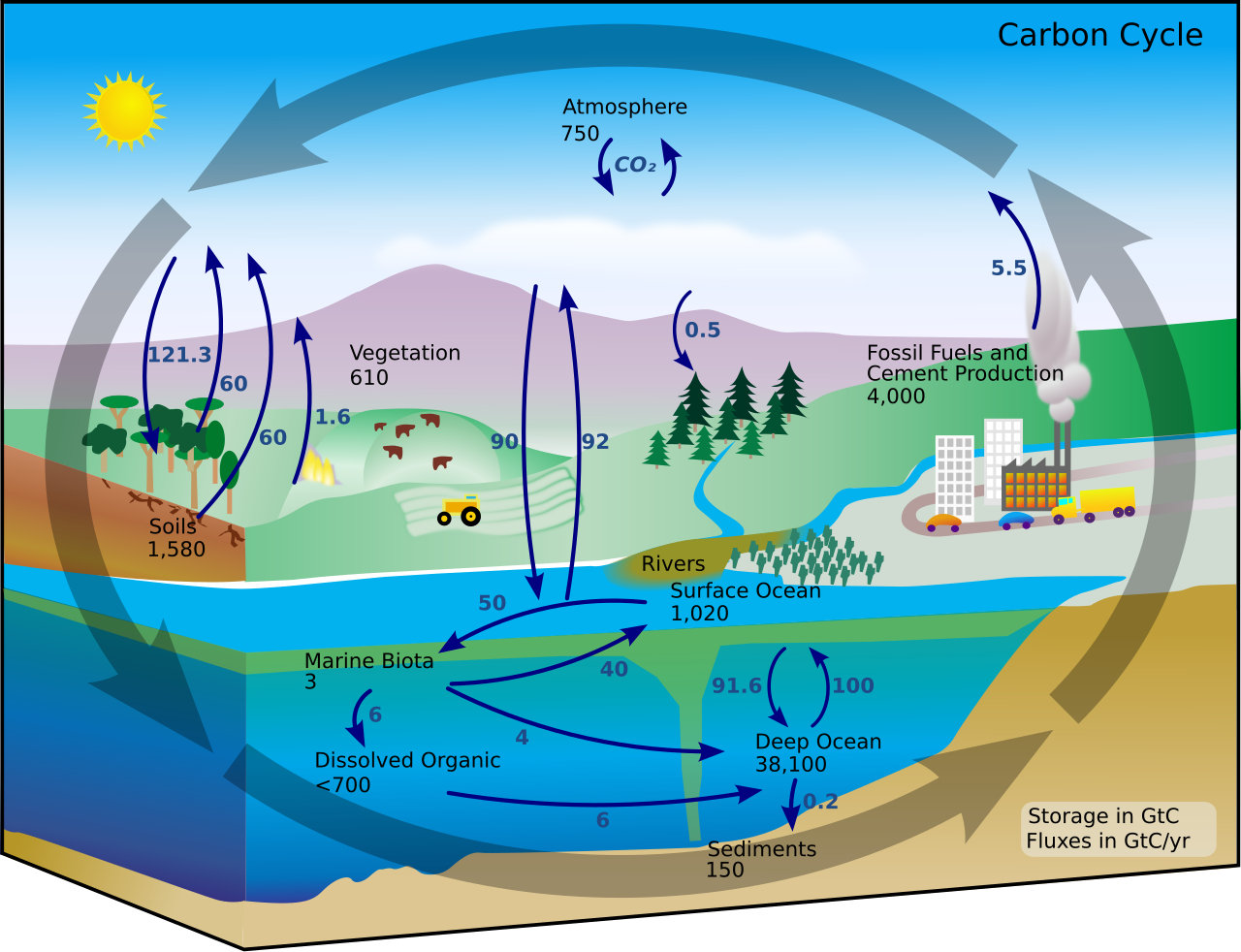
The ocean’s dissolved inorganic carbon is a set of linked forms: dissolved CO2, carbonic acid, bicarbonate, and carbonate. Adding CO2 shifts that equilibrium towards bicarbonate, lowers the carbonate ion, and lowers pH. Surface seawater is a base, near pH 8. Acidification means a fall in pH, not a change of the ocean into an acid. Since pre-industrial times the surface fall is about 0.1 pH units. Because pH is a negative logarithm, a fall of 0.1 is a rise of about 26% in the hydrogen-ion concentration (10^0.1 is about 1.26). Organisms that precipitate calcium carbonate meet a lower saturation state for aragonite and calcite. Chapter 8 puts this in the carbon cycle. Chapter 10 is the community consequence. No numerical model of a particular bay is attempted here.

Carbon Cycle-Cute -No
2.3.3 Pollutants, as an ecological category #
In these notes a pollutant is a substance or a form of energy added by human activity at a rate that changes organisms or fluxes. Whether it biomagnifies depends on persistence, on solubility in fat, and on poor excretion. DDT (and its metabolite DDE) and methylmercury are the textbook cases: concentrations rise towards the tops of food webs. Eggshell thinning in raptors followed the insecticidal use of DDT and receded where that use was later restricted. The toxicology is not a dose chart, and these notes give none. Acid deposition from sulfur and nitrogen oxides is Chapter 8 seen as a community damage. A nutrient becomes a pollutant when its flux exceeds the one the receiving system was built around. Eutrophication is that statement for nitrogen and phosphorus.

Ecological Pyramid
Key terms. Hadley cell; rain shadow; upwelling; El Niño; microclimate; thermocline; soil horizon; cation exchange; photic zone; law of the minimum; law of tolerance; ocean acidification; biomagnification.
Summary. Regional climate is uneven heating plus cells, winds, currents, and mountains. The organism meets a microclimate, a soil profile, and a light climate, not the annual mean on a map. Water and nutrients are resources whose availability is set by physics and chemistry as much as by the amount present. Liebig’s single limiting factor is the first picture and colimitation is the usual correction. Added CO2 is a greenhouse gas, taken up in Chapter 10, and through the carbonate system it lowers ocean pH now. Biomagnification is a food-web process, not a property of every poison.
Self-check.
1. Why do many hot deserts lie near 30° latitude, and why can a desert also lie in a rain shadow at another latitude?
2. What does an El Niño do to eastern equatorial Pacific upwelling, and why does that change production?
3. A temperate lake’s surface water is warm and its deep water is cold and dark. Why can the deep water run out of oxygen in summer, and what does autumn turnover return to the surface?
4. Why can an old tropical rainforest sit on poor soil? Why is that not a description of every tropical soil?
5. Surface ocean pH has fallen by about 0.1 units and the water is still near pH 8. Why is “acidification” still the right word, and what has happened to the hydrogen-ion concentration?
