
8.1 What a cycle is #
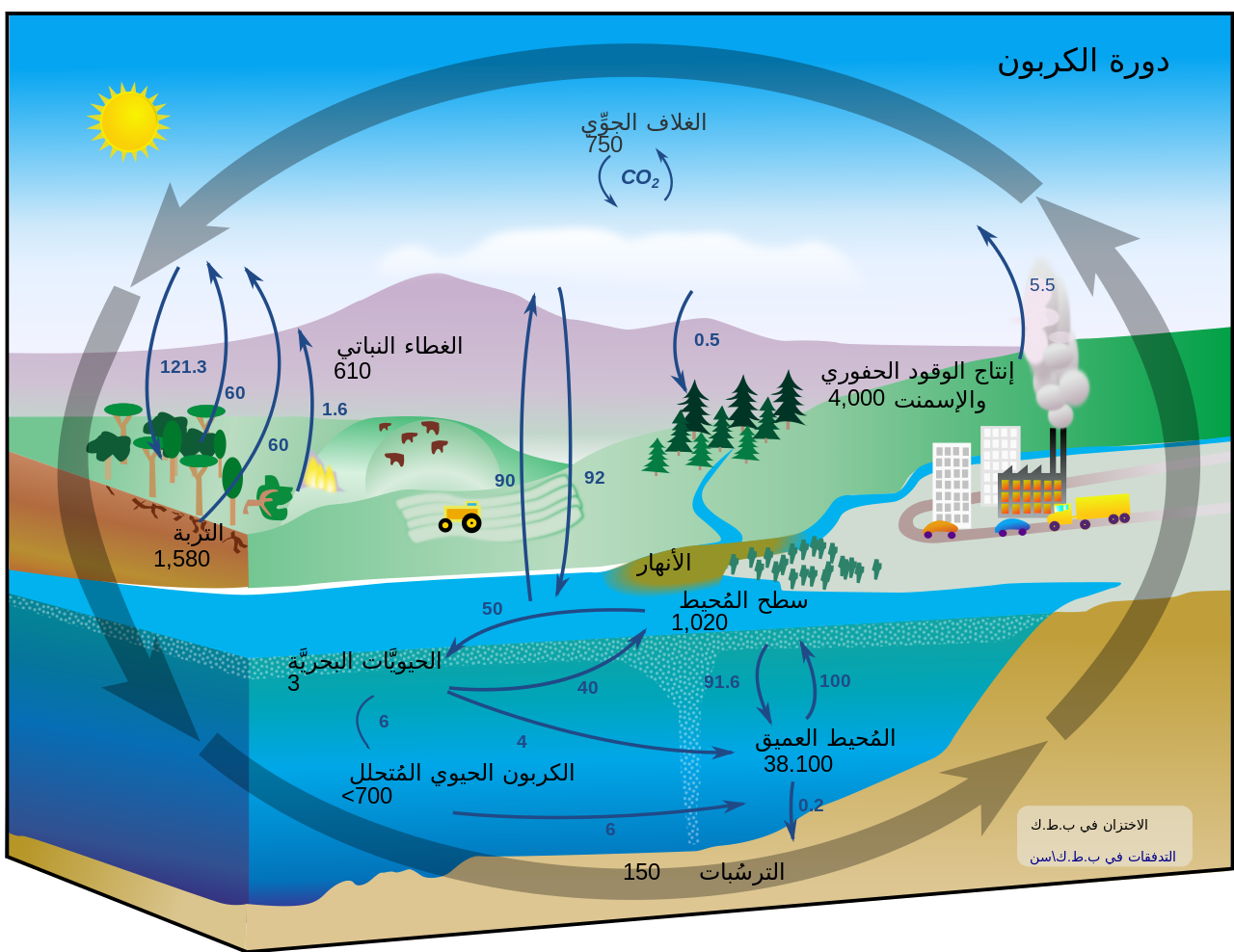
A biogeochemical cycle is the movement of an element among biotic and abiotic pools. Biological, geological, and chemical fluxes all count. A significant gas phase, as in carbon, nitrogen, sulfur, and water, lets the cycle operate globally on a short timescale. Phosphorus has no significant gas phase. It moves in dust, rivers, and organisms, and a local loss to sediment is a local loss for a long time. The organisms on each arrow are Microbiology. Photosynthesis and nodule physiology are Plant Physiology. These notes own the pools, the relative sizes of the fluxes, and the consequences of changing a flux.
Carbon Cycle-Cute Ar
8.2 Carbon #
8.2.1 Pools and the slow thermostat #
The active pools are the atmosphere, terrestrial biomass and soils, and the ocean, with the deep ocean the largest of those. Sedimentary carbonates and fossil organic carbon are much larger and much slower, until they are mined or weathered. Weathering of silicate rocks consumes CO2 and, over hundreds of thousands to millions of years, acts as a thermostat: warmer, wetter climates weather faster and draw CO2 down. That geological feedback is real. It does not operate on the century scale of fossil-fuel burning. The deep-time carbon record is Evolutionary Biology.
8.2.2 Biological and physical pumps #
Photosynthesis moves carbon into biomass. Respiration, decomposition, and fire move it back. A net land sink is the difference of two large gross fluxes. It can hide a large turnover, and it can change sign in a drought or after a major fire.
In the sea, the solubility pump is physical. Cold water holds more dissolved CO2, and the deep ocean is filled by water that sank at high latitudes. The biological pump is the sinking of organic particles. A third process cuts across the intuition that shells are a simple store. Precipitating calcium carbonate from bicarbonate releases CO2 into the surrounding water (Ca²⁺ + 2 HCO₃⁻ → CaCO₃ + CO₂ + H₂O). Shells store carbon in the solid and, by that stoichiometry, add CO2 to the water. The net effect of calcification on atmospheric CO2 is not “shells lock carbon away” read as a single arrow.
The equilibrium among dissolved CO2, bicarbonate, and carbonate is Chapter 2. Added CO2 lowers carbonate ion and pH. That is the chemical content of ocean acidification.
Methane is a separate carbon pool and a much stronger greenhouse gas per molecule than CO2. The multiplier depends on the time horizon, because methane oxidises in the atmosphere over about a decade while CO2 persists much longer. These notes will not quote a single “methane is n times CO2.” Several tens of times, on a century horizon, and a higher factor on a shorter horizon, is the resolution that stays honest. Wetlands, ruminants, fossil extraction, and thawing permafrost are sources. Methanogenesis and methane oxidation are Microbiology.
8.2.3 The perturbation #
Fossil-fuel burning, cement production, and land-use change move geological and soil carbon into the atmosphere faster than weathering and the current sinks return it. The Keeling curve, measured at Mauna Loa since 1958, shows the seasonal cycle of Northern Hemisphere photosynthesis and respiration on top of the rise. Pre-industrial CO2 was about 280 ppm. By the mid-2020s the annual mean was above about 420 ppm and still rising. Fossil emissions are on the order of 10 petagrams of carbon a year, with a smaller addition from land-use change. On the current global budget, about half of the emitted CO2 remains in the atmosphere in a typical year. The ocean and the land take up substantial fractions. Those fractions are measured. They are not guaranteed to stay the same if the sinks saturate or if drought and fire reverse the land sink. These notes do not invent a remaining budget in tonnes. The ecological consequences are Chapter 10.
8.3 Nitrogen #
The study of Nitrogen provides fundamental principles governing cellular architecture, molecular interactions, and physiological regulation.

Nitrogen Cycle-Cy
8.3.1 The large pool that most organisms cannot use #
N2 is about 78% of the atmosphere and is triple-bonded. Biological fixation to ammonia is done by bacteria and archaea, free-living or symbiotic. Rhizobia in legume nodules, Frankia, and cyanobacteria are the ecological agents. The enzyme and the oxygen problem are Microbiology. The nodule is Plant Physiology. Lightning fixes a smaller amount. Haber–Bosch industrial fixation, cultivation of nitrogen-fixing crops, and combustion that produces nitrogen oxides together now create reactive nitrogen at a rate of the same order as natural terrestrial fixation. The human addition has roughly doubled the global creation of reactive nitrogen relative to the pre-industrial land. That comparison, associated with Vitousek and with later global budgets, is the ecological fact. The chemical engineering is not in these notes.
8.3.2 The transformations #
The sequence, with the guilds named in Microbiology and only listed here, is:
| Step | Change | Ecological point |
|---|---|---|
| Fixation | N2 to ammonia | The only biological route from N2. Costly in energy, and oxygen-sensitive |
| Assimilation | Inorganic N into biomass | Plants, fungi, and microbes compete for the same ions |
| Ammonification | Organic N to ammonium | A step of decomposition, Chapter 7 |
| Nitrification | Ammonium to nitrite to nitrate | Chemoautotrophs. Archaea and bacteria oxidise ammonium; some bacteria, including some Nitrospira, carry the oxidation through to nitrate. Produces acidity. Nitrate leaches |
| Denitrification | Nitrate to N2O and N2 | Anoxic. Returns N2. Leaks a greenhouse gas when incomplete |
| Anammox | Ammonium plus nitrite to N2 | Another return to N2, important in oxygen-minimum zones and sediments |
A diagram with one arrow between “organic nitrogen” and “nitrate” hides the branch. Nitrate is mobile in most temperate soils because the cation-exchange surfaces hold ammonium and do not hold the anion. Tropical soils with variable charge can hold anions. The temperate leaching problem should not be copied onto every soil.
8.3.3 What extra reactive nitrogen does #
Added nitrogen increases production where nitrogen was limiting, changes which plants win, acidifies soils when nitrification runs ahead of uptake, eutrophies waters that receive the runoff, and increases N2O. Species of nutrient-poor grasslands and heaths decline where deposition fertilises them, a pattern well documented in industrial regions of Europe. A critical load is a management threshold for deposition and is not a single global number. These notes give no fertiliser recommendation. The community outcome, a shift towards fast-growing species and away from those that conserved nutrients, is the ecological content.
8.4 Phosphorus #
Weathering of rock is the source. Dust moves some phosphorus between continents. Organisms take up phosphate. Death and decomposition return it. In soil, phosphate sorbs to iron and aluminium oxides and precipitates with calcium, so a large total phosphorus can accompany a small available pool. There is no significant gas to replace a local loss.
Freshwater production is often phosphorus-limited, which is why phosphate in detergents and sewage changed lakes in the twentieth century. Marine systems need phosphorus too. Over geological time, phosphorus is sometimes argued to limit the biosphere because nitrogen can be fixed from the air and phosphorus cannot. That is a hypothesis about long timescales. It is not a rule for managing one lake, where the limiting element is a local measurement.
Eutrophication is the community face of the extra nutrient. Algal production rises. Decomposition of the bloom consumes oxygen. Fish and invertebrates die in the hypoxic water, or leave it. Shallow lakes can switch into the turbid state of Chapter 6. The seasonal hypoxic zone in the Gulf of Mexico, linked to nutrients from the Mississippi, is a standard coastal case. Internal loading makes the recovery lag: sediment that has stored phosphorus can release it when the overlying water goes anoxic, so cutting the external input does not always clear the lake at once. That is hysteresis with a chemical mechanism.
Nitrogen more often limits many coastal marine waters, and phosphorus more often limits fresh waters. Both statements have exceptions. Colimitation, again, is common. A policy of removing only one element because a textbook named it will fail where the other element, or both, is the local limit.
8.5 Sulfur and water #
8.5.1 Sulfur #
Rock weathering, volcanoes, and the burning of sulfur-rich fuels move sulfur. Marine plankton release dimethyl sulfide, which oxidises to particles that can affect cloud brightness. A proposed feedback in which this release regulates climate has not been established as a strong control. In anoxic sediments, sulfate reduction produces sulfide: the black mud and the rotten-egg smell. Reoxidation returns sulfate. The organisms are Microbiology, in the same Winogradsky stack as the purple sulfur bacteria.
Acid deposition from sulfur dioxide and nitrogen oxides acidified lakes and damaged forests in parts of Europe and eastern North America in the late twentieth century. Where sulfur emissions were later reduced, deposition fell and many waters recovered, slowly where soils had lost their base cations. These notes name the pattern and the recovery. They do not recite a statute.
8.5.2 Water #
Evaporation from surfaces and transpiration from plants together are evapotranspiration. Condensation, precipitation, infiltration, groundwater flow, and runoff complete the land branch. A catchment (a watershed, in many texts) is the land that drains to one point, and it is the natural unit for a water budget and for a nutrient budget, because the output can be measured at the outlet.
Removing vegetation shifts the partition from transpiration towards runoff and can raise water tables or flood peaks. In regions where a large share of the rain comes from water recycled by the vegetation itself, including substantial parts of the Amazon, the share varies by season and by estimate and is large enough that deforestation can change the rainfall, not only the runoff. Groundwater that is withdrawn faster than it is recharged is a stock being mined. Fossil groundwater is not a renewable flux on a human timescale.
The water cycle is also an energy cycle. Evaporation stores latent heat and condensation releases it, which moves heat from the surface into the atmosphere. Irrigation and deforestation change local climate by changing that partition, as well as by changing albedo.
8.6 Coupled cycles #
A leaf has a stoichiometry, so carbon, nitrogen, and phosphorus do not move independently. Adding nitrogen can increase plant growth and store carbon until phosphorus or water limits it. The same addition can speed the decomposition of some soil carbon and release CO2. The sign of a fertilisation effect on stored carbon is an empirical result, not a deduction from one arrow. Fire releases carbon, nitrogen, and sulfur together and leaves much of the phosphorus in the ash. Any single-element diagram is a slice through a coupled system.
Key terms. Solubility pump; biological pump; Keeling curve; reactive nitrogen; Haber–Bosch; nitrification; denitrification; anammox; eutrophication; internal loading; acid deposition; catchment; evapotranspiration.
Summary. Elements cycle; the gas-phase cycles of carbon, nitrogen, and sulfur are global on short timescales, and phosphorus is sedimentary and local. Pre-industrial CO2 was about 280 ppm and by the mid-2020s was above about 420, with fossil emissions on the order of 10 petagrams of carbon a year and about half of the CO2 remaining in the air in a typical year. Calcification is not a simple lock-up of atmospheric carbon. Human fixation has roughly doubled the creation of reactive nitrogen. The microbial steps, from nitrogenase to anammox, are Microbiology. Phosphorus often limits fresh waters, nitrogen often limits coasts, and internal loading delays recovery. Acid deposition showed that a sulfur flux can reorganise lakes, and that reducing the flux allows recovery. Water is a cycle and an energy flux, budgeted on a catchment.
Self-check.
1. Why does silicate weathering not cancel fossil-fuel CO2 on a century scale?
2. A student says coral skeletons are a straightforward sink that removes CO2 from the water. What does the carbonate stoichiometry say instead?
3. Which step is the only biological route from N2, and which two steps return N2? Why does nitrate leach from many temperate soils while ammonium is held?
4. Why can a lake stay turbid and phosphorus-rich after the external phosphorus input has been cut?
5. Why is a catchment a better unit for a nutrient budget than a political boundary? What does deforestation do to the split between transpiration and runoff?
—
—
—