
2.1 Principles of Somatic Embryogenesis #
Somatic Embryogenesis (SE) is the developmental process whereby a non-zygotic somatic cell reprograms into a bipolar embryonic structure capable of developing into an intact plantlet through stereotypic morphological stages identical to zygotic embryogeny (Globular, Heart, Torpedo, Cotyledonary). Unlike organogenesis (which produces unipolar shoots that subsequently require adventitious root induction), a somatic embryo possesses both a coordinated Shoot Apical Meristem (SAM) and Root Apical Meristem (RAM) connected by an autonomous, closed vascular axis.
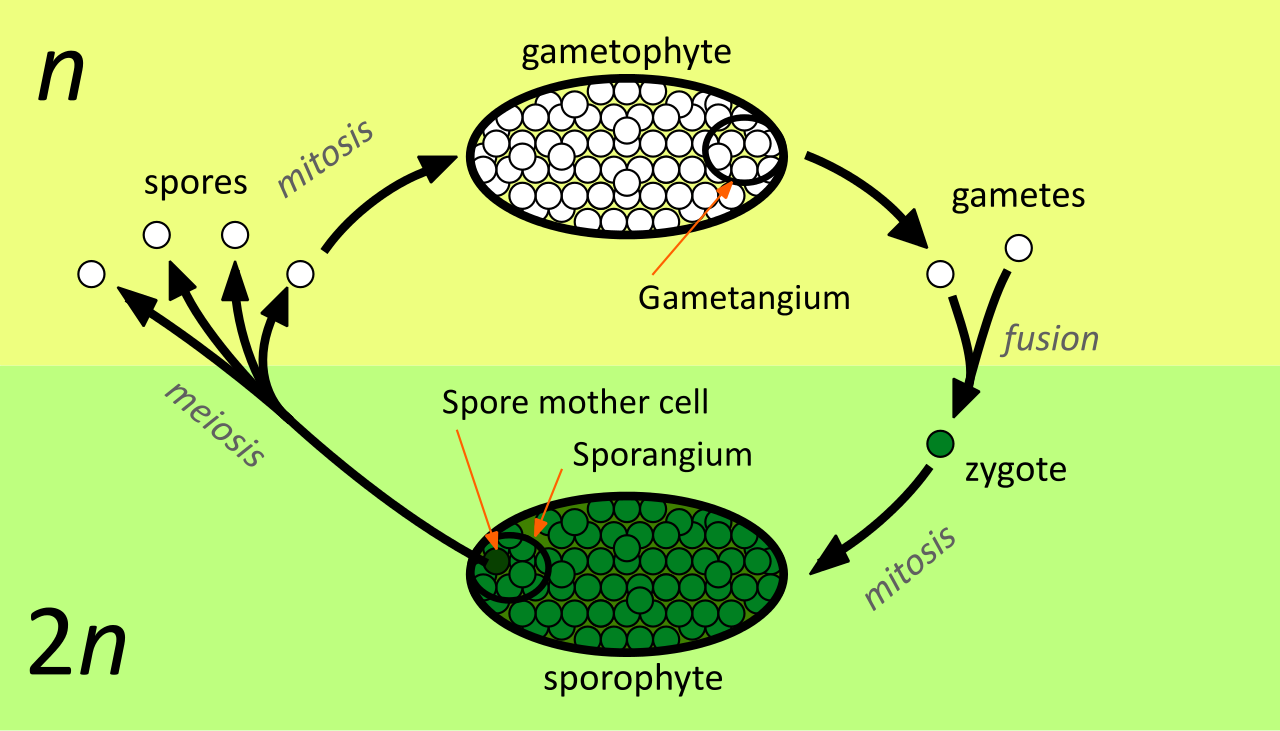
Alternation Of Generations
2.1.1 Induction Pathways: Direct vs. Indirect #
1. Direct Somatic Embryogenesis: Somatic embryos arise directly from explant tissues without an intervening callus phase. Typical of pre-embryogenic determined cells (PEDCs) found in immature zygotic embryos, microspores, and ovular tissues. Cultured under mild auxin shocks.
2. Indirect Somatic Embryogenesis: Requires the de-differentiation of somatic cells into an unorganized, proliferating embryogenic callus phase (IEDCs, Induced Embryogenic Determined Cells) before embryo maturation. Typically induced by prolonged exposure to high concentrations of synthetic auxins (predominantly 2,4-D, 1–5 mg/L), which destabilize somatic chromatin architecture and activate embryonic gene networks.
                  SOMATIC EMBRYOGENESIS PATHWAYS
Direct:   Explant (PEDCs) ────────[Mild Auxin]───────► Somatic Embryos
                                                           ▲
Indirect: Explant (IEDCs) ──[High 2,4-D]──► Embryogenic ──┘
                                             Callus (PEMs)
2.2 Molecular Genetic Regulators of Somatic Embryogenesis #
The developmental reprogramming of a somatic cell into an embryo is governed by key transcription factors and signaling receptors:
- SERK (Somatic Embryogenesis Receptor-Like Kinase): A leucine-rich repeat receptor kinase (LRR-RLK) expressed exclusively in single competent somatic cells that are transitioning into pro-embryogenic masses (PEMs). Serves as the premier molecular biomarker of embryogenic competence.
- WUSCHEL (WUS): Homeodomain transcription factor that maintains embryonic stem cell identity; ectopic overexpression of WUS in vegetative tissues triggers vegetative somatic embryogenesis without exogenous hormones.
- BABY BOOM (BBM): An AP2/ERF-family transcription factor that promotes cell proliferation and converts somatic leaves into somatic embryos.
- LEAFY COTYLEDON 1 & 2 (LEC1, LEC2): Master regulators that orchestrate embryo maturation, seed protein synthesis, and lipid storage accumulation.
2.3 Maturation and Desiccation Tolerance #
A major technological hurdle in SE is arresting premature germination (precocious germination) and inducing true physiological maturation:
1. Auxin Withdrawal: Proembryogenic masses (PEMs) will not mature in the continued presence of 2,4-D. Callus must be transferred to auxin-free medium to allow polar auxin gradients (PIN1 efflux carriers) to establish the heart and torpedo stages.
2. Abscisic Acid (ABA) Induction: Exogenous ABA (10–50 µM) is supplemented to arrest precocious budding, stimulate deposition of storage reserves (albumins, globulins, starch), and induce synthesis of Late Embryogenesis Abundant (LEA) proteins and osmotic protectants (sucrose, trehalose).
3. Controlled Partial Desiccation: Exposing torpedo-stage embryos to precise relative humidity gradients (90% → 60%) triggers a developmental switch, terminating embryonic gene expression and priming the embryo for vigorous, synchronous vegetative germination.
2.4 Synthetic Seed Technology (SynSeeds) #
Synthetic Seeds (Artificial Seeds) are artificially encapsulated somatic embryos, shoot buds, or protocorms designed to be handled, stored, transported, and planted like natural seeds. First developed by Murashige (1977) and Redenbaugh (1984):
       [SYNTHETIC SEED ARCHITECTURE]
          Calcium Alginate Hydrogel Capsule (Artificial Testa)
                     │
         ┌───────────┴───────────┐
         ▼                       ▼
Artificial Endosperm       Somatic Embryo / Propagule
(MS salts, sucrose,        (Bipolar embryo with intact
 fungicides, biofertilizers)  SAM and RAM axes)
2.4.1 The Sodium Alginate Encapsulation Protocol #
The most widely adopted encapsulation matrix is the ion-exchange Calcium Alginate hydrogel system:
1. Somatic embryos are suspended in a 2.5–3.5% (w/v) aqueous solution of Sodium Alginate (Na-alginate) prepared in liquid MS medium supplemented with 3% sucrose and antimicrobial agents (artificial endosperm).
2. The embryo-alginate mixture is drawn into a sterile pipette and dropped dropwise into a gently agitated 75–100 mM solution of Calcium Chloride (CaCl2· 2H2O).
3. Ion Exchange Cross-Linking: Sodium cations (Na+) are displaced by divalent calcium cations (Ca2+). The calcium ions cross-link the guluronic acid units of adjacent alginate polymer chains via the classic “egg-box” structural conformation, forming discrete, rigid, spherical hydrogel beads within 20–30 minutes.
4. Beads are rinsed thoroughly with sterile water to remove unreacted chloride ions.
| Component of SynSeed | Natural Seed Homologue | Biochemical Composition & Functional Role |
|---|---|---|
| Somatic Embryo | Zygotic Embryo | Bipolar regenerable propagule carrying elite genetics |
| Alginate Hydrogel Matrix | Seed Coat (Testa) | Mechanical protection against abrasion and physical trauma |
| Nutrient & Sugar Adjuvants | Triploid Endosperm | MS mineral salts + 3% sucrose providing energy for germination |
| Protective Bio-agents | Chemical Seed Dressings | Fungicides, systemic bactericides, Rhizobium / mycorrhizae |
2.5 Key Takeaways & Exam High-Yield Summary #
- Bipolarity Defines Embryos: Somatic embryos are bipolar (possess both shoot and root meristems); organogenic shoots are unipolar.
- SERK Gene: The definitive molecular marker of somatic embryogenic competence.
- Role of 2,4-D: 2,4-D induces embryogenic callus proliferation; it MUST be removed for embryos to progress to heart and torpedo stages.
- Calcium Alginate Complexation: Sodium alginate + CaCl2 forms the protective hydrogel capsule through Ca2+ cross-linking of guluronate residues.
2.6 Review & Self-Assessment Questions #
1. Why does prolonged exposure to 2,4-D arrest somatic embryo development at the globular stage?
- Answer: High concentrations of exogenous 2,4-D flood cellular auxin pools and disrupt the endogenous polar auxin transport gradients established by PIN efflux carriers, preventing the bilateral symmetry shift required for heart-stage cotyledon formation.
2. What is the advantage of using synthetic seeds over conventional vegetative cuttings in elite clonal crops?
- Answer: Synthetic seeds combine the genetic uniformity and vigor of clonal propagation with the ease of mechanized sowing, low storage volume, disease-free status, and potential for long-term cryopreservation without requiring labor-intensive greenhouse cutting propagation.
—
—
—