
7.1 The flower #
The study of The flower provides fundamental principles governing cellular architecture, molecular interactions, and physiological regulation.
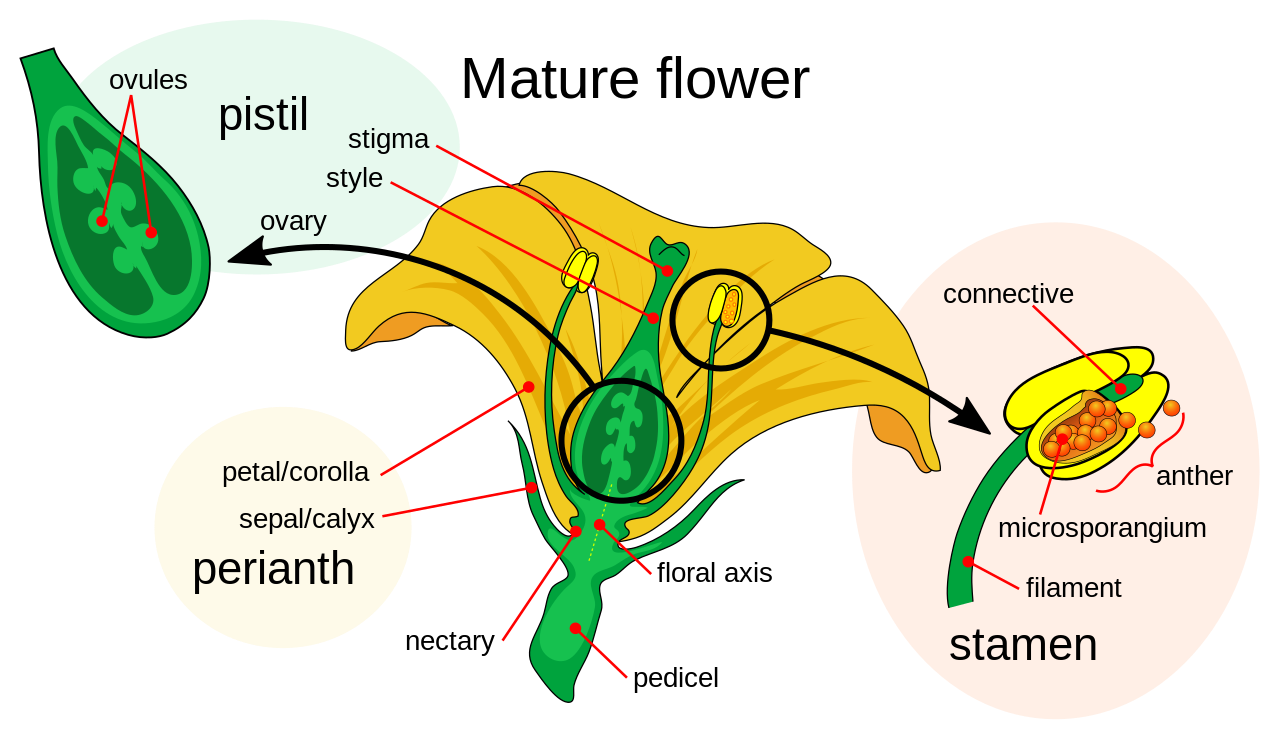
Mature Flower
7.1.1 Whorls #
A flower is a determinate shoot of sporophylls, usually with a sterile perianth. From the outside: sepals, petals (or tepals, if those two are alike), stamens, and carpels. A stamen is filament plus anther, typically four pollen sacs. A carpel is a megasporophyll closed around the ovules, which is what “angiosperm” names: stigma, style, and ovary. A complete flower has all four whorls. A perfect flower has both stamens and carpels. Maize is monoecious and holly dioecious when the flowers are imperfect.
Connation joins members of one whorl; adnation joins different whorls. A pea flower is bilateral: a banner, two wings, and a keel, ten stamens of which nine are fused, and one superior carpel. The ABC model of organ identity is Developmental Biology (Coen and Meyerowitz). A grass floret is the same plan reduced to lodicules, the bracts lemma and palea, usually three stamens, and one ovule. Its fruit is a caryopsis.
7.1.2 Ovary position and symmetry #
A superior ovary sits above the other whorls (hypogynous: tulip, Brassicaceae). An inferior ovary lies below them, so the other whorls appear to arise from its top (epigynous: daffodil, apple, Asteraceae). The fruit then includes the ovary wall plus the surrounding tissue. In a perigynous flower a hypanthium surrounds a free superior ovary, as in cherry and rose. The cherry fruit is still the ovary. The cup is not part of the pericarp.
Radial (actinomorphic) flowers have several planes of symmetry. Bilateral (zygomorphic) flowers have one, as in pea, orchid, and snapdragon. Bilateral form is often associated with a narrower set of pollinators. That association is a tendency (Chapter 9), not a rule of construction.
7.2 Life cycle and double fertilisation #
7.2.1 Pollen and the embryo sac #
In the anther, meiosis produces microspores. Each divides into a vegetative cell and a generative cell inside it. The generative cell makes two sperm either before shedding or in the tube. The outer wall, the exine, is sporopollenin. The tapetum, a sporophytic lining, feeds the grains and deposits the pollen coat used in sporophytic self-incompatibility (Chapter 9). Pollination delivers pollen to a stigma, not, as in pine, into a micropyle. Fertilisation is later.
The usual embryo sac is the Polygonum type; other types exist. The ovule has a nucellus, one integument or two, a micropyle, and a chalaza, and is often anatropous. One megaspore, usually the chalazal product of meiosis, undergoes three free nuclear mitoses. Walls then make seven cells and eight nuclei: egg and two synergids at the micropyle, three antipodals at the chalaza, and a central cell with two polar nuclei. The synergid filiform apparatus is the wall ingrowth associated with receiving the tube. One synergid usually degenerates as the tube arrives.
The tube grows through stigma and style, usually enters the micropyle, and is guided chemically. LURE peptides, described from Torenia and Arabidopsis, are one such signal; the wider story is Developmental Biology. Two sperm are released into the embryo sac.
7.2.2 Double fertilisation, embryo, and food #
Double fertilisation was reported by Navashin in 1898 and by Guignard in 1899. One sperm fuses with the egg to give the zygote, then the embryo (2n). The other fuses with the central cell. In the Polygonum type the two polar nuclei plus that sperm make a triploid primary endosperm nucleus, which divides into the endosperm. Angiosperm food storage is a separate fertilisation product, not the body of the female gametophyte as in pine. A functional reading, not a measured universal saving, is that a large food store is not built unless fertilisation has occurred. Gymnosperms provision the female gametophyte before fertilisation.
In a typical eudicot the zygote gives a suspensor and an embryo (globular, heart, torpedo, then mature), with a radicle, hypocotyl, cotyledons, and plumule. Further embryology is Developmental Biology. Cereals keep a large endosperm, protein-rich aleurone outside and starch inside. The gibberellin signal from embryo to aleurone is Plant Physiology. Bean and pea move the reserves into the cotyledons and leave little endosperm. Perisperm, as in beet, is stored nucellus, maternal tissue, not endosperm. Seedless parthenocarpy, as in commercial banana and seedless grape, is fruit set without fertilisation.
| Moss | Fern | Pine | Flowering plant | |
|---|---|---|---|---|
| Dominant generation | Gametophyte | Sporophyte | Sporophyte | Sporophyte |
| Gametophyte | Free, green, large | Free prothallus, small | Inside ovule or pollen | Embryo sac or pollen |
| Sperm | Swims in external water | Swims in external water | Tube; non-motile | Tube; non-motile |
| Meiosis makes | Spores in the capsule | Spores in sori | Microspores and megaspores | Microspores and megaspores |
| Dispersal unit | Spore, no embryo | Spore, no embryo | Seed; food is n | Seed in a fruit; food often 3n endosperm or cotyledons |
7.3 Fruits #
A fruit develops from the ovary, sometimes plus accessory tissue. It protects and disperses seeds. Human food is a later use, or the point of a dispersal syndrome, not the definition.
By origin: a simple fruit is one ovary of one flower (pea, cherry, tomato). An aggregate fruit is many separate carpels of one flower (raspberry, an aggregate of drupelets). A multiple fruit is an inflorescence fused into one structure (pineapple, fig, mulberry). Strawberry is an aggregate accessory fruit: the achenes are the fruits, the flesh is receptacle.
By texture, simple fruits are fleshy or dry. Fleshy: berry (tomato; pericarp fleshy throughout), drupe (cherry; a stony endocarp around one seed), pome (apple; the flesh is mostly hypanthium, and the core is the inferior ovary). Dry and dehiscent: follicle (milkweed; one carpel, one split), legume (pea; one carpel, two splits), capsule (poppy). Dry and indehiscent: achene (sunflower), caryopsis (wheat; the pericarp is fused to the seed coat), nut (hazel), samara (ash), schizocarp (maple). The pericarp itself is exocarp, mesocarp, and endocarp: in a peach, skin, flesh, and stone.
Commercial names diverge. A sunflower “seed” is an achene. A wheat grain is a fruit. An almond is the seed of a drupe. A coconut is a drupe. A peanut is a legume.
7.4 Monocots and eudicots #
“Dicot” as a clade is obsolete. The old dicotyledons are paraphyletic: they include the eudicots and earlier lineages that also have two cotyledons. A magnolia has two cotyledons and is not a eudicot. The practical contrast below is between monocots and eudicots, and the rows are usual, not universal. Trillium is a monocot with net-veined leaves. Palms make huge stems without a typical cambium.
| Character | Monocots | Eudicots |
|---|---|---|
| Cotyledons | One | Two |
| Leaf venation | Usually parallel | Usually reticulate |
| Floral parts | Usually in threes | Usually in fours or fives |
| Stem bundles | Scattered | In a ring |
| Vascular cambium | Absent in the typical case | Often present |
| Pollen | Usually monosulcate (one furrow) | Usually tricolpate, the eudicot synapomorphy |
| Root system | Often fibrous, adventitious | Often a persistent taproot |
| Examples | Grass, lily, orchid, palm | Pea, oak, sunflower, Arabidopsis |
Tricolpate pollen, or a form derived from it, is the robust synapomorphy of the eudicots. Cotyledon number is a convenient field character and a bad definition. Amborella, water lilies, Austrobaileyales, and the magnoliids are flowering plants outside both columns. Chapter 8 places them. Teaching them as dicots hides the tree.
7.5 Key terms, summary, and self-check #
Key terms. Carpel; superior ovary; inferior ovary; hypanthium; tapetum; embryo sac; synergid; double fertilisation; endosperm; aleurone; berry; drupe; caryopsis; eudicot; tricolpate.
Summary. A flower is whorls on a short shoot: perianth, stamens, and closed carpels, with the ovary superior, inferior, or surrounded by a hypanthium. The Polygonum embryo sac has seven cells and eight nuclei. One sperm makes the zygote and the other, with the polar nuclei, makes triploid endosperm, which is not the pine’s haploid food tissue. Fruits are simple, aggregate, or multiple, and fleshy or dry; the commercial name is often a different category from the botanical one. Monocots and eudicots differ in cotyledons, venation, floral numbers, stem bundles, and pollen, and two cotyledons do not make a eudicot.
Self-check.
1. How do a superior ovary, an inferior ovary, and a perigynous cherry differ?
2. How many cells and nuclei are in a Polygonum embryo sac, and which fusion makes endosperm?
3. Why can a flowering plant delay filling a food store in a way a pine cannot?
4. Classify a raspberry, a pineapple, a sunflower “seed”, and a cherry.
5. Why is a magnolia with two cotyledons not a eudicot, and which pollen character marks the eudicots?
—
—
—