
1.1 Embryophytes, and the word “plant” #
1.1.1 The clade #
In these notes a plant is an embryophyte, a land plant: liverworts, mosses, hornworts, lycophytes, ferns and their living allies, gymnosperms, and angiosperms. The name records a multicellular embryo retained and fed on the parent gametophyte. Everyday speech uses “plant” for almost any green organism that is not an animal, and that usage mixes lineages that parted long before any of them came onto land.
Fungi were once filed with plants because they are sessile and walled. Their walls are chitin, not cellulose of the plant type, and their nutrition is absorptive. Lichens are fungi harbouring green algae or cyanobacteria. They turn up in floras and in succession (Chapter 10). They are not a plant taxon.
1.1.2 “Algae” is not a clade #
“Alga” names a grade, not a branch: a photosynthetic organism that is not an embryophyte.
Cyanobacteria are bacteria. “Blue-green algae” is a historical label. An endosymbiotic cyanobacterium became the plastid (Cell Biology). Glaucophytes, red algae, and the green lineage have primary plastids from that uptake. Brown algae, diatoms, dinoflagellates, and euglenoids have secondary or tertiary plastids. A kelp is a stramenopile, closer to diatoms than to a moss. Holdfast, stipe, and blade are not root, stem, and leaf.
Green algae are not a clade once land plants are removed. Chlorophytes include Chlamydomonas, Ulva, and Chlorella. Streptophytes are the charophyte algae plus the land plants. Older books used the stoneworts (Chara, Nitella) as the model sister group because they branch and are oogamous. Phylogenomics instead generally places the Zygnematophyceae — Spirogyra, the desmids, and their relatives — as the closest living relatives of embryophytes. They conjugate. They have no flagella and no archegonia, so the sister group of land plants need not look like a half-built moss. Other charophyte classes branch more deeply, in an order that has been revised more than once.
A phragmoplast, rosette-shaped cellulose synthases, plasmodesmata, and oogamy already occur among aquatic charophytes. Cell Biology contrasts the phragmoplast with an animal cleavage furrow. Part of the land-plant body was inherited from freshwater relatives.
1.1.3 Shared derived characters #
Four characters mark the embryophytes.
1. Alternation of generations in which both the haploid gametophyte and the diploid sporophyte are multicellular. Hofmeister’s comparative work of 1851 showed that mosses, ferns, and seed plants are versions of one life cycle. “Cryptogam”, the old word for a plant with hidden reproduction, is not a current taxon.
2. A multicellular, dependent embryo. The zygote divides inside the archegonium, or inside the seed-plant structure that corresponds to it, and is nourished by the parental gametophyte.
3. Walled spores in multicellular sporangia. The wall contains sporopollenin, resistant enough for aerial dispersal. A jacket of sterile cells makes the sporangium an organ, not a single fertile cell.
4. Apical meristems, so growth in length is localised at tips while tissues behind the tip differentiate.
Two further characters need their limits stated. Antheridia and archegonia, jacketed gametangia, are clear in bryophytes and ferns; seed plants reduce or lose the free versions (Chapters 6 and 7). A cuticle covers aerial surfaces. Stomata occur on moss and hornwort sporophytes and on vascular plants. Liverwort air pores do not close by guard-cell movement, and liverworts lack stomata. Whether that is a loss or a later origin depends on the bryophyte tree (Chapter 4). Mycorrhizal-like fungi are already present with Early Devonian plants of the Rhynie chert.
1.2 What moving onto land required #
1.2.1 Four physical facts #
A submerged alga is supplied, buoyed, and, for swimming gametes, connected by the water around it. Air changes the terms. Desiccation: ordinary air dries a surface. Support: air does not hold a body up. Transport: once part of the body is in soil and part in air, diffusion through cells is too slow, so the body stays small and wet on the outside, or water and sugars move internally. Reproduction: swimming sperm need a film of water, and any airborne spore, pollen grain, or seed has to survive drying.
These are constraints, not one event. A moss and an oak are both embryophytes. They are not the same machine, and the moss is not an unfinished oak.
1.2.2 Structural answers #
Cuticle, and stomata where they exist, localise gas exchange instead of leaving the whole surface open. Guard-cell mechanism and the definition of water potential are Plant Physiology. Support and long-distance transport are the jobs of vascular tissue, which bryophytes lack as lignified xylem and sieve-element phloem. A tracheid both stiffens and conducts; in early wood those are one cell type. Turgid living cells braced by walls support a herb. Cohesion–tension is Plant Physiology; the cells are Chapter 2.
Dispersal is met first by sporopollenin-walled spores. The gametophyte grown from one still needs external water if its sperm swim. Pollen and seeds later keep those stages on the parent and replace the swim with a pollen tube (Chapters 4 to 7). Roots, root hairs, and mycorrhizae take mineral ions from soil; membrane selectivity is Cell Biology and Plant Physiology. A character that suits land now was not necessarily gained at the shoreline. The order alga–moss–fern–seed plant is a list of life cycles, not a phylogeny.
1.3 Alternation of generations #
The study of Alternation of generations provides fundamental principles governing cellular architecture, molecular interactions, and physiological regulation.
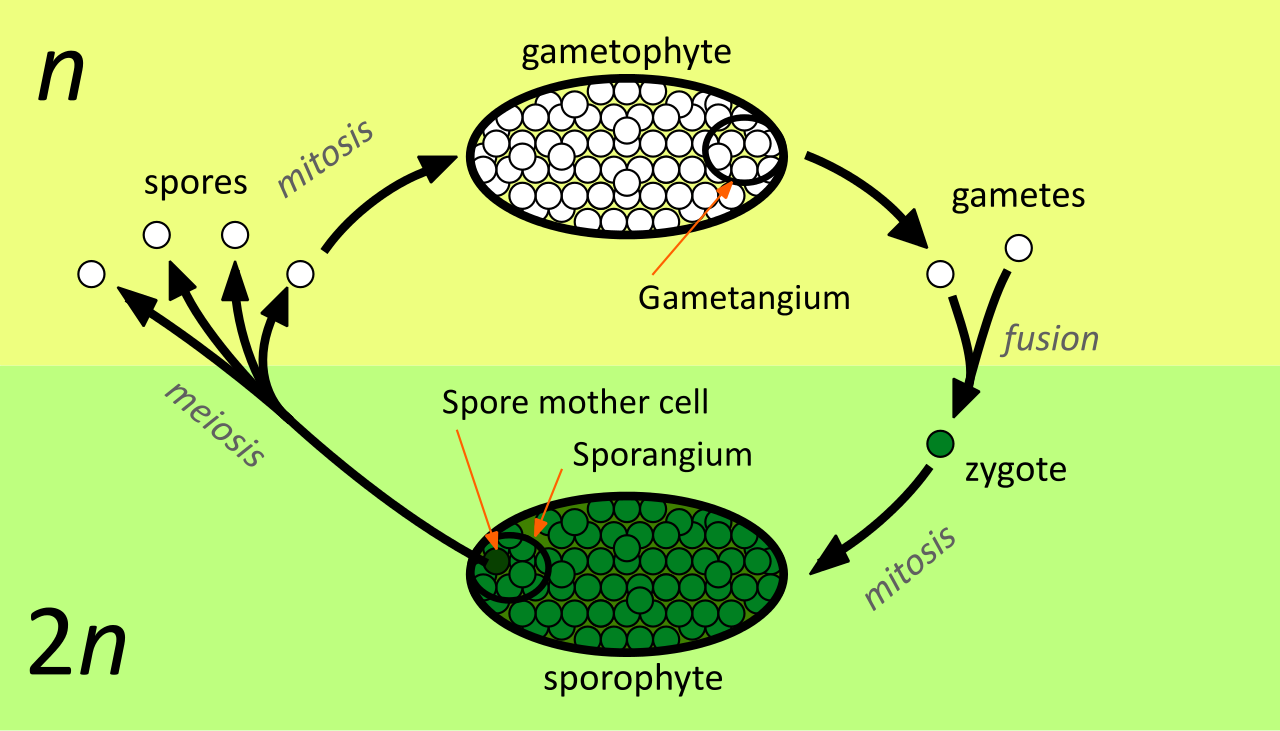
Alternation Of Generations
1.3.1 Two bodies, and where meiosis sits #
The gametophyte (haploid) produces gametes by mitosis. Fusion makes a zygote. The zygote develops into the sporophyte (diploid), which produces spores by meiosis. A spore builds a new gametophyte by mitosis. “Dominant” means larger, longer-lived, and photosynthetically independent. Bryophytes: gametophyte dominant, sporophyte attached. Vascular plants: sporophyte dominant. Seed plants: gametophyte microscopic and, on the female side, retained in the ovule.
The error that breaks every later chapter is to import the animal arrangement, in which meiosis makes gametes. In land plants meiosis makes spores. A spore is not a gamete. A pollen grain is not a sperm: it is a male gametophyte that will produce sperm by further mitosis. An ovule is a megasporangium plus integuments, not a gamete.
| Event | Division | Product | Ploidy |
|---|---|---|---|
| Spore formation in a sporangium | Meiosis | Spores | 2n to n |
| Growth of the gametophyte | Mitosis | Gametophyte | stays n |
| Formation of sperm and egg | Mitosis | Gametes | stays n |
| Fertilisation | Fusion | Zygote | n + n to 2n |
| Growth of the sporophyte | Mitosis | Sporophyte, including the embryo | stays 2n |
1.3.2 Homospory and heterospory #
Homosporous plants produce one kind of spore. The gametophyte is often bisexual, though sex can still be set later by the environment or by genes. Most bryophytes and most ferns are homosporous.
Heterosporous plants produce microspores, which become male gametophytes, and megaspores, which become female gametophytes. Megaspores are larger because they are provisioned, or because they stay where the parent feeds them. Heterospory evolved more than once: among lycophytes, among some fern relatives, and on the line to seed plants. All seed plants are heterosporous. A seed is not a large spore. Heterospory is only the precondition. The seed adds retention of the megaspore, a dependent female gametophyte, an embryo formed before dispersal, and a coat from the integument, released as one unit (Chapter 6).
1.4 Key terms, summary, and self-check #
Key terms. Embryophyte; streptophyte; Zygnematophyceae; alternation of generations; gametophyte; sporophyte; sporopollenin; antheridium; archegonium; apical meristem; cuticle; homospory; heterospory.
Summary. A plant, here, is a land plant: a clade nested among streptophyte green algae, with zygnematophytes the best-supported living sister group. Embryophytes share a dependent multicellular embryo, walled spores in jacketed sporangia, apical meristems, and multicellular generations of both ploidies; cuticle, stomata, and jacketed gametangia belong with that list once liverworts and seed plants are allowed their exceptions. Meiosis makes spores, mitosis makes gametes, and a seed is more than heterospory. Life on land poses drying, gravity, internal transport, and reproduction out of open water, solved to different degrees in different lineages, not as rungs on one ladder.
Self-check.
1. Why do these notes refuse to call brown algae, red algae, and green algae one taxon?
2. Which living algal group is the best-supported sister of land plants, and why is that surprising if one expected Chara?
3. Name four shared derived characters of embryophytes. Where do stomata fail to be universal?
4. Which division produces spores, and which produces gametes?
5. Why is a heterosporous fern not yet a seed plant?
—
—
—