
3.1 Operons and split genes #
The study of Operons and split genes provides fundamental principles governing cellular architecture, molecular interactions, and physiological regulation.
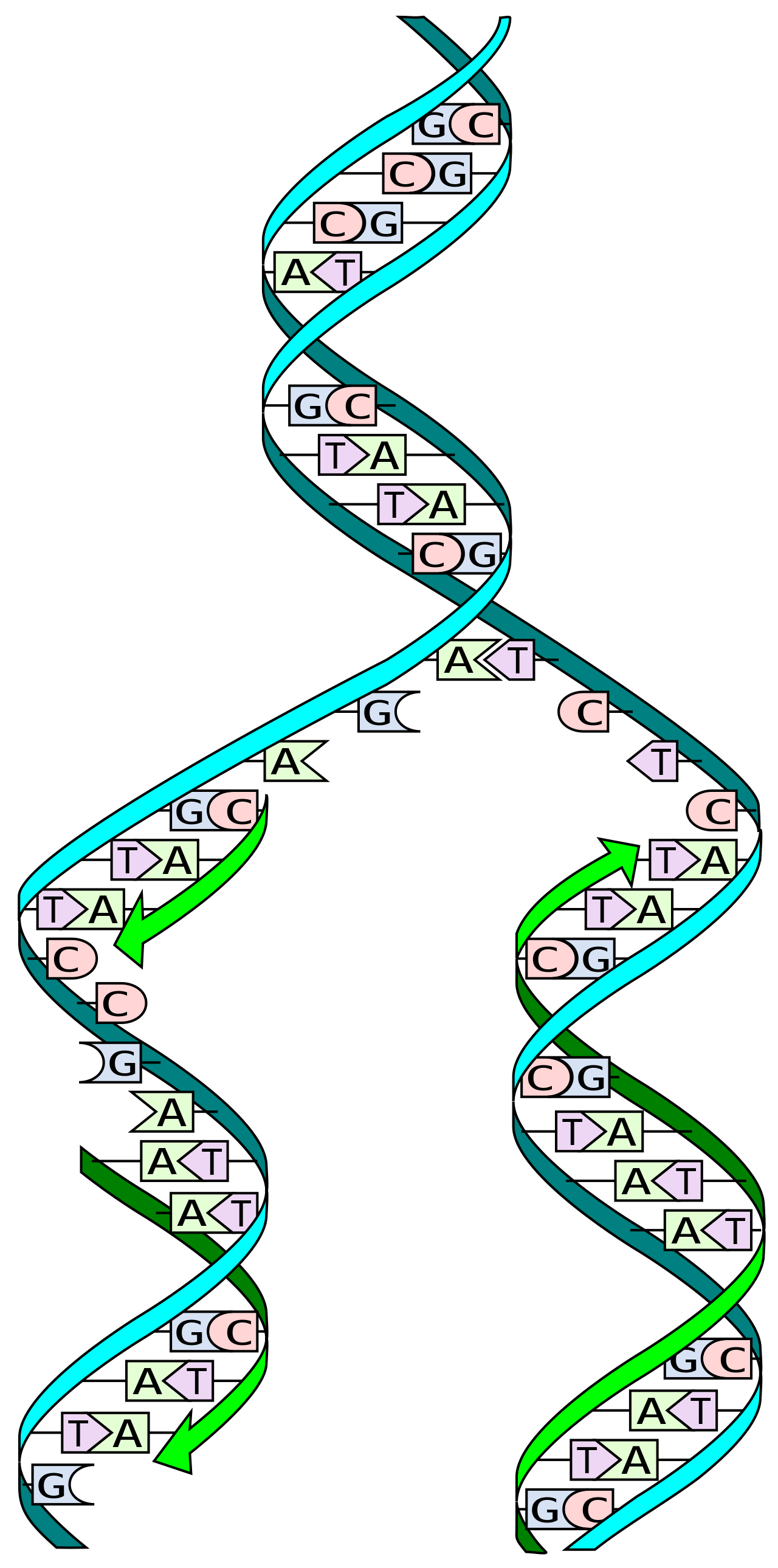
Dna Replication Split
3.1.1 Prokaryotic operons #
In bacteria and archaea, genes of one pathway are often neighbours, transcribed from a single promoter into one mRNA. That arrangement is an operon. The mRNA is polycistronic: several open reading frames, each with its own ribosome-binding site, so each can be translated. The lac and trp operons in Chapter 10 are the worked examples of regulation; the genomic fact is here.

Lac Operon
Bacterial protein-coding genes are almost always continuous. Group I and group II introns occur in bacteria and in organelles, but they are not the rule and they are not spliceosomal introns (Chapter 7). Archaea are not small bacteria in this respect. It does not mean “the *E.
3.1.2 Eukaryotic genes with introns #
A typical eukaryotic protein-coding gene is split. Exons remain in the mRNA. Introns are transcribed and then removed. Exons are often short, on the order of 100–200 bp. Introns are commonly much longer, sometimes tens of kilobases. Most human protein-coding genes have several introns.

Exon Intron
The mRNA is ordinarily monocistronic. Eukaryotic ribosomes scan from the cap and usually translate only the first suitable open reading frame (Chapter 8), so a second coding sequence on the same mRNA is not routinely expressed. Exceptions exist: some viral RNAs use internal ribosome entry, and some nematode genes are transcribed as operons and then separated by trans-splicing. Coordinate regulation in eukaryotes is usually shared transcription factors, not a shared mRNA. Introns allow alternative splicing (Chapter 7) and can carry regulatory sites.
3.2 The C-value paradox #
3.2.1 Genome size is not a measure of complexity #
The C-value is the DNA content of a haploid, unreplicated genome. It does not rank organisms by morphological complexity or by the number of cell types. The human haploid genome is about 3.1 Gb. An onion’s is several times larger, about 16 Gb.

Mhc Class Ii Gene Transcription Regulation Complex
Gene number shows a related mismatch. Humans have about 20,000 protein-coding genes, the same order as many animals with fewer cell types, and not a thousandfold more than a bacterium despite a thousandfold more DNA. Complexity is not proportional to C, nor to the count of protein-coding genes. Regulation and alternative splicing do work that a gene count does not capture.
What dissolves the paradox is composition. Protein-coding exons are about 1–2% of the human genome. Introns, regulatory DNA, and repetitive DNA make up the bulk. The extra DNA is mostly non-coding bulk, not a hidden catalogue of extra human genes.
3.3 Repetitive DNA #
3.3.1 Satellites and transposons, in outline #
Tandem repeats sit head to tail. Satellite DNA forms long arrays; human centromeres are built on alpha-satellite repeats of about 171 bp, together with CENP-A. They mutate by replication slippage, which is why mismatch-repair failure shows up as microsatellite instability (Chapter 5). They are reiterated sequence, not extra genes.
Interspersed repeats are mostly transposons or their fossils. DNA transposons move by a cut-and-paste transposase at inverted repeats; in the human genome they are almost all dead. Human LINE-1 is present in hundreds of thousands of copies, most of them truncated, and a small number of copies can still move. SINEs do not encode the enzyme and depend on LINE machinery. Alu elements, SINEs of about 300 bp, are present in about a million copies and together make up about a tenth of the human genome.
An insertion into a gene can cause disease, and repeats provide homology for unequal recombination. Those are the genomic consequences. The enzymes of a particular element are not developed here.
3.4 Two genomes side by side #
3.4.1 A typical bacterial genome and the human genome #
E. coli K-12 stands for a typical bacterial genome, and the human haploid nucleus for an animal genome.
| E. coli K-12 | Human, haploid nuclear | |
|---|---|---|
| Size | about 4.6 Mb | about 3.1 Gb |
| Form | one circular chromosome | 23 linear chromosomes |
| Protein-coding genes | about 4,300 | about 20,000 |
| Share that is protein-coding exons | most of the genome | about 1–2% |
| Introns in protein-coding genes | rare | typical |
| Transcription unit | often a polycistronic operon | typically one gene, monocistronic mRNA |
| Packaging | nucleoid, supercoiling, small DNA-binding proteins | nucleosomes and dynamic folding, in a nucleus |
| Origins | one (oriC) | many thousands |
| Extra replicons | plasmids | a separate mitochondrial genome |
Plasmids are circular DNA with their own origin, often carrying accessory genes such as antibiotic resistance. They are the natural relatives of the vectors in Chapter 12. Human mitochondria keep a circular genome of about 16.6 kb, with 13 protein-coding genes plus transfer RNAs and ribosomal RNAs. The information point is that a eukaryotic cell has more than one genome, and the small one uses a slightly different code (Chapter 8).
3.5 Key terms, summary, and self-check #
Key terms. Operon; polycistronic; exon; intron; C-value; alpha satellite; LINE; SINE; Alu; plasmid.
Summary. Bacterial pathway genes are often one continuous, polycistronic transcription unit in a genome that is mostly coding. Eukaryotic protein-coding genes are typically split, their mRNAs monocistronic, and their exons only about 1–2% of the human sequence. Genome size does not measure complexity because most of the variation is non-coding, especially satellites and transposon fossils. E. coli has about 4.6 Mb and about 4,300 protein-coding genes on one circular chromosome. The human haploid nucleus has about 3.1 Gb and about 20,000 protein-coding genes on 23 linear chromosomes, plus a small mitochondrial genome.
Self-check.
1. What makes an mRNA polycistronic, and why does ordinary eukaryotic scanning not translate a second open reading frame on it?
2. State the C-value paradox, and name the class of sequence that accounts for most of the extra DNA.
3. Give one tandem repeat and one interspersed repeat in the human genome. Which of them encodes its own reverse transcriptase?
4. Compare E. coli and the human haploid nucleus for size, chromosome form, protein-coding gene number, and whether introns are typical.
5. Why is “3.1 Gb, therefore far more genes than a fish or a plant” a bad inference?
—
—
—