
2.1 Alleles that are not simply dominant #
The study of Alleles that are not simply dominant provides fundamental principles governing cellular architecture, molecular interactions, and physiological regulation.
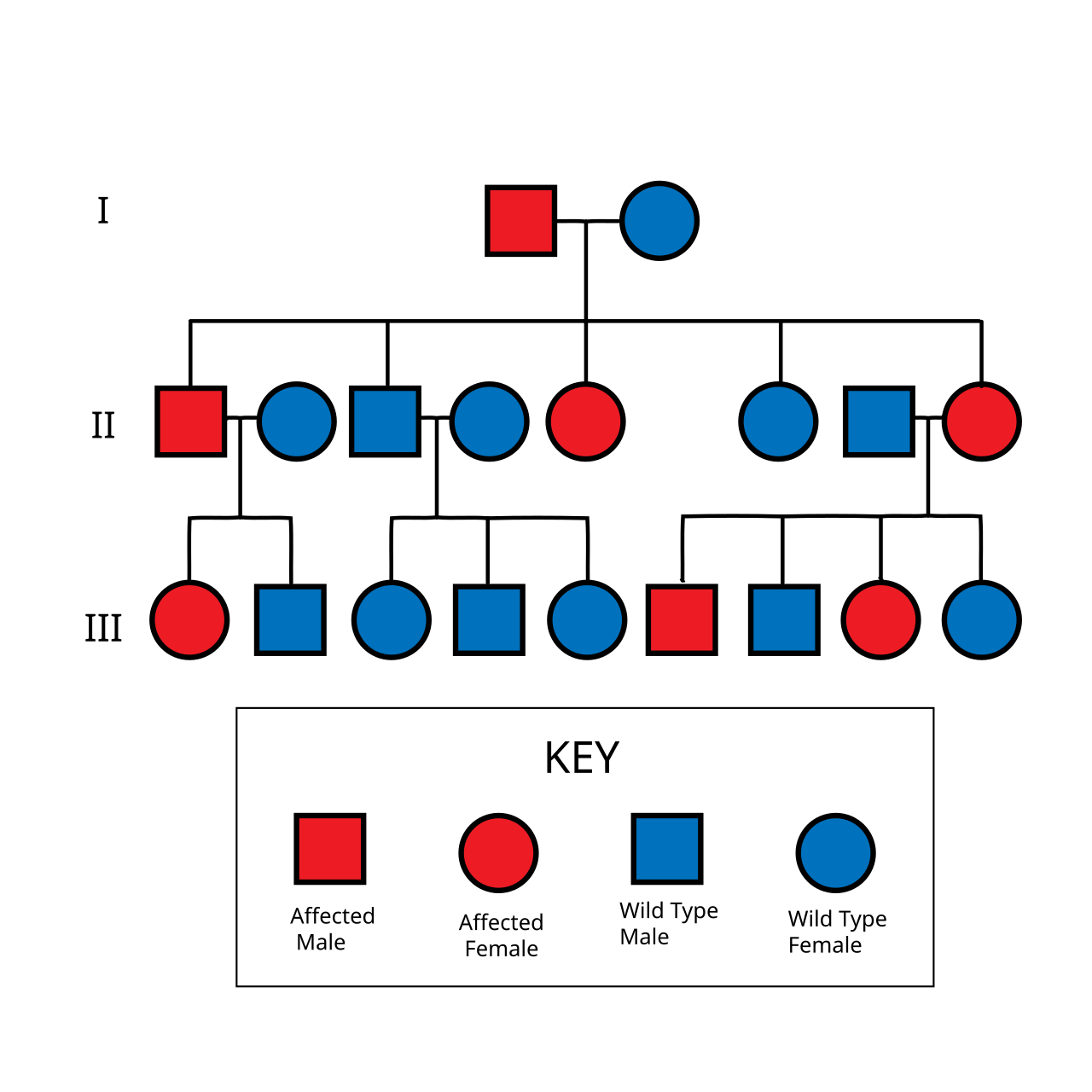
Autosomal Dominant Pedigree Chart
2.1.1 Incomplete dominance #
Complete dominance is a fact about a chosen phenotype, not a law of molecules. In incomplete dominance the heterozygote is intermediate and the F2 phenotypic ratio matches 1:2:1.
In the snapdragon, Antirrhinum majus, red crossed with white gives pink F1 plants, and the F2 is about 1 red : 2 pink : 1 white. Selfed pink plants keep segregating, so nothing has blended permanently. A common reason is dose: one functional copy of a pigment enzyme makes less pigment than two. Mirabilis jalapa also shows incomplete dominance of flower colour. Its famous result in these notes is a different experiment, Correns’s leaf variegation, in Chapter 8.
2.1.2 Codominance: MN and ABO #
In codominance both products are detected in the heterozygote. The phenotype is a sum of two presences, not a dilute version of one parent.
MN is the simple case. Alleles L^M and L^N of glycophorin A put M, N, or both antigens on the red cell. MN × MN gives 1 M : 2 MN : 1 N. There is no dominance and, in the simple series, no null. ABO has three alleles. I^A and I^B are codominant and both dominate i. The H structure carries a fucose; the A enzyme adds N-acetylgalactosamine and the B enzyme adds galactose; i adds neither. Group O is ii. Group AB has both enzymes. People who cannot make H, the Bombay phenotype, type as O even if they carry I^A or I^B, because the downstream enzymes have no substrate. That upstream block is epistasis.
2.1.3 Multiple alleles #
A diploid carries two alleles. A population can carry more. For n alleles there are n(n+1)/2 genotypes. ABO’s three alleles give six genotypes and four phenotypes.
Rabbit coat colour is a dominance series rather than codominance: full colour C > chinchilla c^ch > Himalayan c^h > albino c. Himalayan pigment forms at cooler extremities, so temperature changes where the genotype is expressed. That is not a second gene and not a phenocopy. Multiple alleles do not change segregation inside one mating.
2.2 One gene, more than one consequence #
2.2.1 Lethal alleles: the yellow mouse #
Cuénot’s yellow mouse is dominant for coat and lethal when homozygous. Yellow × yellow gives about 2 yellow : 1 non-yellow, and litters are smaller by about a quarter. The missing class is A^Y A^Y. Every living yellow mouse is A^Y A. Yellow × non-yellow gives 1:1.
Segregation has not failed. A class dies after it is formed. The modern reading is a rearrangement at agouti that yellows the coat and, when homozygous, disrupts an essential neighbour. A 2:1 ratio among live young of two heterozygotes is the clue. Chi-square then uses expectations 2/3 and 1/3 of the number born.
2.2.2 Pleiotropy #
Pleiotropy is several effects of one gene, not an interaction of two genes. A^Y affects colour, viability, and, in heterozygotes, a tendency to obesity. Sickle-cell haemoglobin, Chapter 9, is another case: one missense in HBB affects cell shape, oxygen delivery, and, in heterozygotes where malaria is present, survival of infection.
The signature is co-segregation. Characters that assort independently are two loci. Close linkage can imitate pleiotropy until a recombinant appears, so the family has to be large enough for loose linkage to have shown itself.
2.3 Genes interacting #
2.3.1 Epistasis and a two-step pigment pathway #
Epistasis masks the phenotypic effect of one gene by the genotype at another. Both genes still segregate. The sixteen combinations of a dihybrid self are regrouped, so 9:3:3:1 collapses.
Let enzyme A convert a colourless precursor to a coloured intermediate, and enzyme B convert that intermediate to the final pigment. Then A− B− is the final colour, A− bb stops at the intermediate, and aa makes no intermediate, so alleles of B are hidden. The F2 is 9 : 3 : 4. This is recessive epistasis. Labrador coat colour matches it: black B− E−, chocolate bb E−, yellow ee whatever B is.
If the intermediate is also colourless, only A− B− is coloured and the F2 is 9:7, complementary gene action, also called duplicate recessive epistasis. Sweet-pea flower colour is the classical 9:7. If either gene can make the pigment, only aa bb is colourless and the ratio is 15:1, the duplicate-gene ratio of shepherd’s-purse seed shape. Dominant epistasis, for the set, is 12:3:1, as in summer-squash fruit colour.
| Interaction | F2 ratio | Pathway reading |
|---|---|---|
| Recessive epistasis | 9:3:4 | An early recessive block hides a later gene; the intermediate can be a third colour |
| Complementary | 9:7 | Both steps are required and the intermediate is invisible |
| Duplicate genes | 15:1 | Either dominant allele is sufficient |
| Dominant epistasis | 12:3:1 | A dominant allele at one locus masks the other locus |
Once the order of action is known, the ratio follows from which genotypes still make a visible product.
2.3.2 Penetrance, expressivity, and phenocopy #
Penetrance is the proportion of people of a stated genotype who show the phenotype at all. Expressivity is how far they show it. Polydactyly can be absent in a carrier, which is incomplete penetrance, and variable in digit number among those who show it. An unaffected carrier still transmits, so a dominant pedigree can skip. Hereditary retinoblastoma is inherited as a dominant of high but incomplete penetrance: a germline mutation is usually followed by loss of the remaining copy in a retinal cell, and not every carrier develops a tumour.
A phenocopy is an environmental phenotype that mimics a genetic one in someone who lacks that genotype. Limb reductions after thalidomide resembled rare genetic reductions and were not passed on by the people who had them. A phenocopy does not segregate unless the children meet the same environment. Incomplete penetrance is genotype without phenotype. A phenocopy is phenotype without the suspected genotype.
2.4 Sex as an environment for the phenotype #
2.4.1 Sex-limited and sex-influenced traits #
These traits are usually autosomal. They are not X-linkage, which is Chapter 3. Sex changes whether, or how strongly, the genotype is expressed. The hormones are Animal and Human Physiology.
A sex-limited trait is expressed in one sex only. Milk yield is the clear case: a bull transmits a genotype for his daughters’ yield and does not lactate. Transmission through the silent sex rules out Y-linkage, which never passes through a daughter. A sex-influenced trait is expressed in both sexes with different dominance. In some sheep, a horned allele is dominant in rams and recessive in ewes. Pattern baldness is taught the same way, with the caution that common baldness is polygenic. The allele is more readily expressed when androgens are present. Heterozygous males and heterozygous females need not match.
2.5 Key terms, summary, and self-check #
Key terms. Incomplete dominance; codominance; multiple alleles; Bombay phenotype; lethal allele; pleiotropy; epistasis; penetrance; expressivity; phenocopy; sex-limited; sex-influenced.
Summary. Segregation survives the modified ratios. Incomplete dominance gives 1:2:1; codominance shows both products, as in MN and AB. A lethal homozygote turns 3:1 into 2:1 among the living. A two-step pathway gives 9:3:4 if the intermediate is coloured and 9:7 if it is not; duplicate genes give 15:1. Penetrance and expressivity describe whether and how far a genotype shows. A phenocopy copies the phenotype without the genotype. Sex-limited and sex-influenced expression are autosomal, not sex-linked.
Self-check.
1. Why does a pink snapdragon F1 not revive blending inheritance?
2. Yellow × yellow gives 40 yellow and 18 non-yellow live young. What ratio is the null, and which genotype is missing?
3. Why does a colourless intermediate give 9:7 rather than 9:3:4?
4. Which observation fits a sex-limited autosomal trait and rules out Y-linkage?
5. A parent shows a dominant-looking phenotype and five children, in a different environment, do not. Why is a phenocopy a better first hypothesis than incomplete penetrance?
