
5.1 The Root System: Tap, Fibrous & Adventitious Roots; Regions of Root Tip & Modifications #
In angiosperms (flowering plants), the plant body consists of an underground root system and an aerial shoot system. The root system develops primarily from the radicle of the germinating seed embryo.
- Types of Root Systems:
- Tap Root System: The primary root originates directly from the radicle and persists throughout life, giving off lateral roots (secondary and tertiary roots). Characteristic of dicotyledonous plants (e.g., Mustard, Gram).
- Fibrous Root System: In monocotyledonous plants, the primary root is short-lived and is replaced early by a large cluster of thin, thread-like roots originating from the base of the stem (e.g., Wheat, Rice).
- Adventitious Root System: Roots that develop from parts of the plant other than the radicle—such as stems, branches, or leaves (e.g., Grass, Monstera, Banyan tree).
- Regions of the Root Tip (Proximal to Distal):
- Root Cap: A thimble-like multicellular protective covering at the apex that shields the tender tender growing point as it penetrates the abrasive soil.
- Region of Meristematic Activity: A few millimeters above the root cap; composed of very small, thin-walled, dense protoplasmic cells that divide repeatedly.
- Region of Elongation: Proximal to meristem; cells undergo rapid enlargement and elongation, responsible for the longitudinal growth of the root.
- Region of Maturation: Cells differentiate and mature into specialized tissues. Epidermal cells in this zone form delicate, thread-like root hairs that dramatically maximize surface area for absorbing water and mineral nutrients from soil.
- Root Modifications: Roots often modify their structure to perform specialized functions:
- Food Storage: Swollen tap roots in Carrot and Turnip; swollen adventitious roots in Sweet Potato.
- Mechanical Support: Prop roots hanging down from heavy banyan tree branches; Stilt roots emerging from lower stem nodes in Maize and Sugarcane.
- Respiration: In swampy, saline coastal mangrove areas, oxygen is deficient in waterlogged soil. Mangroves like Rhizophora produce vertical, upward-growing roots called pneumatophores that emerge above the mud with respiratory pores (lenticels) to take in oxygen.
5.2 The Stem: Nodes, Internodes & Modifications (Tendrils, Thorns, Phylloclade, Underground storage) #
The stem is the ascending axis of the plant body that develops from the plumule of the embryo during germination. It bears branches, leaves, flowers, fruits, and buds. The key diagnostic hallmark that distinguishes a stem from a root is the presence of nodes (regions where leaves are born) and internodes (portions between two successive nodes).
Young stems are typically green and photosynthetic; later they often become woody and dark brown. Beyond basic conduction of water and nutrients, stems undergo remarkable modifications:
- Underground Stems for Food Storage & Perennation: Underground stems of Potato (tuber), Ginger and Turmeric (rhizome), Zaminkand and Colocasia (corm), and Onion and Garlic (bulb) store nutrients and act as organs of perennation to survive unfavorable environmental seasons. Notice: A potato possesses ‘eyes’ which are true axillary buds on nodes!
- Stem Tendrils: Slender, spirally coiled structures developing from axillary buds that help climbing plants with weak stems attach to supports (e.g., Gourds like cucumber, pumpkin, watermelon, and grapevines).
- Stem Thorns: Axillary buds that lose growing points and become stiff, woody, straight, pointed thorns that protect plants from browsing herbivores (e.g., Citrus and Bougainvillea).
- Phylloclades (Photosynthetic Stems): In arid regions, stems become flattened (e.g., Opuntia) or fleshy cylindrical (e.g., Euphorbia) containing chlorophyll to carry out photosynthesis, while leaves are reduced to spines to minimize transpirational water loss.
- Vegetative Propagation Modifications: Runners (strawberry, grass), Stolons (mint, jasmine), Offsets (one internode long runner in aquatic Pistia and Eichhornia / water hyacinth), and Suckers (chrysanthemum, banana, pineapple).
5.3 The Leaf: Venation (Reticulate vs Parallel), Phyllotaxy & Leaf Modifications #
The leaf is a lateral, generally flattened vegetative organ borne on the stem that originates from shoot apical meristems and develops at a node. Leaves bear an axillary bud in their axil, which later develops into a branch. Leaves are arranged in an acropetal order (youngest at the apex) and are the most important vegetative organs for photosynthesis.
A typical leaf consists of three main parts: leaf base (hypopodium), petiole (stalk holding the lamina to light), and lamina / leaf blade (expanded green surface containing veins and veinlets). In monocots, the leaf base expands into a sheath clasping the stem, while in leguminous plants, the leaf base becomes swollen, called a pulvinus.
- Venation (Arrangement of Veins in Lamina):
- Reticulate Venation: Veinlets form a complex interconnected network. Characteristic of dicotyledonous leaves (e.g., Mango, Peepal, China rose).
- Parallel Venation: Veins run parallel to each other across the entire lamina. Characteristic of monocotyledonous leaves (e.g., Grasses, Maize, Banana).
- Leaf Types: A leaf is simple when its lamina is intact or, if incised, incisions do not touch the midrib. A leaf is compound when incisions reach the midrib, breaking the lamina into distinct leaflets. Compound leaves are pinnately compound (leaflets on a common axis called rachis, as in Neem) or palmately compound (leaflets attached at tip of petiole, as in Silk cotton).
- Phyllotaxy (Pattern of Leaf Arrangement on Stem):
- Alternate: A single leaf arises at each node in an alternating manner (e.g., China rose, Mustard, Sunflower).
- Opposite: A pair of leaves arises at each node opposite to one another (e.g., Calotropis and Guava).
- Whorled: More than two leaves arise at a single node forming a whorl (e.g., Alstonia).
- Leaf Modifications: Tendrils for climbing (Peas), spines for defense (Cacti), fleshy storage leaves (Onion, Garlic), and insect-trapping pitchers (Pitcher plant, Venus flytrap).
5.4 Inflorescence: Racemose (Indeterminate) vs Cymose (Determinate) #
A flower is a modified shoot wherein the shoot apical meristem changes into a floral meristem. The internodes do not elongate, and the axis condenses. The arrangement and distribution of flowers on the floral axis (peduncle) is termed an inflorescence.
Depending on whether the main growing apex terminates in a flower or continues to grow indefinitely, inflorescences are categorized into two major types:
| Diagnostic Feature | Racemose Inflorescence | Cymose Inflorescence |
|---|---|---|
| Growth of Main Axis | Main axis continues to grow indefinitely (indeterminate growth). | Main axis terminates in a flower, limiting continuous growth (determinate growth). |
| Arrangement of Flowers | Flowers are borne laterally in an acropetal succession (oldest flowers at base, youngest at apex). | Flowers are borne in a basipetal succession (oldest flower at apex, youngest flowers toward base). |
| Opening of Flowers | Centripetal (from periphery toward center). | Centrifugal (from center toward periphery). |
| NCERT Examples | Mustard, Radish, Lupin. | Solanum, Jasmine, Bougainvillea, Dianthus. |
5.5 The Flower: Calyx, Corolla, Aestivation (Valvate, Twisted, Imbricate, Vexillary) #
The flower is the reproductive unit in angiosperms, specialized for sexual reproduction. A typical flower has four concentric whorls arranged successively on the swollen end of the stalk or pedicel, called the thalamus or receptacle:
- Calyx (Sepals): Outermost accessory whorl, generally green and leaf-like, protecting the flower in bud stage.
- Corolla (Petals): Brightly colored accessory whorl that attracts insect pollinators.
- Androecium (Stamens): Male reproductive whorl composed of stamens (filament + bilobed 4-sporangiate anther).
- Gynoecium (Carpels / Pistils): Female reproductive whorl composed of stigma, style, and ovary.
The mode of arrangement of sepals or petals in the floral bud with respect to other members of the same whorl is called aestivation. NCERT describes four primary types:
- Valvate: Sepals or petals in a whorl merely touch one another at the margin without overlapping (e.g., Calotropis).
- Twisted: One margin of the appendage overlaps that of the next one in a regular direction (e.g., China rose, Lady’s finger, Cotton).
- Imbricate: Margins of sepals or petals overlap one another irregularly, without any particular direction (e.g., Cassia and Gulmohar).
- Vexillary (Papilionaceous): Found in pea and bean flowers. There are 5 petals: the largest posterior petal is the standard (vexillum), which overlaps two lateral wings (alae), which in turn overlap the two smallest anterior petals fused to form the keel (carina).
5.6 Placentation: Marginal, Axile, Parietal, Free Central, Basal #
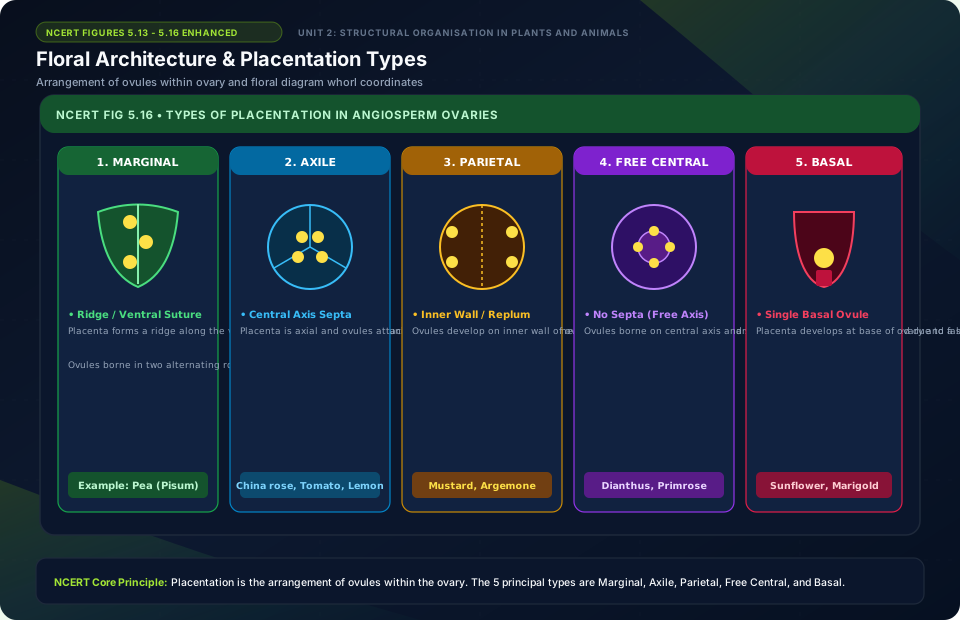
The arrangement of ovules within the ovary is known as placentation. The placenta is the specialized tissue on the ovary wall to which ovules are attached. NCERT classifies placentation into five major types:
- Marginal Placentation: The placenta forms a ridge along the ventral suture of the unilocular monocarpellary ovary, and ovules are borne along this ridge in two alternate rows (e.g., Pea).
- Axile Placentation: The ovary is multilocular (divided into chambers by septa), and the placenta arises from the central central axis where septa meet. Ovules are attached to this central axis (e.g., China rose, Tomato, Lemon).
- Parietal Placentation: Ovules develop on the inner peripheral wall of the ovary. The ovary is unilocular, but often becomes two-chambered due to the formation of a false septum called replum (e.g., Mustard and Argemone).
- Free Central Placentation: Ovules are borne on a central axis, and septa are completely absent, making the ovary unilocular (e.g., Dianthus and Primrose).
- Basal Placentation: The placenta develops directly at the base of a unilocular ovary, bearing a single ovule (e.g., Sunflower and Marigold).
5.7 Fruit & Seed Structure; Semi-Technical Floral Description & Family Solanaceae #
Following fertilization, the ovary matures into a fruit, and the ovules develop into seeds. If a fruit forms without fertilization of the ovary, it is called a parthenocarpic fruit (e.g., Banana).
In mango and coconut, the fruit is called a drupe. Drupes develop from monocarpellary superior ovaries and are one-seeded. In mango, the pericarp is well-differentiated into an outer thin epicarp, a middle fleshy edible mesocarp, and an inner stony hard endocarp. In coconut, the mesocarp is fibrous.
A seed consists of a seed coat and an embryo. In dicots (gram, pea), food is stored in two fleshy cotyledons, and endosperm is consumed during development (non-endospermic). In monocots (maize, wheat), the seed is endospermic, with a proteinaceous outer layer called the aleurone layer, a single shield-shaped cotyledon called scutellum, and protective sheaths: coleoptile (covering plumule) and coleorhiza (covering radicle).
A widely distributed family in tropics, subtropics, and temperate zones. Characterized by alternate leaves, persistent calyx, epipetalous stamens, and bicarpellary syncarpous superior ovary with an obliquely placed septum and swollen axile placenta bearing many ovules.
Floral Formula: ⊕ ⚥ K(5) Ĉ(5) A5 G̲(2)
Economic importance: Food (Tomato, Brinjal, Potato), Spice (Chilli), Medicine (Belladonna, Ashwagandha), Fumigatory (Tobacco), and Ornamental (Petunia).
Floral Architecture & Placentation Types
🚨 Examiner Traps & Common Misconceptions
✅ Reality: Potato (tuber), ginger (rhizome), and onion (bulb) are modified underground stems! They possess nodes, internodes, and scale leaves which roots never have.
✅ Reality: In epigynous flowers, the floral parts arise above the ovary, so the ovary is inferior (e.g., guava, cucumber, ray florets of sunflower).
💡 Memory Hack & Mnemonic
Aestivation Examples: ‘Call Tim For Big Apple Pies’ (Calotropis = Valvate, Twisted = China rose/Cotton, Imbricate = Cassia/Gulmohar, Pea/Bean = Papilionaceous/Vexillary).
⭐ 10/10 Active Recall Self-Check: Chapter 5
Test your mastery before closing this lecture note. Can you answer these without looking back?
- What are the primary diagnostic characteristics that define Morphology of Flowering Plants in the NCERT syllabus?
- How do the physiological or anatomical structures covered in this chapter adapt the organism to its environment?
- What are the most common trick questions examiners create based on the exceptions in this chapter?
- Can you state the core mnemonic formula for remembering the sequential stages or components described above?
⭐ 10/10 Active Recall Self-Check: Chapter 5
Test your mastery before closing this lecture note. Can you answer these without looking back?
- What are the primary diagnostic characteristics that define Morphology of Flowering Plants in the NCERT syllabus?
- How do the physiological or anatomical structures covered in this chapter adapt the organism to its environment?
- What are the most common trick questions examiners create based on the exceptions in this chapter?
- Can you state the core mnemonic formula for remembering the sequential stages or components described above?