
4.1 Basis of Classification: Symmetry, Germ Layers, Coelom & Segmentation #
With over a million animal species cataloged, classifying animals into systematic phyla requires examining structural patterns, embryonic development, and anatomical symmetries. The fundamental diagnostic criteria established in NCERT are:
- Levels of Structural Organization:
- Cellular level: Loose cell aggregates with minimal division of labor (Phylum Porifera).
- Tissue level: Cells performing the same function are arranged into tissues (Phyla Cnidaria and Ctenophora).
- Organ level: Tissues grouped into specialized functional organs (Phylum Platyhelminthes).
- Organ system level: Organs coordinate into physiological systems like digestive, circulatory, and nervous systems (Annelids, Arthropods, Molluscs, Echinoderms, Chordates).
- Body Symmetry:
- Asymmetrical: Cannot be divided into equal halves through any central plane (sponges).
- Radial symmetry: Any plane passing through the central axis divides the organism into two identical halves (Coelenterates, Ctenophores, and adult Echinoderms).
- Bilateral symmetry: Body can be divided into identical left and right halves in only one plane (Platyhelminthes to Chordates).
- Germ Layers: Animals in which embryonic cells are arranged in two germ layers—an outer ectoderm and an inner endoderm with an undifferentiated mesoglea in between—are diploblastic (Cnidaria, Ctenophora). Animals where a third embryonic germ layer, the mesoderm, develops between the ectoderm and endoderm are triploblastic (Platyhelminthes to Chordata).
- Coelom (Body Cavity): Presence or absence of a fluid-filled cavity between the body wall and gut wall:
- Acoelomates: Body cavity is completely absent; mesoderm is solid (Platyhelminthes).
- Pseudocoelomates: Body cavity is not lined by mesoderm; instead, mesoderm is present as scattered pouches between ectoderm and endoderm (Aschelminthes / roundworms).
- Coelomates (Eucoelomates): True body cavity completely lined on both sides by mesoderm (Annelida to Chordata).
- Segmentation (Metamerism): The body is externally and internally divided into repeated serial segments (e.g., Earthworm).
- Notochord: A mesodermally derived rod-like structural axis formed on the dorsal side during embryonic development in chordates.
4.2 Non-Chordates I: Porifera (Sponges), Coelenterata (Cnidaria) & Ctenophora #
The non-chordate radiation begins with primitive, simple diploblastic metazoans:
- Phylum Porifera (Sponges): Primitive multicellular animals with cellular grade organization and asymmetrical bodies. They possess a unique water canal (water transport) system: water enters through minute pores called ostia in the body wall into a central cavity, the spongocoel, and exits through the large top opening, the osculum. This water current drives food gathering, respiratory gas exchange, and waste removal. The spongocoel and canals are lined by flagellated collar cells called choanocytes. The skeleton consists of calcareous/siliceous spicules or proteinaceous spongin fibers. Reproduction is asexual by fragmentation and sexual by internal fertilization with indirect development through a ciliated larval stage. Examples: Sycon (Scypha), Spongilla (freshwater sponge), and Euspongia (bath sponge).
- Phylum Coelenterata (Cnidaria): Aquatic, mostly marine, sessile or free-swimming, radially symmetrical, diploblastic animals. They possess specialized stinging cells called cnidoblasts or cnidocytes (containing stinging capsules called nematocysts) on tentacles, used for defense, anchorage, and capturing prey. Cnidarians have a central gastro-vascular cavity with a single opening on a hypostome. They exhibit two basic body forms: sessile, cylindrical polyp (e.g., Hydra, Adamsia) and umbrella-shaped, free-swimming medusa (e.g., Aurelia / jellyfish). Cnidarians exhibiting both forms show metagenesis (alternation of generations), where polyps produce medusae asexually, and medusae produce polyps sexually (e.g., Obelia). Examples: Physalia (Portuguese man-of-war), Adamsia (sea anemone), Pennatula (sea pen), Gorgonia (sea fan), and Meandrina (brain coral).
- Phylum Ctenophora (Sea Walnuts or Comb Jellies): Exclusively marine, radially symmetrical, diploblastic organisms. The body bears 8 external rows of ciliated comb plates that mediate locomotion. They lack cnidocytes, capturing prey with colloblasts. Ctenophores exhibit stunning bioluminescence (emitting biological light). They reproduce exclusively sexually with external fertilization and indirect development. Examples: Pleurobrachia and Ctenoplana.
4.3 Non-Chordates II: Platyhelminthes (Flatworms) & Aschelminthes (Roundworms) #
The transition to triploblastic, bilaterally symmetrical body plans occurs in the worm phyla:
- Phylum Platyhelminthes (Flatworms): Dorso-ventrally flattened, triploblastic, bilaterally symmetrical, acoelomate animals with organ-level organization. Most flatworms are endoparasites in animals, possessing hooks and suckers for attachment. Parasitic flatworms absorb nutrients directly through their body surface. They possess specialized excretory and osmoregulatory cells called flame cells (protonephridia). They are hermaphrodites (monoecious) with internal fertilization. Planaria exhibits immense capacity for true regeneration. Examples: Taenia solium (tapeworm) and Fasciola hepatica (liver fluke).
- Phylum Aschelminthes (Roundworms): Body is circular in cross-section (hence ’roundworms’). They are free-living (aquatic or terrestrial) or parasites in plants and animals. They possess organ-system level organization, bilateral symmetry, triploblastic layers, and are pseudocoelomates. The alimentary canal is complete with a well-developed, muscular pharynx. An excretory tube removes wastes through an excretory pore. Sexes are separate (dioecious), and females are distinctly longer than males. Fertilization is internal with direct or indirect development. Examples: Ascaris lumbricoides (common roundworm), Wuchereria bancrofti (filarial worm causing elephantiasis), and Ancylostoma (hookworm).
4.4 Non-Chordates III: Annelida, Arthropoda (Largest Phylum), Mollusca & Echinodermata #
Advanced non-chordates exhibit true organ systems, coelomic cavities, and complex circulatory and sensory organs:
- Phylum Annelida (Segmented Worms): Bilateral, triploblastic, true coelomates with distinct metameric ring-like segmentation. Longitudinal and circular muscles facilitate locomotion. Aquatic annelids like Nereis possess lateral appendages called parapodia for swimming. Excretion and osmoregulation are performed by coiled tubular organs called nephridia. Annelids possess a closed circulatory system. Nereis is dioecious, while earthworms (Pheretima) and leeches (Hirudinaria) are monoecious.
- Phylum Arthropoda (Jointed Appendages): The largest phylum in Kingdom Animalia, encompassing over two-thirds of all named animal species on Earth! Body is covered by a tough chitinous exoskeleton and divided into head, thorax, and abdomen. Appendages are jointed. Respiratory organs include gills, book gills, book lungs, or a tracheal system. Circulatory system is open. Excretion occurs via Malpighian tubules. Sensory organs include compound eyes, antennae, and statocysts (balance organs). Examples: Economically beneficial (Apis honeybee, Bombyx silkworm, Laccifer lac insect), Disease vectors (Anopheles, Culex, Aedes mosquitoes), Gregarious pest (Locusta locust), and Living fossil (Limulus king crab).
- Phylum Mollusca (Soft-Bodied Animals): The second largest animal phylum. Terrestrial or aquatic, coelomate, bilaterally symmetrical animals. Body is unsegmented and covered by a calcareous shell, divided into an anterior head, muscular foot (locomotion), and visceral hump. A soft, spongy layer of skin forms a mantle over the visceral hump, creating a mantle cavity containing feather-like gills (ctenidia) for respiration and excretion. The mouth contains a file-like rasping organ for feeding called a radula. Examples: Pila (apple snail), Pinctada (pearl oyster), Sepia (cuttlefish), Loligo (squid), Octopus (devilfish), Aplysia (sea hare), Dentalium (tusk shell), and Chaetopleura (chiton).
- Phylum Echinodermata (Spiny-Skinned Animals): Exclusively marine organisms with an endoskeleton of calcareous ossicles. Adult echinoderms exhibit radial symmetry, but their free-swimming larvae are strictly bilaterally symmetrical! Their most distinctive hallmark is the water vascular system (derived from the coelom), which drives locomotion, capture and transport of food, and respiration. An excretory system is completely absent. Sexes are separate; fertilization is external with indirect development via free-swimming larvae. Examples: Asterias (starfish), Echinus (sea urchin), Antedon (sea lily), Cucumaria (sea cucumber), and Ophiura (brittle star).
4.5 Hemichordata: Stomochord & Transitional Features #
Phylum Hemichordata was earlier treated as a subphylum under Phylum Chordata, but is now classified as an independent non-chordate phylum of worm-like marine animals. They possess a rudimentary structure in the collar region called a stomochord, which is structurally different from a true chordate notochord.
Hemichordates are bilaterally symmetrical, triploblastic, coelomate animals with organ-system level organization. The body is cylindrical, divided into an anterior proboscis, a short collar, and a long trunk. Respiration occurs through numerous paired pharyngeal gill slits. The circulatory system is open, and excretion is mediated by a single proboscis gland. Fertilization is external with indirect development via a tornaria larva. Examples: Balanoglossus and Saccoglossus (acorn worms).
4.6 Phylum Chordata: Urochordata, Cephalochordata & Vertebrata #
Animals belonging to Phylum Chordata are fundamentally characterized by four diagnostic structural hallmarks present at some stage of their life history:
- A solid, flexible dorsal supporting rod: the notochord.
- A hollow, single dorsal nerve cord (in non-chordates, the nerve cord is ventral, solid, and double).
- Paired pharyngeal gill slits opening through the pharynx.
- A muscular post-anal tail for propulsion and balance.
- A ventral, muscular, multichambered heart with a closed circulatory system.
Phylum Chordata is divided into three subphyla: Urochordata, Cephalochordata, and Vertebrata.
- Protochordates (Acraniata): Exclusively marine primitive chordates lacking a skull or vertebral column.
- Subphylum Urochordata (Tunicata): Notochord is present only in the larval tail and is completely lost in the sessile adult through retrogressive metamorphosis. Examples: Ascidia, Salpa, and Doliolum.
- Subphylum Cephalochordata: Notochord extends from head to tail region (rostrum to tail) and persists throughout life. Example: Branchiostoma (Amphioxus or lancelet).
- Subphylum Vertebrata: In vertebrates, the embryonic notochord is replaced in the adult by a cartilaginous or bony vertebral column. Thus, all vertebrates are chordates, but not all chordates are vertebrates. Vertebrates possess a ventral muscular heart (2, 3, or 4 chambers), kidneys for excretion and osmoregulation, and paired appendages (fins or limbs).
4.7 Vertebrate Classes: Cyclostomata, Chondrichthyes, Osteichthyes, Amphibia, Reptilia, Aves, Mammalia #
Subphylum Vertebrata is divided into two divisions: Agnatha (jawless) and Gnathostomata (jaw-bearing). Gnathostomata is further divided into Superclass Pisces (bearing fins) and Superclass Tetrapoda (bearing limbs). NCERT details 7 vertebrate classes:
| Vertebrate Class | Diagnostic Anatomical Features | Heart & Thermoregulation | Representative Examples |
|---|---|---|---|
| Cyclostomata (Jawless Vertebrates) | Ectoparasites on fishes. Circular sucking mouth without jaws. 6–15 pairs of gill slits. No scales or paired fins. Cartilaginous skull/vertebrae. Marine, but migrate to freshwater for spawning, dying soon after; larvae metamorphose and return to sea. | 2-chambered. Poikilotherm (cold-blooded). | Petromyzon (Lamprey) and Myxine (Hagfish). |
| Chondrichthyes (Cartilaginous Fishes) | Marine fishes with cartilaginous endoskeleton. Notochord persistent throughout life. Mouth is ventral. Gill slits separate without operculum (gill cover). Placoid scales pointing backward. Swim bladder absent (must swim constantly to avoid sinking). Pelvic fins in males bear claspers. Internal fertilization; many viviparous. | 2-chambered (1 atrium, 1 ventricle). Poikilotherm. | Scoliodon (Dogfish), Pristis (Sawfish), Carcharodon (Great white shark), Trygon (Sting ray with poison sting), Torpedo (Electric ray). |
| Osteichthyes (Bony Fishes) | Marine and freshwater fishes with bony endoskeleton. Mouth is mostly terminal. 4 pairs of gill slits covered by an operculum on each side. Skin covered by cycloid/ctenoid scales. Air bladder present regulating buoyancy. Mostly oviparous with external fertilization. | 2-chambered. Poikilotherm. | Marine: Exocoetus (Flying fish), Hippocampus (Sea horse). Freshwater: Labeo (Rohu), Catla, Clarias (Magur). Aquarium: Betta (Fighting fish), Pterophyllum (Angel fish). |
| Amphibia | Can live in aquatic and terrestrial habitats. Two pairs of limbs. Moist skin without scales. Eyes have eyelids. Tympanum represents ear. Alimentary canal, urinary, and reproductive tracts open into a common chamber called the cloaca. Respiration by gills (larva), lungs, and moist skin. External fertilization in water. | 3-chambered (2 atria, 1 ventricle). Poikilotherm. | Bufo (Toad), Rana (Common frog), Hyla (Tree frog), Salamandra (Salamander), Ichthyophis (Limbless amphibian). |
| Reptilia (Creeping / Crawling) | First truly terrestrial tetrapods. Body covered by dry, cornified skin with epidermal scales or scutes. Tympanum represents ear. Two pairs of pentadactyl limbs. Shed scales as skin cast (snakes/lizards). Internal fertilization; oviparous with cleidoic (shelled) eggs. | 3-chambered (incomplete 4-chambered). Crocodiles have 4-chambered heart! Poikilotherm. | Chelone (Turtle), Testudo (Tortoise), Chameleon (Tree lizard), Calotes (Garden lizard), Crocodilus, Naja (Cobra), Bangarus (Krait), Vipera (Viper). |
| Aves (Birds) | Possession of feathers; forelimbs modified into wings. Hindlimbs have scales modified for perching, walking, swimming. Skin dry without glands except preen/oil gland at base of tail. Long bones are pneumatic (hollow with air cavities). Digestive tract has crop and gizzard. Lungs connected to air sacs for continuous double respiration. | 4-chambered. Homeotherm (warm-blooded). | Corvus (Crow), Columba (Pigeon), Psittacula (Parrot), Struthio (Ostrich / flightless), Pavo (Peacock), Aptenodytes (Penguin), Neophron (Vulture). |
| Mammalia | Most advanced vertebrates. Hallmark: presence of mammary glands producing milk for nourishing young. Possess body hair, external ears or pinnae, and heterodont, thecodont, diphyodont teeth. Well-developed muscular diaphragm. Internal fertilization; viviparous (except monotremes). | 4-chambered. Homeotherm (warm-blooded). | Oviparous: Ornithorhynchus (Platypus). Viviparous: Macropus (Kangaroo), Pteropus (Flying fox), Camelus, Macaca (Monkey), Rattus, Canis, Felis, Elephas, Equus, Delphinus (Dolphin), Balaenoptera (Blue whale), Panthera tigris, Panthera leo. |
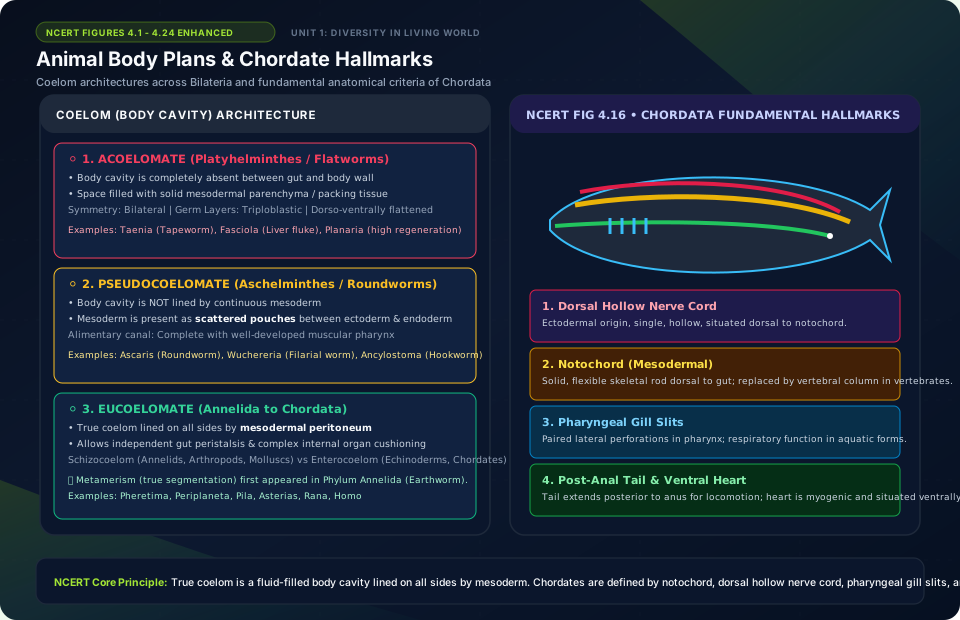
Animal Body Plans & Chordate Hallmarks
🚨 Examiner Traps & Common Misconceptions
✅ Reality: Adult echinoderms exhibit radial symmetry, but their free-swimming larvae are strictly bilaterally symmetrical!
✅ Reality: All vertebrates are chordates, but not all chordates are vertebrates! Protochordates (Tunicates and Lancelets) lack a vertebral column.
💡 Memory Hack & Mnemonic
Four Hallmark Chordate Characters: ‘Never Put Dogs Down’ (Nerve cord dorsal/hollow, Pharyngeal gill slits, post-anal Tail, Notochord present).
⭐ 10/10 Active Recall Self-Check: Chapter 4
Test your mastery before closing this lecture note. Can you answer these without looking back?
- What are the primary diagnostic characteristics that define Animal Kingdom in the NCERT syllabus?
- How do the physiological or anatomical structures covered in this chapter adapt the organism to its environment?
- What are the most common trick questions examiners create based on the exceptions in this chapter?
- Can you state the core mnemonic formula for remembering the sequential stages or components described above?
⭐ 10/10 Active Recall Self-Check: Chapter 4
Test your mastery before closing this lecture note. Can you answer these without looking back?
- What are the primary diagnostic characteristics that define Animal Kingdom in the NCERT syllabus?
- How do the physiological or anatomical structures covered in this chapter adapt the organism to its environment?
- What are the most common trick questions examiners create based on the exceptions in this chapter?
- Can you state the core mnemonic formula for remembering the sequential stages or components described above?