
16.1 Nitrogenous Wastes: Ammonotelism (Bony fishes, Aquatic amphibians), Ureotelism (Mammals, Frogs), Uricotelism (Birds, Reptiles, Insects) #
Animals accumulate metabolic nitrogenous wastes such as ammonia, urea, and uric acid, either through protein and nucleic acid catabolism or through excess ingestion. These wastes must be eliminated from the body to prevent cellular toxicity. Depending on the chemical form of nitrogenous waste excreted, animals are classified into three major groups:
| Mode of Excretion | Toxicity & Water Requirement | NCERT Representative Examples |
|---|---|---|
| Ammonotelism (Ammonia) | Most toxic; readily soluble in water. Requires huge amounts of water for excretion. Excreted by simple diffusion across body surface or gill surfaces as ammonium ions (NH4+). Kidneys play minimal role. | Bony fishes, aquatic amphibians, and aquatic insects. |
| Ureotelism (Urea) | ~100,000 times less toxic than ammonia. Formed in the liver via the Ornithine cycle (urea cycle) by combining ammonia with CO2. Requires moderate water for elimination. | Mammals, terrestrial amphibians (adult frogs), and marine fishes (sharks). |
| Uricotelism (Uric Acid) | Least toxic; insoluble in water. Excreted in the form of a thick paste or dry pellets with minimal water loss, a supreme adaptation for terrestrial water conservation. | Reptiles, birds, land snails, and terrestrial insects. |
16.2 Human Excretory System: Gross Kidney Anatomy, Cortex, Medulla, Renal Pyramids & Pelvis #
The human excretory system consists of a pair of kidneys, one pair of ureters, a urinary bladder, and a urethra.
Gross Kidney Anatomy: Kidneys are bean-shaped, reddish-brown organs situated retroperitoneally between the levels of the last thoracic (T12) and third lumbar (L3) vertebra close to the dorsal abdominal wall. Each adult kidney measures 10–12 cm in length, 5–7 cm in width, 2–3 cm in thickness, with an average weight of 120 to 170 grams.
Towards the center of the inner concave border is a notch called the hilum, through which the ureter, renal blood vessels, and nerves enter. Inner to the hilum is a broad funnel-shaped space called the renal pelvis with calyces. The kidney is divided into two distinct zones: an outer renal cortex and an inner renal medulla. The medulla is divided into a few conical masses called medullary pyramids projecting into the calyces. The cortex extends between the medullary pyramids as renal columns called the Columns of Bertini.
16.3 Nephron Histology: Malpighian Corpuscle (Glomerulus + Bowman’s Capsule), PCT, Henle’s Loop, DCT & Collecting Duct #
Each human kidney contains approximately one million complex tubular functional units called Nephrons. A nephron consists of two main parts: the Glomerulus and the Renal Tubule:
- Malpighian Body (Renal Corpuscle): Consists of the Glomerulus (a tuft of capillaries formed by the afferent arteriole, draining into the narrower efferent arteriole) enclosed by a double-walled cup-shaped Bowman’s Capsule.
- Renal Tubule:
- Proximal Convoluted Tubule (PCT): Highly coiled tubule lined by simple cuboidal brush-border epithelium with microvilli.
- Henle’s Loop: A hairpin-shaped loop consisting of a thin descending limb (highly permeable to water, impermeable to electrolytes) and a thick ascending limb (impermeable to water, actively transports electrolytes).
- Distal Convoluted Tubule (DCT): Coiled tubule involved in conditional reabsorption and secretion, emptying into a straight Collecting Duct.
- Types of Nephrons:
- Cortical Nephrons (~85%): Henle’s loop is short and extends only very little into the medulla; vasa recta is absent or highly reduced.
- Juxtamedullary Nephrons (~15%): Henle’s loop is very long and runs deep into the inner medulla; accompanied by a hairpin-shaped capillary loop called the vasa recta. Essential for concentrating urine!
16.4 Mechanism of Urine Formation: Glomerular Ultrafiltration (Net Filtration Pressure, GFR = 125 mL/min = 180 L/day) #
Urine formation involves three essential physiological processes: Glomerular Filtration, Tubular Reabsorption, and Tubular Secretion.
1. Glomerular Ultrafiltration: Blood is filtered so finely across three membranes—the capillary endothelium, the basement membrane, and the visceral podocyte layer of Bowman’s capsule (bearing specialized slit pores or filtration slits)—that almost all plasma constituents except proteins pass into the capsule lumen. This is non-selective ultrafiltration driven by hydrostatic pressure.
The volume of filtrate formed by both kidneys per minute is the Glomerular Filtration Rate (GFR). In a healthy human, GFR is approximately 125 mL/minute, which amounts to a massive 180 Liters of filtrate per day!
16.5 Tubular Reabsorption (99% of Filtrate Reclaimed) & Selective Tubular Secretion (K+, H+, NH3) #
Although 180 Liters of glomerular filtrate is produced daily, only 1.5 Liters of urine is actually excreted. This means that nearly 99% of the filtrate is reabsorbed by the renal tubules!
- Proximal Convoluted Tubule (PCT): Reabsorbs nearly 70–80% of electrolytes and water, and 100% of glucose and amino acids by active and passive mechanisms. Also maintains blood pH by selective secretion of H+, ammonia, and potassium ions.
- Henle’s Loop: Descending limb is permeable to water but impermeable to salts (filtrate becomes concentrated hypertonic); Ascending limb is impermeable to water but actively pumps NaCl out into the medullary interstitium (filtrate becomes hypotonic).
- Distal Convoluted Tubule (DCT): Performs conditional reabsorption of Na+ and water under the influence of Aldosterone and ADH, and reabsorbs HCO3−.
- Collecting Duct: Large amounts of water can be reabsorbed here under ADH to produce concentrated urine; allows small amounts of urea into medullary interstitium to maintain high osmolarity.
- Tubular Secretion: Active secretion of H+, K+, and ammonia into the tubule maintains ionic and acid-base equilibrium in body fluids.
16.6 Counter-Current Multiplier Mechanism: Henle’s Loop & Vasa Recta Creating Medullary Hyperosmolarity (1200 mOsm/L) #
Mammals have the unique ability to produce hypertonic urine (up to 4 times more concentrated than blood plasma: 1200 mOsmol/L compared to 300 mOsmol/L in the cortex). This concentration mechanism is mediated by the Counter-Current Multiplier System operating between the two limbs of Henle’s loop and the two limbs of the vasa recta:
- The flow of filtrate in the two limbs of Henle’s loop is in opposite directions (down the descending limb, up the ascending limb), establishing a counter-current.
- Similarly, the flow of blood through the two limbs of the vasa recta is in opposite directions.
- The ascending limb of Henle’s loop actively pumps NaCl into the medullary interstitium. This NaCl enters the descending limb of the vasa recta and is returned to the interstitium by the ascending vasa recta.
- Similarly, small amounts of urea diffuse out from the collecting duct into the medullary interstitium and cycle back into the thin ascending limb.
- This counter-current exchange traps NaCl and urea in the medullary interstitium, establishing a steep osmotic gradient increasing from 300 mOsmol/L in the cortex to 1200 mOsmol/L in the deep inner medulla. As water moves down the collecting duct through this hyperosmolar zone, water is drawn out by osmosis, producing highly concentrated urine.
16.7 Regulation of Kidney Function: Hypothalamus-ADH (Vasopressin), Renin-Angiotensin-Aldosterone System (RAAS) & Atrial Natriuretic Factor (ANF) #
Kidney function is regulated by feedback mechanisms involving the hypothalamus, the Juxtaglomerular Apparatus (JGA), and the heart:
- Hypothalamus and ADH (Vasopressin): Osmoreceptors in the body are activated by changes in blood volume and body fluid osmolarity. Excessive water loss stimulates the release of Antidiuretic Hormone (ADH) from the neurohypophysis. ADH facilitates water reabsorption from the DCT and collecting duct, preventing diuresis. When fluid volume is restored, osmoreceptors shut off ADH release.
- Renin-Angiotensin-Aldosterone System (RAAS): The Juxtaglomerular Apparatus (JGA) is a cellular modification formed by the cellular contact between the afferent arteriole and DCT. A fall in glomerular blood flow/GFR stimulates JG cells to release the enzyme Renin. Renin converts plasma angiotensinogen to angiotensin I and then to Angiotensin II (a potent vasoconstrictor that raises GFR). Angiotensin II also stimulates the adrenal cortex to release Aldosterone, which drives Na+ and water reabsorption in the DCT.
- Atrial Natriuretic Factor (ANF): An increase in blood flow to the heart atria stimulates the secretion of ANF. ANF causes vasodilation, lowering blood pressure. Thus, ANF acts as a physiological brake and antagonist to the RAAS mechanism.
16.8 Micturition Reflex & Excretory Disorders: Uremia, Renal Calculi (Kidney Stones) & Glomerulonephritis; Hemodialysis #
Micturition: The process of releasing urine from the urinary bladder. As urine collects, the stretch receptors on the bladder wall send signals to the CNS, triggering the autonomic motor reflex that contracts bladder smooth muscles and relaxes the urethral sphincter (micturition reflex). An adult human excretes an average of 1 to 1.5 Liters of urine per day, eliminating roughly 25 to 30 grams of urea.
Excretory Disorders:
- Uremia: Accumulation of urea in blood due to kidney failure, highly toxic and requiring Hemodialysis (filtering patient blood through cellophane dialyzing tubing immersed in dialyzing fluid containing heparin anticoagulant).
- Renal Calculi: Insoluble stones or masses of crystallized salts (e.g., calcium oxalates) formed within the kidney.
- Glomerulonephritis: Inflammation of the glomeruli of the kidneys.
- Renal Transplantation: The ultimate surgical remedy for acute or chronic renal failure, replacing a damaged kidney with a compatible donor organ (immunosuppressive drugs like cyclosporin A are given to prevent graft rejection).
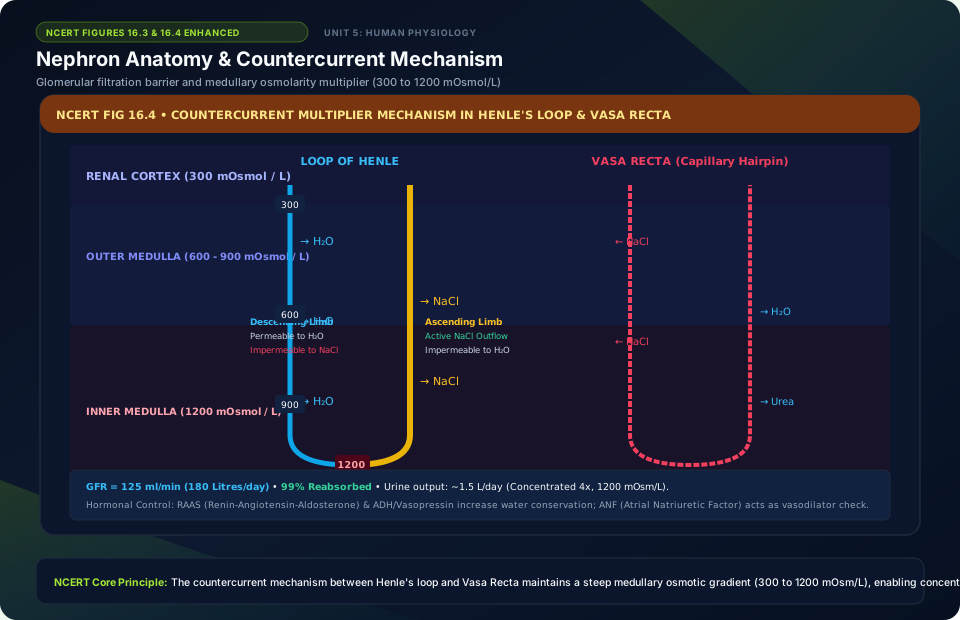
Nephron Anatomy & Countercurrent Mechanism
🚨 Examiner Traps & Common Misconceptions
✅ Reality: The descending limb of Henle’s loop is permeable to WATER but virtually impermeable to electrolytes! The ascending limb is impermeable to water but transports electrolytes.
✅ Reality: ANF is a powerful vasodilator released by heart atria that causes natriuresis, lowering blood pressure as an antagonist to RAAS!
💡 Memory Hack & Mnemonic
Nitrogenous Waste Toxicity & Water Need: ‘Ammonia is Most Toxic, Urea is Medium, Uric Acid is Least Toxic (Water Saver)’.
⭐ 10/10 Active Recall Self-Check: Chapter 16
Test your mastery before closing this lecture note. Can you answer these without looking back?
- What are the primary diagnostic characteristics that define Excretory Products and their Elimination in the NCERT syllabus?
- How do the physiological or anatomical structures covered in this chapter adapt the organism to its environment?
- What are the most common trick questions examiners create based on the exceptions in this chapter?
- Can you state the core mnemonic formula for remembering the sequential stages or components described above?
⭐ 10/10 Active Recall Self-Check: Chapter 16
Test your mastery before closing this lecture note. Can you answer these without looking back?
- What are the primary diagnostic characteristics that define Excretory Products and their Elimination in the NCERT syllabus?
- How do the physiological or anatomical structures covered in this chapter adapt the organism to its environment?
- What are the most common trick questions examiners create based on the exceptions in this chapter?
- Can you state the core mnemonic formula for remembering the sequential stages or components described above?