
13.1 Characteristics of Plant Growth: Indeterminate, Open & Measurable; Arithmetic vs Geometric Growth #
Growth is regarded as one of the most fundamental and conspicuous characteristics of a living being. Growth can be defined as an irreversible, permanent increase in the size of an organ or its parts, or even of an individual cell, accompanied by metabolic processes that consume energy.
Plant growth exhibits unique characteristics:
- Indeterminate and Open Growth: Plants retain the capacity for unlimited growth throughout their entire lifespan because of the presence of meristems at certain locations in their body. Cells of such meristems divide and self-perpetuate; new cells are constantly added to the plant body. Hence, plant growth is described as open.
- Measurable Growth: At the cellular level, growth is a consequence of increase in the amount of protoplasm. Because measuring protoplasmic volume directly is difficult, growth is measured by parameters such as increase in fresh weight, dry weight, length, area, volume, and cell number (e.g., a single maize root apical meristem can give rise to more than 17,500 new cells per hour; cells in a watermelon may increase in size up to 350,000 times!).
- Growth Patterns:
- Arithmetic Growth: Following mitotic cell division, only one daughter cell continues to divide while the other differentiates and matures. Length increases at a constant rate linearly over time:
Lt = L0 + rt. - Geometric Growth: Both daughter cells retain the ability to divide mitotically, producing an initial slow lag phase, a rapid exponential (log) phase, and a terminal stationary phase, resulting in a characteristic sigmoid (S-shaped) curve:
W1 = W0ert(where r is the relative growth rate and measure of efficiency index).
- Arithmetic Growth: Following mitotic cell division, only one daughter cell continues to divide while the other differentiates and matures. Length increases at a constant rate linearly over time:
13.2 Phases of Growth: Meristematic, Elongation & Maturation #
The period of growth in roots and stems is divided into three distinct chronological and spatial phases:
- Phase of Meristematic Activity (Cell Division): Constantly dividing cells located at the root apex and shoot apex. Cells are characterized by rich protoplasm, large conspicuous nuclei, thin primary cellulosic cell walls, and abundant plasmodesmatal connections.
- Phase of Elongation: Cells proximal to the meristematic zone. Hallmarks of this phase include increased vacuolation, cell enlargement, and new cell wall deposition, resulting in rapid longitudinal elongation.
- Phase of Maturation: Located further proximal to elongation zone. Cells attain their maximal size in terms of wall thickening and protoplasmic modifications, differentiating into specialized permanent tissues (xylem, phloem, parenchyma, sclerenchyma).
13.3 Differentiation, Dedifferentiation (Interfascicular Cambium) & Redifferentiation #
The life cycle of plant tissues involves three progressive cellular transitions:
- Differentiation: Cells derived from apical and cambial meristems mature to perform specific physiological functions. During differentiation, cells undergo major structural changes in their cell walls and protoplasm. For example, to form a tracheary vessel element, the cell loses its protoplasm and develops very strong, elastic, lignocellulosic secondary cell walls to carry water under high tension.
- Dedifferentiation: Living, differentiated mature cells that have lost the capacity to divide can regain the power of mitotic division under specific environmental conditions. For example, fully differentiated parenchymatous cells dedifferentiate to form interfascicular cambium and cork cambium (phellogen) during secondary growth.
- Redifferentiation: The new cells produced by dedifferentiated meristems once again lose the capacity to divide and mature to perform specific functions. For example, secondary xylem, secondary phloem, and cork (phellem) cells are redifferentiated tissues.
13.4 Development & Plasticity (Heterophylly in Cotton, Coriander, Larkspur vs Buttercup) #
Development is the broad term that includes all changes that an organism goes through during its life cycle from seed germination to senescence. Development is the sum of growth and differentiation: Development = Growth + Differentiation.
Plants follow different developmental pathways in response to environmental cues or phases of life to form different kinds of structures. This remarkable adaptive ability is called Plasticity.
The classic manifestation of plasticity is Heterophylly (occurrence of different forms of leaves on the same plant):
- Developmental / Environmental Heterophylly in Terrestrial Plants: In Cotton, Coriander, and Larkspur, juvenile leaves are markedly different in shape from mature adult leaves.
- Environmental Plasticity in Aquatic Plants: In Buttercup (Ranunculus), submerged leaves are highly dissected and ribbon-like to withstand water currents, whereas aerial leaves emerging above water are broad, lobed, and entire.
13.5 Plant Growth Promoters: Auxins (Apical Dominance, 2,4-D Herbicide), Gibberellins (Bolting, Internode Elongation), Cytokinins (Cell Division, Delaying Senescence) #
Plant growth and development are regulated by chemical substances called Plant Growth Regulators (PGRs) or phytohormones, broadly categorized into promoters and inhibitors:
- Auxins (from Greek auxein, to grow): First isolated by F.W. Went (1928) from tips of oat (Avena sativa) coleoptiles; first isolated chemically from human urine. Natural auxins include Indole-3-acetic acid (IAA) and Indole-3-butyric acid (IBA); synthetic auxins include Naphthalene acetic acid (NAA) and 2,4-dichlorophenoxyacetic acid (2,4-D).
- Promotes apical dominance: the growing apical bud suppresses the growth of lateral (axillary) buds. Decapitation (removal of shoot tip) induces lateral branching (widely used in tea plantation and hedge-making).
- Initiates root formation in stem cuttings (propagation).
- Prevents premature leaf and fruit drop, but promotes abscission of older mature leaves and fruits.
- Induces parthenocarpy in tomatoes.
- 2,4-D is widely used as a selective weedicide to eradicate broad-leaved dicot weeds in mature monocot cereal lawns.
- Gibberellins (GAs): Discovered in Japan by E. Kurosawa (1926) studying ‘bakanae’ (foolish seedling) disease in rice caused by the fungus Gibberella fujikuroi. More than 100 GAs are known; GA3 is the most intensively studied.
- Causes rapid elongation of internodes; increases length of grape stalks and elongates apple fruit shape.
- Delays senescence, allowing fruits to stay on trees longer for extended marketing.
- Spraying juvenile conifers with GAs hastens the maturity period, leading to early seed production.
- Promotes bolting (internode elongation just prior to flowering) in rosette plants like beet and cabbage.
- Accelerates malting process in the brewing industry.
- Cytokinins: Discovered by Skoog and Miller (1955) as kinetin (a modified adenine purine) from autoclaved herring sperm DNA. Natural cytokinin was isolated as zeatin from corn kernels and coconut milk.
- Promotes active cell division, especially in root apices, developing shoot buds, and young fruits.
- Helps produce new leaves, chloroplasts in leaves, lateral shoot growth, and adventitious shoot formation.
- Overcomes apical dominance.
- Promotes nutrient mobilization, delaying leaf senescence (Richmond-Lang effect).
13.6 Plant Growth Inhibitors: Ethylene (Gaseous Fruit Ripening, Triple Response) & Abscisic Acid (ABA / Stress Hormone) #
Plant growth inhibitors suppress metabolic activities and mediate survival under abiotic stress conditions:
- Ethylene: A simple gaseous hydrocarbon PGR discovered by Cousins (1910), who confirmed that volatile gas released from ripened oranges accelerated ripening of stored unripened bananas.
- Highly effective in fruit ripening: enhances respiration rate dramatically during fruit ripening, a surge called the respiratory climacteric.
- Widely used in agriculture as Ethephon (an aqueous solution that releases ethylene into plant tissues).
- Breaks seed and bud dormancy; initiates germination in peanut seeds and sprouting of potato tubers.
- Promotes rapid petiole elongation in deep-water rice plants, keeping leaves above water.
- Promotes root growth and root hair formation, maximizing absorption surface.
- Induces flowering and synchronizes fruit-set in pineapples.
- Abscisic Acid (ABA): Also known as Dormin or Stress Hormone.
- Acts as a general plant growth inhibitor and inhibitor of plant metabolism.
- Stimulates rapid closure of stomata under water deficiency, minimizing transpirational water loss.
- Increases tolerance of plants to various kinds of abiotic stresses (hence called the stress hormone).
- Promotes seed dormancy, preventing premature vivipary (germination on parent plant) and helping seeds withstand desiccation.
- In most physiological situations, ABA acts as an antagonist to Gibberellins (GAs).
- Photoperiodism & Vernalization:
- Photoperiodism: The response of plants to periods of day and night light exposure. Plants are classified into Short-Day Plants (SDP), Long-Day Plants (LDP), and Day-Neutral Plants (DNP) based on critical photoperiod thresholds. The site of light perception is the leaves, which synthesize a hypothetical mobile hormonal substance called florigen that migrates to the shoot apex to induce flowering.
- Vernalization: The quantitative or qualitative dependence of flowering on low chilling temperatures (1°C to 7°C). Prevents precocious reproductive development late in the growing season, seen in biennial plants (sugarbeet, cabbage, carrot) and winter varieties of wheat, barley, and rye.
13.7 Photoperiodism (Short-day, Long-day & Day-neutral Plants; Florigen) & Vernalization (Chilling Requirement) #
Photoperiodism (Short-day, Long-day & Day-neutral Plants; Florigen) & Vernalization (Chilling Requirement) is a core concept in this chapter. Understanding this requires analyzing its structural organization, biological mechanisms, and regulatory feedback pathways.
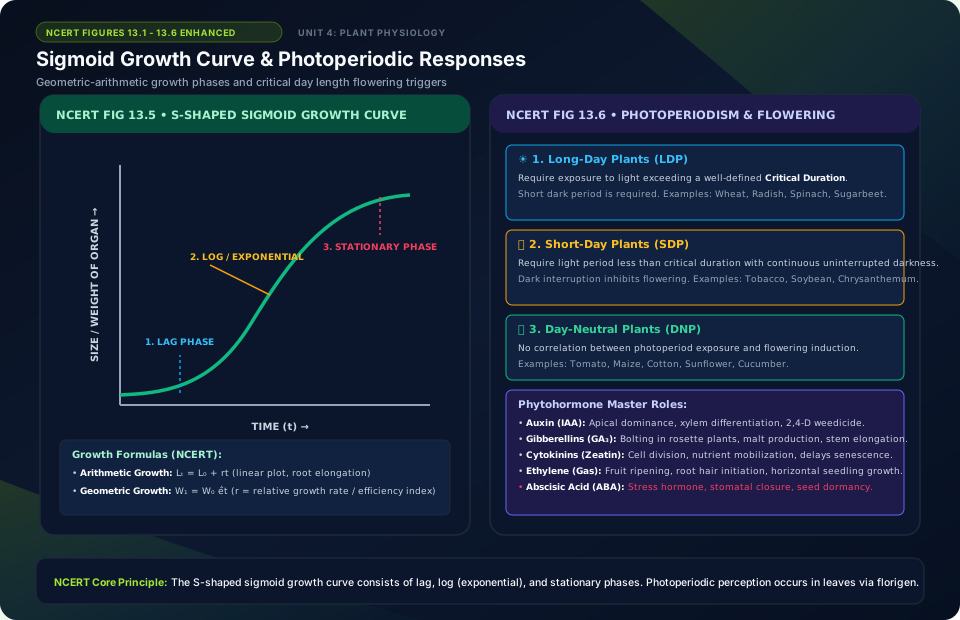
Sigmoid Growth Curve & Photoperiodic Responses
🚨 Examiner Traps & Common Misconceptions
✅ Reality: Auxin promotes apical dominance: the growing terminal bud represses lateral branch buds! Pruning the tip removes auxin and causes bushy lateral branching.
✅ Reality: ABA enforces seed dormancy and stomatal closure during drought; Gibberellins break dormancy and induce alpha-amylase for germination.
💡 Memory Hack & Mnemonic
Five Hormone Classes: ‘All Good Children Eat Apples’ (Auxin, Gibberellin, Cytokinin, Ethylene, Abscisic Acid).
⭐ 10/10 Active Recall Self-Check: Chapter 13
Test your mastery before closing this lecture note. Can you answer these without looking back?
- What are the primary diagnostic characteristics that define Plant Growth and Development in the NCERT syllabus?
- How do the physiological or anatomical structures covered in this chapter adapt the organism to its environment?
- What are the most common trick questions examiners create based on the exceptions in this chapter?
- Can you state the core mnemonic formula for remembering the sequential stages or components described above?
⭐ 10/10 Active Recall Self-Check: Chapter 13
Test your mastery before closing this lecture note. Can you answer these without looking back?
- What are the primary diagnostic characteristics that define Plant Growth and Development in the NCERT syllabus?
- How do the physiological or anatomical structures covered in this chapter adapt the organism to its environment?
- What are the most common trick questions examiners create based on the exceptions in this chapter?
- Can you state the core mnemonic formula for remembering the sequential stages or components described above?