
12.1 Cellular Respiration Fundamentals: Aerobic Respiration vs Fermentation (Lactic & Alcoholic) #
All living organisms require energy to perform life processes. While green plants trap solar energy via photosynthesis, the energy locked inside the covalent C-C bonds of carbohydrates must be broken down to yield usable metabolic ATP. This cellular oxidation of food molecules within the cell to release energy is called cellular respiration.
The compounds that are oxidized during respiration are known as respiratory substrates. Usually, carbohydrates (glucose) are oxidized, but proteins, fats, and organic acids can also be used as respiratory substrates under specific physiological conditions.
Based on the availability of oxygen, respiration proceeds via two distinct metabolic routes:
- Aerobic Respiration: Complete oxidation of organic substances in the presence of oxygen into CO2 and H2O with high energy yield (36 to 38 ATP per glucose molecule). Takes place inside the mitochondria of eukaryotic cells.
- Anaerobic Respiration / Fermentation: Incomplete breakdown of glucose in the absence of oxygen, yielding very little energy (less than 7% of total bond energy):
- Alcoholic Fermentation: Carried out by yeasts (Saccharomyces). Pyruvate is decarboxylated by pyruvate decarboxylase and reduced by alcohol dehydrogenase into ethanol and CO2, reoxidizing NADH to NAD+. Yeasts poison themselves to death when alcohol concentration reaches about 13%.
- Lactic Acid Fermentation: Carried out by lactic acid bacteria and during vigorous exercise in human skeletal muscles when oxygen is inadequate. Pyruvate is reduced directly to lactic acid by lactate dehydrogenase without releasing CO2.
12.2 Glycolysis (EMP Pathway): 10 Enzymatic Steps, ATP Investment vs Payoff, Cytosolic Location #
The scheme of Glycolysis was elucidated by Gustav Embden, Otto Meyerhof, and J. Parnas, and is universally known as the EMP pathway. Glycolysis is the common metabolic pathway in both aerobic and anaerobic respiration, occurring in the cytosol (cytoplasm) of all living cells.
Glycolysis is a sequence of 10 enzyme-catalyzed reactions that splits one 6-carbon molecule of glucose into two 3-carbon molecules of pyruvic acid (pyruvate). No oxygen is consumed, and no carbon dioxide is evolved. Glycolysis consists of two distinct phases:
- Preparatory (Energy Investment) Phase (Steps 1–5):
- Step 1: Glucose is phosphorylated to Glucose-6-phosphate by hexokinase (consumes 1 ATP).
- Step 2: Isomerization to Fructose-6-phosphate by phosphohexose isomerase.
- Step 3: Fructose-6-phosphate is phosphorylated to Fructose-1,6-bisphosphate by phosphofructokinase (PFK), the master regulatory pace-maker enzyme of glycolysis (consumes 1 ATP).
- Step 4–5: Fructose-1,6-bisphosphate is cleaved by aldolase into two triose phosphates: Glyceraldehyde-3-phosphate (G3P / PGAL) and Dihydroxyacetone phosphate (DHAP), which interconvert via triose phosphate isomerase.
- Pay-Off (Energy Harvesting) Phase (Steps 6–10, occurring twice per glucose):
- Step 6: PGAL is oxidized and phosphorylated to 1,3-bisphosphoglycerate (1,3-BPG) by glyceraldehyde-3-phosphate dehydrogenase, reducing NAD+ to NADH + H+ (yields 2 NADH per glucose).
- Step 7: 1,3-BPG transfers a high-energy phosphate to ADP, forming 3-phosphoglycerate and ATP via phosphoglycerate kinase (Substrate-Level Phosphorylation).
- Step 8–9: Conversion of 3-PGA to 2-PGA and dehydration to high-energy Phosphoenolpyruvate (PEP) by enolase.
- Step 10: PEP transfers its phosphate to ADP, producing Pyruvate and ATP via pyruvate kinase (Substrate-Level Phosphorylation).
- ATP invested: 2 ATP
- Gross ATP produced: 4 ATP (by substrate-level phosphorylation)
- Net ATP gain: 2 ATP
- Reducing equivalents produced: 2 NADH + H+
- End product: 2 Pyruvate molecules
12.3 Link Reaction (Oxidative Decarboxylation of Pyruvate to Acetyl-CoA by Pyruvate Dehydrogenase) #
Pyruvate, the end product of glycolysis, is generated in the cytoplasm. For aerobic respiration to proceed, pyruvate must enter the mitochondrial matrix through specialized transport proteins.
Inside the mitochondrial matrix, pyruvate undergoes oxidative decarboxylation catalyzed by a multi-enzyme complex called the pyruvate dehydrogenase complex, requiring Mg2+ and coenzyme A (CoA):
Because this reaction connects cytosolic glycolysis with the mitochondrial Krebs cycle, it is universally known as the Link Reaction (Gateway Step). For each glucose molecule oxidized (2 pyruvates), the link reaction yields 2 molecules of Acetyl-CoA, 2 molecules of CO2, and 2 molecules of NADH + H+.
12.4 Tricarboxylic Acid (TCA / Krebs Cycle): Matrix Location, Key Intermediates, Substrate-Level Phosphorylation #
Acetyl-CoA then enters a cyclic pathway discovered by Hans Krebs (1937), known as the Tricarboxylic Acid (TCA) Cycle or Krebs Cycle. Because the first product formed is citric acid, it is also called the Citric Acid Cycle. The cycle occurs exclusively within the mitochondrial matrix:
- The cycle initiates with the condensation of the 2-carbon acetyl group of Acetyl-CoA with 4-carbon oxaloacetic acid (OAA) and water to form 6-carbon Citric Acid, catalyzed by citrate synthase (releasing CoA).
- Citrate is isomerized to isocitrate.
- Isocitrate undergoes oxidative decarboxylation to form 5-carbon α-ketoglutaric acid, yielding CO2 and NADH.
- α-ketoglutaric acid undergoes a second oxidative decarboxylation to form 4-carbon Succinyl-CoA, yielding CO2 and NADH.
- Succinyl-CoA is cleaved to succinic acid, coupled with the synthesis of GTP from GDP (Substrate-Level Phosphorylation). GTP readily transfers its terminal phosphate to ADP to generate ATP.
- Succinate is oxidized to fumarate by succinate dehydrogenase (the only TCA cycle enzyme embedded in the inner mitochondrial membrane!), reducing FAD to FADH2.
- Fumarate is hydrated to malate, which is oxidized to regenerate Oxaloacetic Acid (OAA), reducing NAD+ to NADH + H+.
For 1 molecule of Acetyl-CoA: 3 NADH + 1 FADH2 + 1 ATP (GTP) + 2 CO2.
Per Glucose molecule (2 turns): 6 NADH + 2 FADH2 + 2 ATP + 4 CO2.
12.5 Electron Transport System (ETS) & Oxidative Phosphorylation: Mitochondrial Complexes I, II, III, IV & V #
The metabolic pathway through which electrons pass from one carrier to another in the inner mitochondrial membrane is called the Electron Transport System (ETS). The high-energy electrons stored in NADH and FADH2 during glycolysis, link reaction, and Krebs cycle are passed through five multi-protein complexes embedded in the inner mitochondrial membrane:
- Complex I (NADH Dehydrogenase): Electrons from NADH are oxidized and transferred via FMN and iron-sulfur (Fe-S) centers to ubiquinone (coenzyme Q). Ubiquinone is reduced to ubiquinol (QH2), pumping 4 protons (H+) into the intermembrane space.
- Complex II (Succinate Dehydrogenase): FADH2 generated in the Krebs cycle transfers electrons via Fe-S centers to ubiquinone without pumping protons.
- Complex III (Cytochrome bc1 Complex): Ubiquinol passes electrons to cytochrome c via cytochromes b, c1, and Fe-S proteins, pumping 4 protons into the intermembrane space. Cytochrome c is a small mobile protein attached to the outer surface of the inner membrane acting as a mobile electron shuttle between Complex III and IV.
- Complex IV (Cytochrome c Oxidase): Contains cytochromes a and a3, and two copper centers (CuA and CuB). It transfers electrons to the terminal electron acceptor: molecular Oxygen (O2), which combines with protons to form metabolic water (H2O):
½O2 + 2H+ + 2e− → H2O. Pumps 2 protons. - Complex V (ATP Synthase): Catalyzes Oxidative Phosphorylation. Driven by the proton gradient established across the inner membrane into the intermembrane space. Complex V consists of two functional components:
- F0 Component: An integral transmembrane protein channel through which protons flow down the electrochemical gradient back into the mitochondrial matrix.
- F1 Headpiece: A peripheral protein complex on the matrix side that synthesizes ATP from ADP and Pi. For every pair of protons (2H+) passing through F0 into the matrix, 1 ATP is synthesized.
Equivalence: Oxidation of 1 molecule of NADH yields 3 ATP, while oxidation of 1 molecule of FADH2 yields 2 ATP.
12.6 Respiratory Balance Sheet: Theoretical 36-38 ATP Yield per Glucose #
Calculating the theoretical maximum yield of ATP per molecule of glucose oxidized in complete aerobic respiration requires accounting for all three phases (Glycolysis, Link Reaction, and Krebs Cycle):
| Respiratory Stage | Direct Substrate-Level ATP | Reduced Coenzymes Formed | ATP from Oxidative Phosphorylation |
|---|---|---|---|
| Glycolysis (Cytosol) | 2 ATP (net) | 2 NADH | 2 × 3 = 6 ATP (or 4 via glycerol phosphate shuttle) |
| Link Reaction (Matrix) | 0 ATP | 2 NADH | 2 × 3 = 6 ATP |
| Krebs Cycle (Matrix) | 2 ATP (GTP) | 6 NADH + 2 FADH2 | (6 × 3) + (2 × 2) = 18 + 4 = 22 ATP |
| Total Theoretical Yield | 4 ATP | 10 NADH + 2 FADH2 | 36 to 38 ATP per Glucose |
Note: Real cellular yields are typically ~30–32 ATP due to the proton costs of importing pyruvate and ADP into the mitochondrial matrix.
12.7 Amphibolic Nature of Respiration & Respiratory Quotient (RQ = CO2 evolved / O2 consumed) #
Respiration is traditionally described as a catabolic pathway because substrates are broken down to generate energy. However, respiratory pathway intermediates are constantly withdrawn to synthesize other vital cellular compounds:
- When the body needs to synthesize fatty acids, Acetyl-CoA is withdrawn from the respiratory pathway.
- When proteins are metabolized, amino acids enter at pyruvate, acetyl-CoA, or α-ketoglutarate; conversely, α-ketoglutaric acid is withdrawn to synthesize amino acids via transamination.
- Because the respiratory pathway is involved in both breakdown (catabolism) and synthesis (anabolism), respiration is more accurately designated as an amphibolic pathway rather than simply catabolic.
Respiratory Quotient (RQ): The ratio of the volume of CO2 evolved to the volume of O2 consumed in respiration:
- Carbohydrates (Glucose):
C6H12O6 + 6O2 → 6CO2 + 6H2O; RQ = 6/6 = 1.0. - Fats (Tripalmitin):
2(C51H98O6) + 145O2 → 102CO2 + 98H2O; RQ = 102/145 = 0.7. - Proteins: RQ is approximately 0.9.
- Anaerobic Respiration: No O2 is consumed; RQ = CO2 / 0 = Infinity (∞).
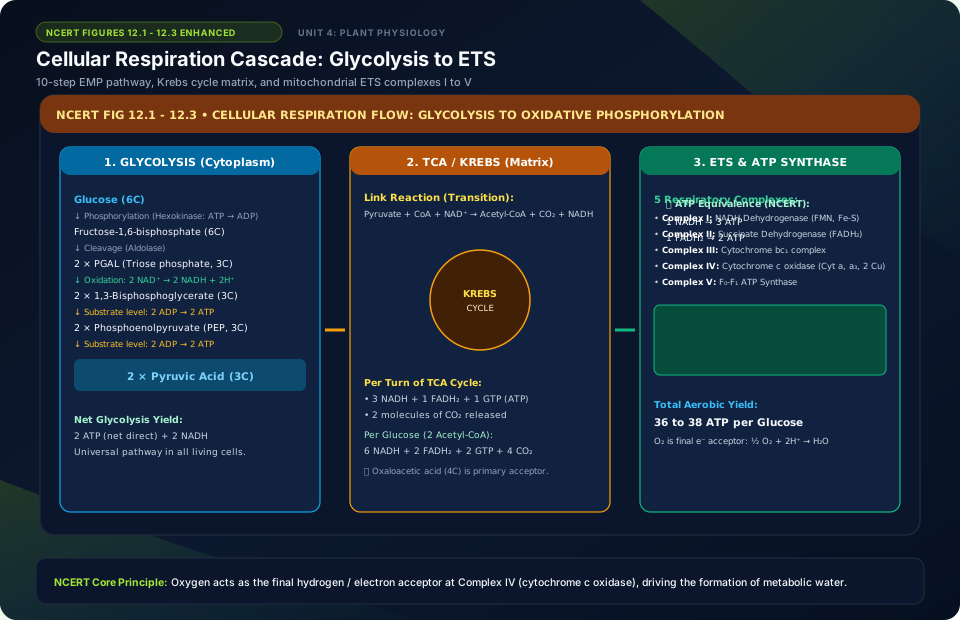
Cellular Respiration Cascade: Glycolysis to ETS
🚨 Examiner Traps & Common Misconceptions
✅ Reality: Glycolysis is completely anaerobic! It occurs in the cytoplasm of all living organisms without consuming any oxygen.
✅ Reality: RQ for carbohydrates is 1.0. For fats (tripalmitin) it is 0.7, and for proteins it is 0.9.
💡 Memory Hack & Mnemonic
Glycolysis Investment & Payoff: ‘Invest 2, Get 4, Net 2 ATP + 2 NADH’.
⭐ 10/10 Active Recall Self-Check: Chapter 12
Test your mastery before closing this lecture note. Can you answer these without looking back?
- What are the primary diagnostic characteristics that define Respiration in Plants in the NCERT syllabus?
- How do the physiological or anatomical structures covered in this chapter adapt the organism to its environment?
- What are the most common trick questions examiners create based on the exceptions in this chapter?
- Can you state the core mnemonic formula for remembering the sequential stages or components described above?
⭐ 10/10 Active Recall Self-Check: Chapter 12
Test your mastery before closing this lecture note. Can you answer these without looking back?
- What are the primary diagnostic characteristics that define Respiration in Plants in the NCERT syllabus?
- How do the physiological or anatomical structures covered in this chapter adapt the organism to its environment?
- What are the most common trick questions examiners create based on the exceptions in this chapter?
- Can you state the core mnemonic formula for remembering the sequential stages or components described above?