
1.1 What is Living? Defining vs Characteristic Features of Life #
When we look at the extraordinary diversity of living forms around us—from majestic banyan trees and microorganisms in boiling hot springs to soaring eagles and humans—we naturally ask the fundamental question: What is living?
To answer this scientifically, biologists distinguish between characteristic features (traits commonly seen in living things) and defining properties (traits exclusive to living organisms with zero exceptions).
- Growth: An increase in mass and an increase in the number of individuals are twin characteristics of growth. In unicellular organisms, growth and reproduction are synonymous (both occur through cell division). However, non-living objects can also grow by the accumulation of material on their outer surface—for example, sand dunes, boulders, and snow-capped mountains grow by surface accretion. In living organisms, growth is strictly intrinsic (from within). Because non-living things also exhibit extrinsic growth, growth alone is not a defining property of life.
- Reproduction: Organisms reproduce to produce progeny possessing features more or less similar to those of parents. Reproduction can be sexual or asexual (e.g., budding in yeast and hydra, true regeneration in Planaria, fragmentation in protonema of mosses). However, several living organisms cannot reproduce at all—such as sterile worker bees, mules, and infertile human couples. Furthermore, no non-living object is capable of reproducing itself. Hence, reproduction is a characteristic feature, but not an all-inclusive defining property of life.
- Metabolism: All living organisms are made of chemicals that are constantly being made and transformed into other biomolecules through thousands of simultaneous chemical reactions. The sum total of all chemical reactions occurring inside a living body is called metabolism. No non-living object exhibits metabolism. While metabolic reactions can be demonstrated outside the body in cell-free systems (in a test tube), these isolated in vitro reactions are not living things themselves, but they are living reactions. Therefore, metabolism is an absolute defining feature of all living organisms without exception.
- Cellular Organization: Living bodies are organized into cells, tissues, and organs. A cell is the basic structural and functional unit capable of independent existence. Cellular organization is therefore a strictly defining feature of life.
- Consciousness: The most obvious and technically complicated feature of all living organisms is the ability to sense their surroundings or environment and respond to these environmental stimuli (physical, chemical, or biological). Plants respond to external factors like light, water, temperature, other organisms, and pollutants. All organisms, from simple prokaryotes to complex eukaryotes, exhibit photoperiodism and sense their environment. Human beings are the only living creatures with self-consciousness (awareness of oneself). Thus, consciousness is an undeniable defining property of life.
1.2 Biodiversity, Need for Classification & Systematics #
Our planet is home to an immense range of living creatures. Currently, the number of species that are known and scientifically described ranges between 1.7 to 1.8 million. This vast variety and variability of life on Earth is termed biodiversity.
If you visit a local forest, garden, or aquatic pond, you will notice thousands of different plants, birds, insects, and fungi. Locally, organisms are called by regional common names. For instance, the common onion has dozens of different names in different Indian languages and across different countries. Because local names vary from place to place and language to language, it is impossible for scientists across the world to communicate accurately without confusion.
This creates the urgent scientific need to standardize the naming of living organisms, so that a particular organism is known by the exact same name all over the globe. This process is called nomenclature. However, naming is only possible when the organism is described accurately and we know to what organism the name is attached. This fundamental prerequisite is called identification.
The branch of science dealing with the identification, nomenclature, and systematic grouping of organisms based on their shared evolutionary histories, comparative anatomy, embryology, and ecological relationships is called systematics (from the Latin word systema, meaning systematic arrangement). Linnaeus used Systema Naturae as the title of his historic publication.
1.3 Binomial Nomenclature & Rules of the ICZN / ICBN #
To eliminate international ambiguity in naming organisms, biologists have established agreed principles and criteria. Plant scientific names are governed by the International Code of Botanical Nomenclature (ICBN), while animal names are standardized by the International Code of Zoological Nomenclature (ICZN).
The universal naming system accepted worldwide was introduced by Carolus Linnaeus and is known as Binomial Nomenclature. In this system, every scientific name consists of two words:
- Generic Name (Genus): Represents the broader genus to which the species belongs and always starts with a capital letter.
- Specific Epithet (Species): Identifies the particular species and always begins with a lowercase letter.
For example, the scientific name of the mango tree is written as Mangifera indica. Here, Mangifera is the genus, and indica is the specific epithet.
- Biological names are generally derived from the Latin language and written in italics. If handwritten, the two words are underlined separately to indicate their Latin origin.
- The first word denoting the genus starts with a capital letter (e.g., Homo), while the specific epithet starts with a small letter (e.g., sapiens).
- The name of the author or discoverer appears after the specific epithet in an abbreviated form and in regular font: e.g., Mangifera indica Linn. (indicating it was first described by Linnaeus).
1.4 Taxonomic Hierarchy: Kingdom, Phylum, Class, Order, Family, Genus, Species #
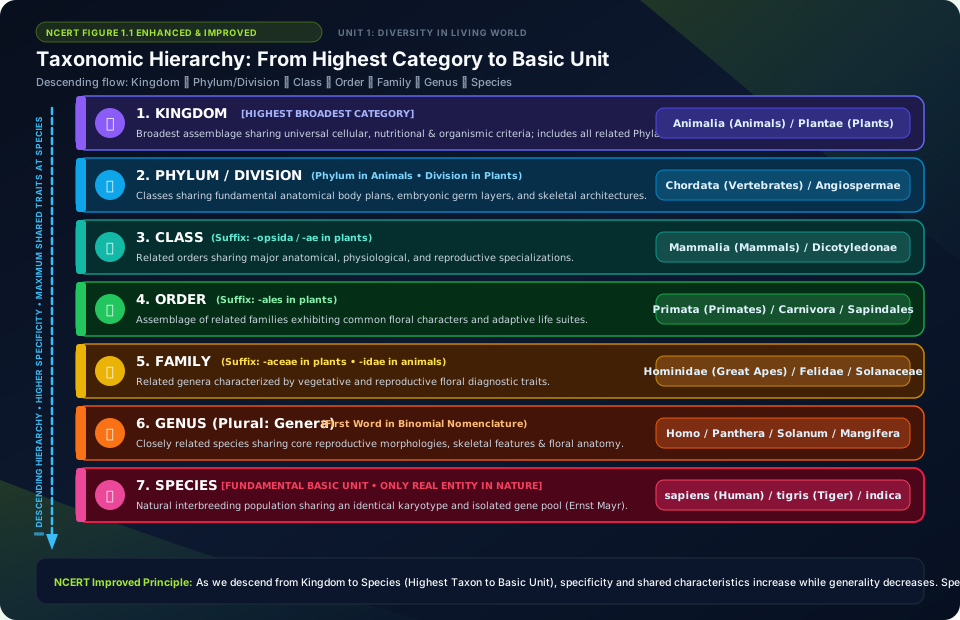
Classification is not an arbitrary mechanical grouping; it is a profound deductive framework mapping evolutionary divergence. It operates as a hierarchy of organized ranks in which each step represents a distinct category. Because each category forms an integral tier of the overall taxonomic architecture, it is termed a taxonomic category, and the unified sequence of all categories constitutes the taxonomic hierarchy. Each category, serving as a distinct unit of classification, represents a rank and is universally designated as a taxon (plural: taxa; e.g., Mammalia is a taxon at the rank of Class; Chordata is a taxon at the rank of Phylum).
💡 The Deductive Reality: Why Hierarchy Flows from Highest Taxon to Basic Unit
NCERT textbooks frequently present the taxonomic hierarchy in an ascending bottom-up ladder (Species → Kingdom), which unintentionally misleads students into believing that biologists begin with a known species and “group upwards”. In authentic scientific investigation and evolutionary biology, taxonomy is strictly deductive: when an uncataloged organism is discovered in a tropical rainforest or deep-sea hydrothermal vent, scientists first identify its broadest kingdom, narrow down its skeletal or developmental body plan (phylum), determine its physiological specializations (class), and progressively zoom in until its unique, interbreeding biological unit (species) is pinpointed. Think of it as a Universal Biological Postal Address: Continent → Country → State → City → Street → Building → Apartment Number → Resident.
The 7 Obligate Taxonomic Categories in True Descending Order (Highest to Basic Unit)
To eliminate ambiguity and master the true flow of biological diversity, study the seven obligate taxonomic ranks descending from the highest, most inclusive category down to the fundamental biological basic unit:
The highest broad taxonomic category grouping all related phyla or divisions sharing universal cellular, nutritional, and developmental foundations. For example, all multicellular heterotrophic organisms lacking cell walls belong to Kingdom Animalia, while all autotrophic multicellular organisms with cellulosic cell walls belong to Kingdom Plantae. (Above kingdom, modern systematics also recognizes three evolutionary Domains: Bacteria, Archaea, and Eukarya).
Encompasses classes sharing fundamental architectural body plans. In animals, Phylum Chordata unites all animals possessing a dorsal hollow nerve cord, notochord, and paired pharyngeal gill slits at some developmental stage (from fish and amphibians to reptiles, birds, and humans). In botanical nomenclature, the term Division is used in place of Phylum (e.g., Angiospermae / Magnoliophyta).
Unites related orders that exhibit shared physiological, anatomical, or reproductive specializations. For example, Class Mammalia unites the order Primata (monkeys, apes, humans) with order Carnivora (tigers, dogs, cats) because all share milk-producing mammary glands, hair on skin, and three middle ear ossicles (malleus, incus, stapes). In plants, Dicotyledonae unites orders having two cotyledons and reticulate leaf venation.
An assemblage of related families exhibiting common evolutionary trends and ecological adaptations. Being a higher category, orders are identified on an aggregate of characters rather than isolated traits. For instance, plant families Solanaceae (potato/tomato family) and Convolvulaceae (morning glory family) are grouped under the single order Polymoniales primarily based on floral characters. In animals, family Felidae (cats) and Canidae (dogs) belong to order Carnivora.
A cohesive group of related genera sharing distinct reproductive, anatomical, and floral features. In plants, families are characterized based on both vegetative and reproductive features of plant species. Genera like Solanum (nightshades), Petunia, and Datura are grouped in Family Solanaceae. In animals, genus Panthera (lion, tiger, leopard) and genus Felis (domestic cats) are classified into Family Felidae.
An aggregate of closely related sister species that share common structural and morphological characteristics with one another compared to species of other genera. For example, the lion (Panthera leo), leopard (Panthera pardus), and tiger (Panthera tigris) share distinctive cranial and vocal anatomy, placing them together in genus Panthera, clearly distinct from genus Felis (small cats). Potato (Solanum tuberosum) and brinjal (Solanum melongena) belong to genus Solanum.
A natural population of individual organisms that share fundamental morphological similarities, possess an identical karyotype, and are reproductively isolated from other groups—meaning they can naturally interbreed among themselves to produce fertile, viable offspring (Ernst Mayr’s Biological Species Concept). While all higher categories (from Genus to Kingdom) are intellectual abstractions created by human taxonomists to map evolutionary relationships, Species is the sole tangible, physical unit of life in nature. Examples: Homo sapiens (human), Mangifera indica (mango), Solanum tuberosum (potato).
⚖️ The Golden Axiom of Taxonomic Specificity: Two Opposite Directions
- Specificity: Dramatically increases
- Shared Characteristics: Increases to maximum
- Total Number of Organisms: Narrows down to one population
- Morphological Similarity: High; identical diagnostic features
- Generality: Increases (broad universal criteria)
- Shared Characteristics: Decreases (only broad traits shared)
- Total Number of Organisms: Expands to encompass billions
- Morphological Diversity: Vast; includes sponges, insects & whales
📊 Classification (Highest Taxon to Basic Unit)
Standard biological classification mapping diverse life forms from the highest obligate category (Kingdom) progressively down to the fundamental basic unit (Species):
| Common Name | Kingdom | Phylum | Class | Order | Family | Genus | Species |
|---|---|---|---|---|---|---|---|
| 👤 Human | Animalia | Chordata | Mammalia | Primata | Hominidae | Homo | sapiens |
| 🪰 Housefly | Animalia | Arthropoda | Insecta | Diptera | Muscidae | Musca | domestica |
| 🐅 Bengal Tiger | Animalia | Chordata | Mammalia | Carnivora | Felidae | Panthera | tigris |
| 🐋 Blue Whale | Animalia | Chordata | Mammalia | Artiodactyla | Balaenopteridae | Balaenoptera | musculus |
| 🐙 Octopus | Animalia | Mollusca | Cephalopoda | Octopoda | Octopodidae | Octopus | vulgaris |
| 🥭 Mango | Plantae | Angiospermae | Dicotyledonae | Sapindales | Anacardiaceae | Mangifera | indica |
| 🌾 Bread Wheat | Plantae | Angiospermae | Monocotyledonae | Poales | Poaceae | Triticum | aestivum |
| 🌳 Sacred Banyan | Plantae | Angiospermae | Dicotyledonae | Rosales | Moraceae | Ficus | benghalensis |
| 🍞 Baker’s Yeast | Fungi | Ascomycota | Saccharomycetes | Saccharomycetales | Saccharomycetaceae | Saccharomyces | cerevisiae |
| 🦋 Monarch Butterfly | Animalia | Arthropoda | Insecta | Lepidoptera | Nymphalidae | Danaus | plexippus |
1.5 Taxonomical Aids & Identification Tools (Herbarium, Botanical Gardens, Museums, Keys) #
Biologists preserve specimens and compile comprehensive reference archives to identify unknown plants and animals. These resources and techniques are known as taxonomical aids.
- Herbarium: A storehouse of collected plant specimens that are dried, pressed, and preserved on paper sheets (standard international sheet size: 29 × 41.5 cm). Herbarium sheets carry a label in the lower right corner stating the date and place of collection, English, local, and botanical names, family, and collector’s name. They serve as a quick referral system in taxonomic studies.
- Botanical Gardens: Specialized institutions having collections of living plants grown for reference, identification, and research. Famous botanical gardens include the Royal Botanic Gardens at Kew (England), Indian Botanic Garden at Howrah (Kolkata), and the National Botanical Research Institute (NBRI) at Lucknow.
- Museums: Biological museums in educational institutions preserve collections of dead plant and animal specimens in preservative solutions (formalin) inside glass jars, or dried as pinned insects and stuffed large birds/mammals for anatomical study.
- Zoological Parks (Zoos): Enclosed protected facilities where wild animals are kept in protected environments under human care, simulating their natural habitats to study food habits and behavior.
- Taxonomic Keys: An analytical tool used for the identification of plants and animals based on similarities and dissimilarities. Keys are based on contrasting characters in a pair called a couplet. Each statement in a couplet is termed a lead. Separate taxonomic keys are required for each taxonomic category such as family, genus, and species.
Taxonomic Hierarchy: From Highest Category to Basic Unit
🚨 Examiner Traps & Common Misconceptions
✅ Reality: Growth can occur non-livingly (e.g., mountains growing by surface accretion), and sterile organisms like worker bees, mules, and infertile human couples cannot reproduce. Only Metabolism and Cellular Organization are strictly defining features with zero exceptions!
✅ Reality: A taxonomic key is strictly dichotomous, based on contrasting pairs called a ‘couplet’. Each statement in a couplet is called a ‘lead’.
💡 Memory Hack & Mnemonic
Taxonomic Hierarchy Order: ‘King Philip Came Over For Good Soup’ (Kingdom -> Phylum -> Class -> Order -> Family -> Genus -> Species).
⭐ 10/10 Active Recall Self-Check: Chapter 1
Test your mastery before closing this lecture note. Can you answer these without looking back?
- What are the primary diagnostic characteristics that define The Living World in the NCERT syllabus?
- How do the physiological or anatomical structures covered in this chapter adapt the organism to its environment?
- What are the most common trick questions examiners create based on the exceptions in this chapter?
- Can you state the core mnemonic formula for remembering the sequential stages or components described above?
⭐ 10/10 Active Recall Self-Check: Chapter 1
Test your mastery before closing this lecture note. Can you answer these without looking back?
- What are the primary diagnostic characteristics that define The Living World in the NCERT syllabus?
- How do the physiological or anatomical structures covered in this chapter adapt the organism to its environment?
- What are the most common trick questions examiners create based on the exceptions in this chapter?
- Can you state the core mnemonic formula for remembering the sequential stages or components described above?