
7.1 The Flower: A Specialized Reproductive Shoot #
The flower is the defining evolutionary innovation of the Angiosperms (Phylum Anthophyta). Morphologically, a flower is an indeterminate shoot apex that has been developmentally reprogrammed into a determinate reproductive axis bearing four successive whorls of modified sterile and fertile leaves:
1. Calyx (Whorl 1): Composed of sepals, typically green and photosynthetic, enclosing and protecting the floral bud.
2. Corolla (Whorl 2): Composed of petals, typically brightly pigmented, featuring volatile-emitting osmophores and epidermal papillae to attract pollinators. (Calyx + Corolla = Perianth; when indifferentiated, units are tepals [perigonium]).
3. Androecium (Whorl 3): The male reproductive whorl composed of stamens; each stamen consists of a sterile filament supporting a fertile, pollen-bearing anther (typically dithecous with four microsporangia).
4. Gynoecium (Whorl 4): The female reproductive core composed of one or more carpels (modified megasporophylls folded conduplicately to enclose the ovules). A carpel or fused carpel complex (pistil) is differentiated into:
- Ovary: Basal swollen chamber enclosing ovules.
- Style: Intermediate sterile transmission tract for pollen tube growth.
- Stigma: Receptive apical surface capturing pollen grains.
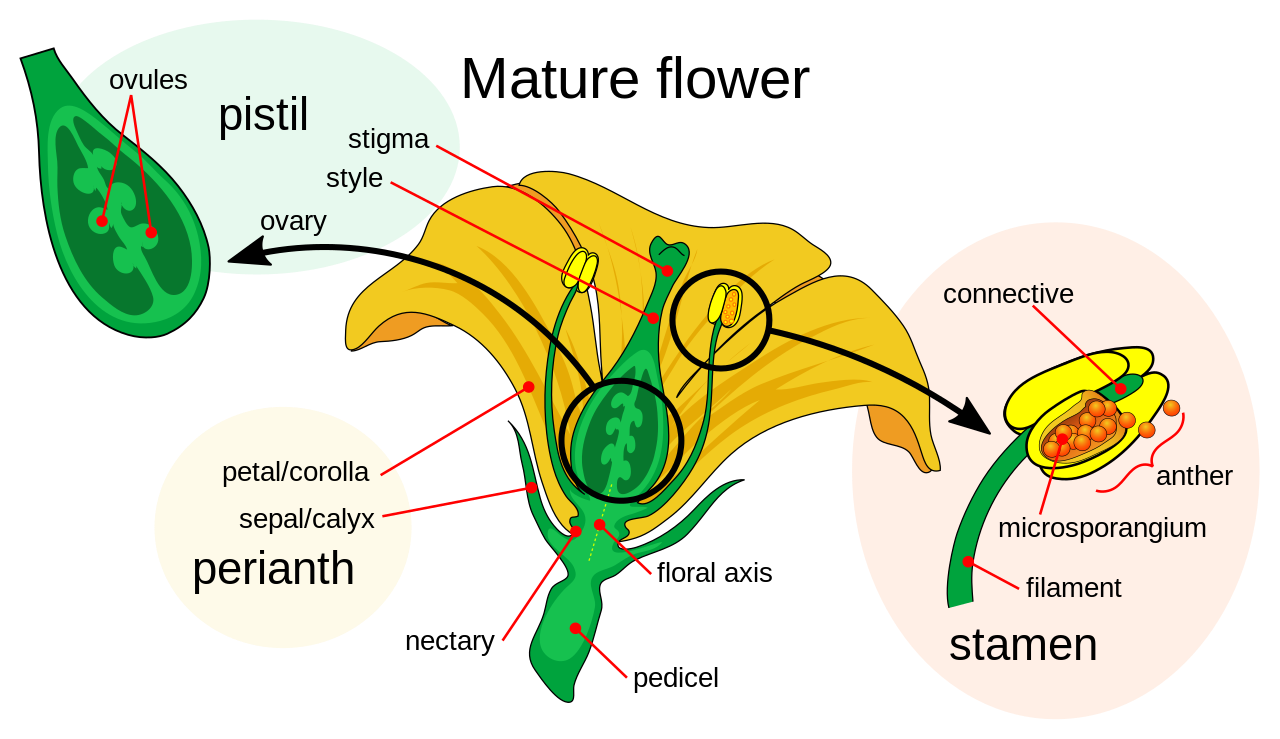
Mature Flower
7.1.1 Ovary Position and Floral Insertion #
The spatial elevation of perianth whorls relative to the ovary insertion plane dictates floral architecture:
- Hypogynous Flower (Superior Ovary): Perianth and stamens insert below the ovary on an elevated receptacle (e.g., Solanum, Brassica).
- Perigynous Flower (Semi-Inferior Ovary): Receptacle forms a cup-like or saucer-shaped hypanthium around the ovary; sepals, petals, and stamens insert on the hypanthium rim (e.g., Rosa, Prunus).
- Epigynous Flower (Inferior Ovary): Hypanthium is completely adnate to and fused with the ovary wall; sepals, petals, and stamens emerge above the ovary summit (e.g., Asteraceae, Cucurbitaceae).

Flower Anatomy (Psf)
7.2 The ABCDE Model of Floral Organ Identity #
In the early 1990s, homeotic floral mutants in Arabidopsis thaliana and Antirrhinum majus (snapdragon) unveiled the molecular logic governing floral organ specification. Organ identity is controlled by combinatorial activity of five classes of homeotic genes, virtually all encoding MADS-box transcription factors (conserved DNA-binding domain binding to CArG-box cis-elements):
       [THE COMBINATORIAL ABCDE FLORAL MODEL]

  Whorl 1: Sepals    ◄─── Class A + E
  Whorl 2: Petals    ◄─── Class A + B + E
  Whorl 3: Stamens   ◄─── Class B + C + E
  Whorl 4: Carpels   ◄─── Class C + E
  Ovules (within 4)  ◄─── Class D + E
7.2.1 Gene Classes and Mutual Antagonism #
1. Class A Genes: APETALA1 (AP1), APETALA2 (AP2).
2. Class B Genes: APETALA3 (AP3), PISTILLATA (PI).
3. Class C Genes: AGAMOUS (AG).
4. Class D Genes: SEEDSTICK (STK), SHATTERPROOF (SHP).
5. Class E Genes: SEPALLATA1, 2, 3, 4 (SEP1–4).
Fundamental Mutual Antagonism: Class A and Class C mutually repress each other:
- If Class A is mutated/inactivated, Class C expands into Whorls 1 and 2.
- If Class C is mutated/inactivated, Class A expands into Whorls 3 and 4.
| Floral Whorl | Target Organ | Active Gene Classes | Arabidopsis Gene Combinations | Protein Quaternary Complex (Floral Quartet) |
|---|---|---|---|---|
| Whorl 1 | Sepals | A + E | AP1 + AP2 + SEP | Tetramer of AP1-AP1-SEP-SEP |
| Whorl 2 | Petals | A + B + E | AP1 + AP2 + AP3 + PI + SEP | Tetramer of AP1-AP3-PI-SEP |
| Whorl 3 | Stamens | B + C + E | AP3 + PI + AG + SEP | Tetramer of AP3-PI-AG-SEP |
| Whorl 4 | Carpels | C + E | AG + SEP | Tetramer of AG-AG-SEP-SEP |
| Ovule | Ovule Identity | D + E | STK + SHP + SEP | Tetramer of STK-SHP-SEP-SEP |
7.2.2 Analysis of Classical Homeotic Mutants #
- *Loss of Class A (ap2 mutant): Class C expands to all whorls. Phenotype: Carpel – Stamen – Stamen – Carpel*.
- *Loss of Class B (ap3 or pi mutant): Class B activity missing. Phenotype: Sepal – Sepal – Carpel – Carpel*.
- *Loss of Class C (agamous mutant): Class A expands to all whorls; floral determinacy is lost (new flowers initiate inside). Phenotype: Sepal – Petal – Petal – Sepal – Petal – Petal…* (yielding double-flowered horticultural varieties).
- *Loss of Class E (sep1 sep2 sep3 sep4 quadruple mutant):* MADS tetramers cannot assemble. All four floral whorls convert into vegetative green leaves!
7.3 Inflorescence Architecture #
Inflorescences represent specialized branch systems dedicated to displaying flowers:
1. Racemose (Indeterminate): Main axis grows indefinitely; terminal bud never forms a flower. Oldest flowers are at the base; youngest flowers are at the apex (acropetal succession):
- Raceme: Unbranched axis with pedicellate flowers (Brassica).
- Spike: Unbranched axis with sessile flowers (Achyranthes).
- Spadix: Thick fleshy axis surrounded by a large petaloid spathe (Colocasia, Araceae).
- Capitulum (Head): Flattened receptacle bearing dense sessile disc and ray florets (Asteraceae).
2. Cymose (Determinate): Main axis terminates in a flower, arresting vertical growth. Successive lateral branches arise below, with oldest flowers at the center/apex (basipetal or centrifugal succession):
- Monochasial Cyme: Single lateral branch produced per node (Heliotropium scorpioid cyme).
- Dichasial Cyme: Paired lateral branches arise beneath terminal flower (Dianthus).
- Verticillaster: Condensed axillary cymes forming false whorls at nodes (Lamiaceae).
7.4 Floral Formulas and Diagrams #
A floral formula is a compact symbolic representation of floral symmetry, sexuality, and whorl merosity:
- ⊕ = Actinomorphic (radially symmetrical).
- † or % = Zygomorphic (bilaterally symmetrical).
- K = Calyx (sepals); K(5) = 5 fused (gamosepalous) sepals.
- C = Corolla (petals); C5 = 5 free (polypetalous) petals.
- P = Perianth / Tepals.
- A = Androecium (stamens); A9+1 = diadelphous stamens; C ⁀ A = epipetalous stamens.
- G = Gynoecium; G̲(3) = Superior ovary, 3 fused carpels (syncarpous); G̅ = Inferior ovary.
Example: Solanaceae Floral Formula
  ⊕ ⚥ K(5) [C(5) A5] G(2)
  Radially symmetrical, bisexual, 5 fused sepals, 5 fused petals,
  5 epipetalous stamens, superior bicarpellary syncarpous ovary.
7.5 Key Takeaways & Exam High-Yield Summary #
- MADS-box Quartet Model: MADS-box proteins function as homeotic tetramers (dimers of dimers) that bind two separate CArG boxes, looping the intervening genomic DNA to recruit chromatin remodelers.
- Agamous Mutant: Lacks Class C. Results in transformation of stamens into petals and carpels into sepals, with loss of floral shoot determinacy.
- Ray vs. Disc Florets in Asteraceae: Ray florets are zygomorphic and ligulate; disc florets are actinomorphic and tubular.
7.6 Review & Self-Assessment Questions #
1. Predict the floral organ phenotype of a double-mutant lacking both Class A and Class B gene functions.
- Answer: In the absence of A and B, only Class C and Class E remain active throughout all four whorls. Because C is active in every whorl, all four whorls develop as carpels (Carpel – Carpel – Carpel – Carpel).
2. What anatomical structure gives zygomorphic flowers their evolutionary success in animal pollination?
- Answer: Bilateral symmetry enforces precise spatial landing orientation on visiting insects, ensuring consistent mechanical contact between anthers/stigmas and specific anatomical locations on the pollinator’s body (e.g., dorsal nototribic pollen placement).
