
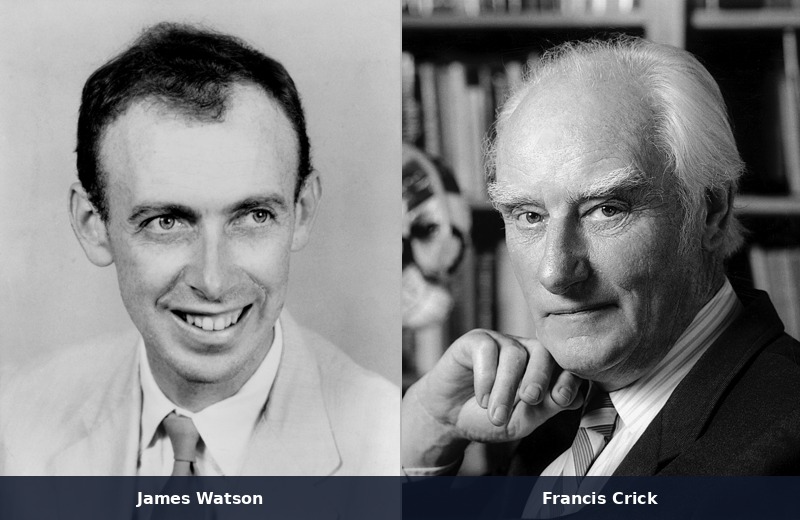
James Watson & Francis Crick
Elucidated the antiparallel double-helical structure of DNA and formulated the Central Dogma of Molecular Biology.
Nobel Prize Recognition
Nobel Prize in Physiology or Medicine (1962) for their discoveries concerning the molecular structure of nucleic acids and its significance for information transfer in living material
It has not escaped our notice that the specific pairing we have postulated immediately suggests a possible copying mechanism for the genetic material.
Curiosity & Historical Discovery Anecdote
The serendipity, obstacles, and fascinating human journey behind the discovery.
On February 28, 1953, Francis Crick walked into The Eagle pub in Cambridge at lunchtime and announced that he and Watson had 'discovered the secret of life'. Their legendary 1-page paper in Nature (April 25, 1953) contained only 128 lines of text, one simple diagram drawn by Crick's artist wife Odile, and the most understated closing sentence in the history of science.
High-Yield Exam Focus (CSIR-NET, GATE, USMLE)
Core mechanisms, experimental controls, and recurring competitive exam questions.
Base complementarity (Chargaff's rules: A=T with 2 hydrogen bonds, G=C with 3 hydrogen bonds); Antiparallel 5' to 3' orientation; Dimensions of B-DNA: 10.5 base pairs per helical turn, 3.4 nm pitch, 0.34 nm rise, 2.0 nm outer diameter.
Landmark Scientific Breakthroughs & Molecular Mechanisms
Step-by-step scientific explanations of the discoveries that defined modern biology.
Elucidation of the Antiparallel Double-Helical Structure of DNA
Experimental Logic & Mechanism:
Synthesizing Erwin Chargaff's base ratios (A=T, G=C) with Rosalind Franklin's Photo 51 X-ray coordinates, Watson and Crick constructed a physical scale model showing two polynucleotide chains winding in opposite directions (antiparallel) around a central axis, with purines pairing strictly with pyrimidines through hydrogen bonding.
The Central Dogma of Molecular Biology and The Adaptor Hypothesis (Crick)
Experimental Logic & Mechanism:
Francis Crick formulated the Central Dogma, asserting that sequence information moves unidirectionally from DNA to RNA to Protein. He predicted the existence of small 'adaptor' molecules (transfer RNA) that decipher trinucleotide codons.
Biographical Journey & Intellectual Legacy
Chronological chronicle of early education, mentorship, research trials, and achievements.
James Dewey Watson was born in Chicago, Illinois. A precocious student, he entered the University of Chicago at 15, completing his Ph.D. in zoology at Indiana University under Salvador Luria on bacteriophage genetics.
Francis Harry Compton Crick was born near Northampton, England. He studied physics at University College London, working on magnetic naval mines during WWII before transitioning to biology under the influence of Erwin Schrödinger's book 'What is Life?'.
In the autumn of 1951, the 23-year-old Watson arrived at the Cavendish Laboratory in Cambridge, where 35-year-old Crick was working on protein crystallography. The two forged an intense partnership, driven by the conviction that DNA, not protein, held the genetic secret.
Using Franklin's X-ray parameters and Chargaff's rules, they discovered complementary base pairing on February 28, 1953, and published their model in Nature on April 25, 1953.
In 1962, Watson, Crick, and Maurice Wilkins shared the Nobel Prize in Physiology or Medicine. Watson subsequently served as director of Cold Spring Harbor Laboratory and head of the Human Genome Project. Crick joined the Salk Institute in California, pioneering theoretical neuroscience until his death in 2004.
Landmark Publications & Primary Literature
Original monographs and communications that announced the breakthroughs to the world.
Watson, J. D., & Crick, F. H. (1953). Molecular structure of nucleic acids: a structure for deoxyribose nucleic acid. Nature, 171(4356), 737-738.
Significance: The paper announcing the double-helical structure of DNA.
Crick, F. H. (1958). On protein synthesis. Symposia of the Society for Experimental Biology, 12, 138-163.
Significance: Formulation of the Sequence Hypothesis and the Central Dogma.
Explore Related Lecture Notes on B10logy
Direct access to comprehensive textbook notes where these discoveries are analyzed in depth.