
1.1 The internal environment #
1.1.1 Bernard and Cannon #
Claude Bernard’s point, set out in his lectures on the phenomena of life (1878), was that a multicellular animal’s cells do not live in the outside world. They live in extracellular fluid, the milieu intérieur, whose composition the animal maintains. The phrase covers the variables later chapters measure: osmolarity, the major ions, pH, glucose, blood gases, temperature in birds and mammals, and the pressure that keeps the fluid moving. Cells tolerate only a narrow band of those variables. Organs exist largely to keep the band.
Walter Cannon, in a 1929 review and in The Wisdom of the Body (1932), named the coordinated defence homeostasis. He stressed that the defence is active, built from opposing effectors, and aimed at a condition that can vary a little rather than at a mathematical point. Core temperature, glucose, and arterial pressure all move. What is defended is the range in which cells still work. A resting value — arterial PO2 near 100 mmHg, plasma sodium near 140 mmol/L, core temperature near 37°C — describes that range in a resting adult. It is not a promise that the value never changes. Cell Biology explains how a membrane separates intracellular from extracellular fluid. These notes explain how the whole animal keeps the extracellular fluid inside the limits the cells require.
1.2 Negative feedback #
The study of Negative feedback provides fundamental principles governing cellular architecture, molecular interactions, and physiological regulation.
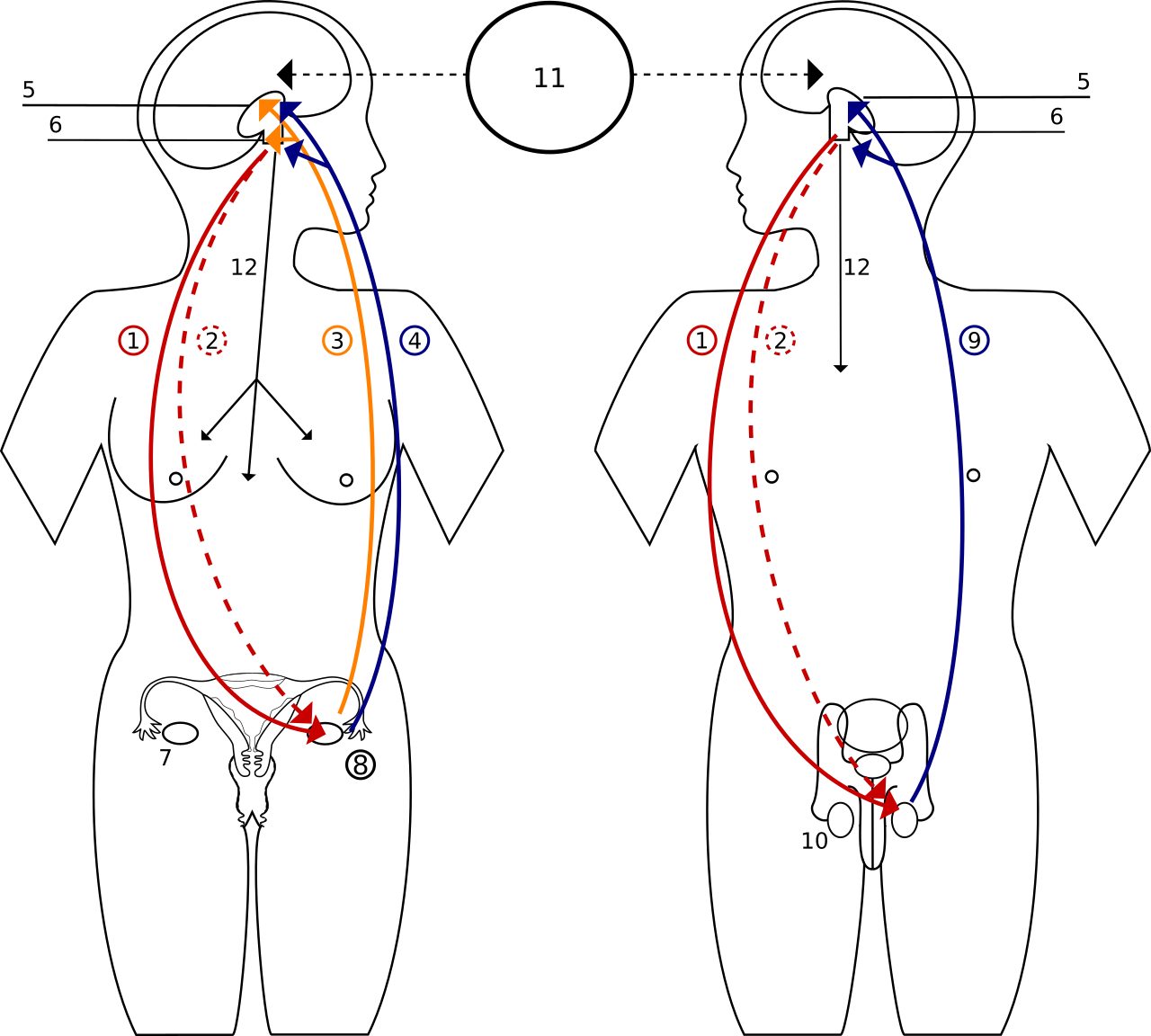
Hormons Feedback – Sprzężenie Zwrotne Hormonow
1.2.1 Sensor, integrator, and effector #
A negative-feedback loop measures a variable, compares it with the value currently being defended, and drives an effector that pushes the variable the other way. The sensor reports the variable, as nerve impulses or as a hormone secretion. The integrator compares that report with the defended value. The effector is the muscle, gland, or organ that changes the variable. A rise must produce a response that lowers it. That sign reversal is what “negative” means. One structure can play more than one role: the pancreatic beta cell is both sensor and effector for glucose.
Gain is the size of the correction per unit of error. Delay is the time from error to effect. The baroreceptor reflex corrects beat by beat. Aldosterone corrects sodium balance over hours and does not oscillate at heart-rate frequencies, because its effector is slow. Most variables have both a fast loop, which buffers the moment, and a slow loop, which changes how much sodium, water, or red-cell mass the body contains so that the fast loop is not left fighting a permanent error.
1.2.2 Blood glucose #
In a healthy adult who has not just eaten, arterial plasma glucose sits at about 4–5.5 mmol/L. After an ordinary meal it rises and is brought back over a couple of hours. The rapid loop does not run through a brain centre. Glucose enters the beta cell through GLUT2, metabolism raises ATP, ATP-sensitive potassium channels close, the cell depolarises, calcium enters, and insulin is secreted. The alpha cell secretes glucagon as glucose falls. Insulin and glucagon then act on liver, muscle, and fat. The pathways inside those cells belong to Biochemistry. The sign of the loop is the physiology: a rise in glucose raises insulin and lowers glucagon, and both changes push glucose down.
The brain controls appetite and autonomic input to the islets, which biases the loop. It is not required for the beta cell to answer the glucose that reaches it. Glucose is defended tightly because neurons take it up without insulin and store little glycogen. A large fall stops higher brain function before it stops the heart. The loop therefore spends insulin after a meal and recruits glucagon, adrenaline, and, if the fast continues, cortisol and growth hormone, rather than letting glucose drift.
1.2.3 Body temperature #
Core temperature in a resting human is about 37°C, lower in the early morning and higher in the evening by about half a degree. The shell — skin and much of the limbs — is cooler and is allowed to vary more. Warm-sensitive neurons in the preoptic hypothalamus report core temperature. Skin thermoreceptors report the outside world before the core has changed. The integrator is hypothalamic. Effectors are cutaneous blood flow, sweat glands, shivering, behaviour such as adding clothing, and, in human infants and many small mammals, brown adipose tissue. Brown fat makes heat without shivering by uncoupling oxidative phosphorylation; the proton leak is Biochemistry, and the physiological point is that a newborn, with a large surface relative to its mass, has a tissue dedicated to heat.
The loop is negative. A rise brings sweating and cutaneous vasodilatation and switches shivering off. A fall does the reverse. Skin temperature is partly feed-forward: stepping into a cold room vasoconstricts the skin before core temperature has fallen. Fever is not a failure of the loop. Endogenous pyrogens raise the defended value through prostaglandin E2 in the preoptic area. The person vasoconstricts and shivers until the core reaches the new value, and sweats when the defended value falls again. The effectors did not reverse their logic. The reference moved.
1.2.4 Arterial pressure #
Mean arterial pressure in a resting young adult is about 90–100 mmHg, often from a systolic pressure near 120 mmHg and a diastolic pressure near 80. Stretch receptors in the carotid sinus and the aortic arch are the sensors of the rapid loop. The medulla, around the nucleus of the solitary tract, is the integrator, with outputs through the vagus and the sympathetic chain. Effectors are heart rate, contractility, arteriolar resistance, and venous tone. A rise in pressure increases baroreceptor firing; the medulla slows the heart and relaxes vessels. Chapter 4 builds the reflex.
The rapid loop defends the pressure the receptors have recently been experiencing. If average pressure stays high for a day or more, firing resets, and the reflex defends the new average. The long-term level is set by how much extracellular fluid the kidney keeps, because over hours cardiac output depends on blood volume. That renal limb — pressure natriuresis, renin, aldosterone, ADH — is Chapter 8. “Blood pressure is regulated” names at least two loops of different speeds, and the fast loop’s reference is not lifelong.
| Variable | Sensor | Integrator | If the variable rises |
|---|---|---|---|
| Plasma glucose | Islet alpha and beta cells | The islet, for the rapid loop | Insulin up, glucagon down; hepatic glucose output falls |
| Core temperature | Preoptic neurons; skin thermoreceptors | Hypothalamus | Sweating and cutaneous vasodilatation; shivering off |
| Arterial pressure, seconds | Carotid sinus and aortic baroreceptors | Medulla | Vagal slowing; less sympathetic vasoconstriction |
| Arterial pressure, hours to days | Renal perfusion and the macula densa | Renin–angiotensin–aldosterone axis, and ADH | Natriuresis, so volume and pressure fall |
1.3 Other modes of control #
1.3.1 Positive feedback, and why it must stop #
Positive feedback amplifies a deviation. Used to hold glucose or temperature it would drive them to a ceiling, so it is not the design of homeostasis. It is the design of a committed transition that must run to completion and then stop. The stop is part of the mechanism.
Two examples fix the idea. In parturition, cervical stretch releases oxytocin, oxytocin strengthens contraction, and contraction increases stretch. Delivery removes the stretch and the loop opens. Chapter 10 gives the endocrine setting. In the Hodgkin cycle, depolarisation opens voltage-gated sodium channels, sodium entry depolarises further, and more channels open. The explosion lasts a fraction of a millisecond because those channels inactivate and potassium channels open. Neurobiology owns the kinetics. The contrast is the kind of stop: inactivation built into the channel, versus removal of the stimulus. Coagulation (Chapter 6) and the LH surge (Chapter 10) are the same pattern. Thrombin makes more thrombin only on a local surface and against anticoagulant mechanisms. The LH surge removes, by ovulation, the follicle that was the source of the oestradiol. Name both the amplifier and the stop.
1.3.2 Feed-forward control #
Feedback corrects an error after it exists. Feed-forward acts on a prediction, and it can be wrong. Pavlov’s cephalic phase is the classical case: the sight, smell, or expectation of food drives the vagus and starts salivary, gastric, and pancreatic secretion before food arrives. If no food comes, acid and intestinal hormones turn the secretions off. Skin cooling before a change in core temperature, and the rise in heart rate and ventilation at the start of exercise, are the same arrangement. Feed-forward reduces the error that feedback must clean up. It does not replace feedback.
1.3.3 Set point and regulated range #
“Set point” is a useful name for the value the system is currently defending. It is misleading if it suggests a neuron with a fixed number written on it, or a value that cannot move. Many variables are held in a band by opposing effectors with different thresholds. Between the onset of sweating and the onset of shivering there is a narrow zone in which a resting person uses neither. The band itself moves: a circadian rhythm shifts temperature, fever shifts it, and sustained hypertension resets the baroreceptors. Gain can change without the reference changing. Acclimatisation to altitude increases the ventilation produced by a given low PO2, partly because the brake of a low PCO2 has been removed, not because the sensors have been assigned a new normal PO2.
1.3.4 Acclimatisation is not adaptation #
Acclimatisation is a reversible change in one individual over days or months. Acclimation is the laboratory version, one imposed variable. Adaptation, for a population, is a heritable trait shaped across generations. That word belongs to Evolutionary Biology.
Heat acclimatisation over one to two weeks brings earlier sweating, a larger and more dilute sweat, a lower heart rate at the same work, and an expanded plasma volume. Altitude acclimatisation is a sequence. Within minutes, low PO2 drives ventilation through the peripheral chemoreceptors; the fall in PCO2 restrains it. Over a day or two the kidney excretes bicarbonate, pH moves back toward normal, and ventilation can rise further. Red-cell 2,3-bisphosphoglycerate rises over days and shifts the oxygen curve. Erythropoietin raises red-cell mass over days to weeks. Return to sea level reverses this. A person from a highland population may also carry genetic differences in the same pathways. Tibetan highlanders, for example, show heritable changes around the hypoxia-inducible pathway, including EPAS1, and do not rely only on the large rise in haemoglobin that a newly arrived lowlander produces. One phenomenon develops in a lifetime and reverses. The other is inherited. How selection produced it is not answered here.
1.4 Key terms, summary, and self-check #
Key terms. Milieu intérieur; homeostasis; negative feedback; gain; sensor; integrator; effector; positive feedback; feed-forward; set point; regulated range; acclimatisation; acclimation; adaptation.
Summary. Bernard’s internal environment is the extracellular fluid cells live in, and Cannon’s homeostasis is its active defence by opposing effectors. Negative feedback measures a variable and pushes it back; glucose, core temperature, and arterial pressure are the three loops used throughout, the last with a fast neural limb and a slow renal limb. Positive feedback is reserved for transitions that run to completion and then stop. Feed-forward predicts, and feedback corrects the prediction. The defended value is a movable range. A change an individual acquires in a new climate is acclimatisation; adaptation, as an evolutionary term, is a different subject.
Self-check.
1. What fluid is Bernard’s milieu intérieur, and what did Cannon add by calling its defence homeostasis?
2. Why is it misleading to demand a separate brain integrator for the rapid control of blood glucose?
3. Name the amplifier and the stop for both the oxytocin loop in labour and the Hodgkin cycle.
4. When a person steps into a cold room, which part of the response is feed-forward, and which is negative feedback?
5. A lowlander ventilates more after three weeks at altitude. A highland population carries a heritable change in the hypoxia pathway. Which is acclimatisation?
—
—
—