
11.1 Reading a pedigree #
The study of Reading a pedigree provides fundamental principles governing cellular architecture, molecular interactions, and physiological regulation.
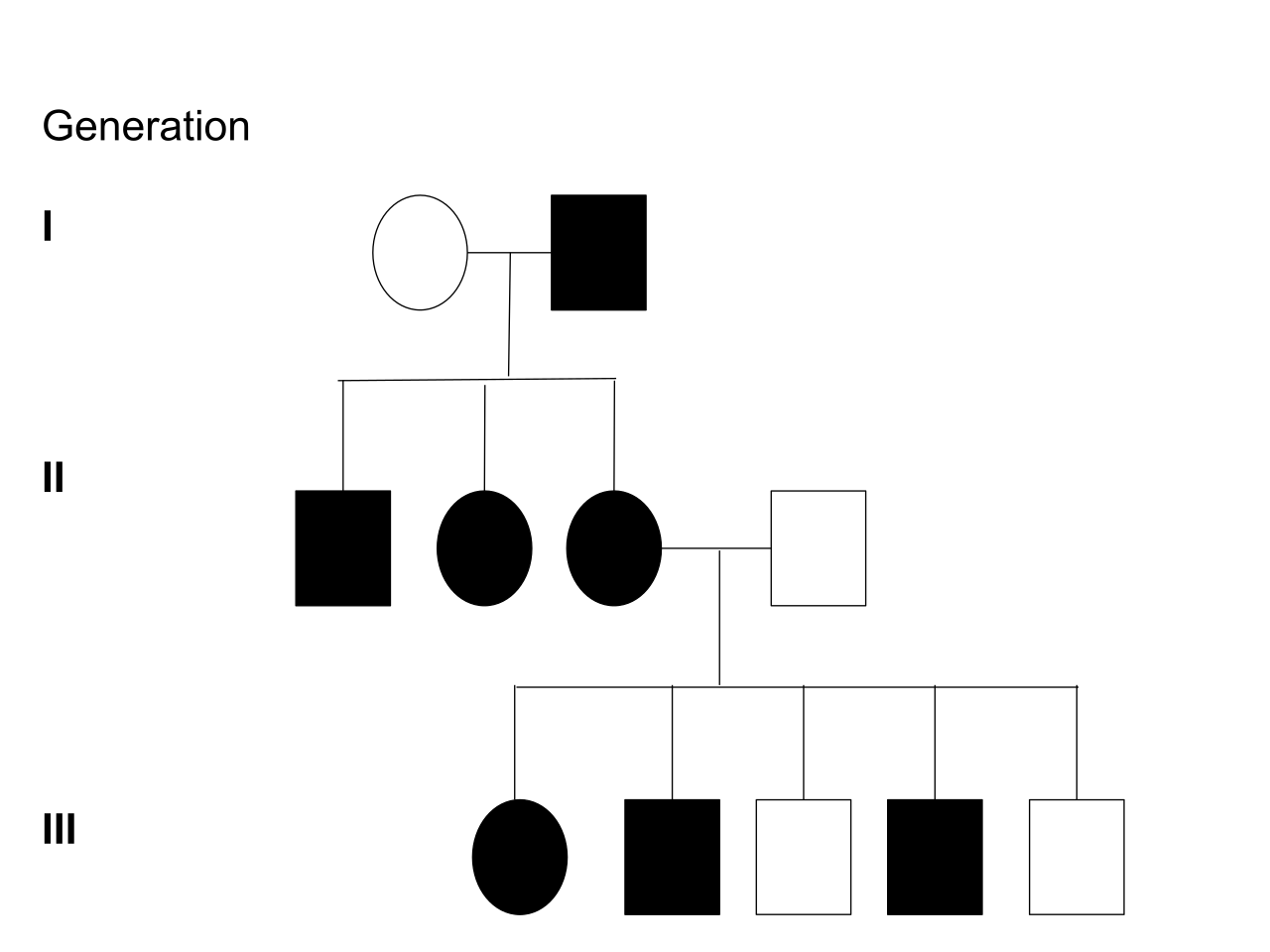
Autosomal Dominant Pedigree
11.1.1 Symbols #
Squares are male, circles female, diamonds unspecified. Filled is affected, open unaffected, a central dot a known carrier, a slash deceased, a double partnership line consanguinity, and an arrow the proband. Roman numerals mark generations and Arabic numerals people within them, left to right. A bar between bracketed twins marks monozygotic twins; dizygotic twins lack the bar.
Families collected because they contain many affected children over-represent those children. The drawing is not an unbiased experiment until ascertainment is allowed for.
11.1.2 Four patterns, and the ambiguities #
Autosomal dominant, rare and fully penetrant: every generation, both sexes, and male-to-male transmission, which X-linkage cannot do. A child of a heterozygote has chance 1/2. Skips mean incomplete penetrance, isolation may be a new mutant, and late onset makes the young uninformative. One genuine father-to-son case excludes the X; its absence in a short pedigree does not prove the X.
Autosomal recessive: affected siblings, carrier parents, risk 1/4, suspicion raised by consanguinity. A single affected child looks sporadic. Pseudodominance is an affected homozygote mating a carrier, so about half the children are affected and the pedigree looks dominant. That happens when the allele is common in the population. X-linked recessive: more males, no father-to-son transmission, daughters of affected males at least carriers, half the sons of a carrier affected. A manifesting heterozygote, a new mutant, or a sex-limited autosomal trait can imitate or spoil the pattern.
Mitochondrial transmission reaches children of affected mothers and not children of affected fathers, with heteroplasmy explaining unaffected children and unequal severity. One generation of a maternal-effect gene looks similar; the grandchildren do not. X-linked dominant, when present, sends an affected father’s trait to every daughter and no son.
11.1.3 Why there is no human test cross #
A test cross needs an assigned homozygous recessive mate and a large progeny. Mates are not assigned, families are small, generations are long, and arranging the mating would not be an acceptable experiment.

Human Karyotype With Bands And Sub-Bands (Simple)
Phenocopies are not bred away. The pedigree’s constraints replace the cross: father-to-son transmission, sex ratio, consanguinity, unaffected transmitters. Population frequencies supply the prior for anyone the pedigree has not already classified. A molecular genotype, methods owned by Molecular Biology and by Biotechnology and Genetic Engineering, still needs a mode before it is a risk to relatives.
11.2 Twins #
11.2.1 What twin studies can show, and where they stop #
Monozygotic twins share essentially the whole genotype; dizygotic twins share half their segregating alleles, like ordinary siblings. Higher concordance in monozygotic pairs suggests a genetic contribution only if the two kinds of twins also share environments equally.
They often do not: monozygotic twins are treated more alike, and many share a placenta. Twins reared apart reduce shared postnatal environment and add biases of their own. A twin heritability is the h² of Chapter 10: one population, no located gene, and no verdict on a new environment. Discordant monozygotic twins show that genotype does not fix the phenotype. The comparison is useful inside those limits and is not a universal percent-genetic.
11.3 Risk as conditional probability #
11.3.1 A worked Mendelian calculation #
The number below is a probability under stated assumptions. It is not a recommendation, and these notes advise no action.
The trait is a fully penetrant autosomal recessive, unnamed. The consultand is unaffected. Both parents are heterozygous because they had an affected child. Among children of two carriers, conditioning on being unaffected leaves a carrier prior of (1/2)/(3/4) = 2/3, and 1/3 for not being a carrier. Her partner is a known heterozygote. They have two unaffected children. If she is a carrier, the chance of that is (3/4)² = 9/16; if she is not, it is 1.
| Hypothesis | Prior | Likelihood | Joint | Posterior |
|---|---|---|---|---|
| Carrier | 2/3 | 9/16 | 18/48 | 9/17 |
| Not a carrier | 1/3 | 1 | 16/48 | 8/17 |
The next child is affected with probability (9/17) × (1/4) = 9/68. Before any children the risk was (2/3) × (1/4) = 1/6. An affected child would set the posterior to 1 and the later risk to 1/4, under complete penetrance and a heterozygous partner. The result assumes the mode, the parentage, no phenocopy, and independent children. A population frequency 2q is used only for someone the pedigree has not classified, and only the frequency in that person’s population.
The same update applies on the X. For a genetically lethal X-linked recessive at equilibrium, and with equal mutation rates in eggs and sperm, Haldane’s result sets the carrier probability of the mother of an isolated affected male at 2/3. A higher mutation rate in sperm changes that prior.
11.4 Key terms, summary, and self-check #
Key terms. Proband; autosomal dominant; autosomal recessive; pseudodominance; X-linked recessive; mitochondrial pedigree; concordance; equal-environment assumption; conditional probability.
Summary. Symbols record sex, status, consanguinity, and the proband. Father-to-son transmission excludes X-linkage; carrier parents and a 1/4 risk mark a recessive, unless pseudodominance imitates dominance; mitochondrial transmission ignores affected fathers and is blurred by heteroplasmy. Humans are not test-crossed. Twin concordance is genetic evidence only under equal environments. A 2/3 carrier prior updated by two unaffected children becomes 9/17, and the next-child risk 9/68, a probability and not advice.
Self-check.
1. Which single birth excludes X-linkage, and why?
2. What mating makes a recessive phenotype look dominant?
3. Why is a monozygotic–dizygotic concordance gap not a portable h²?
4. Why is the consultand’s prior 2/3 rather than 1/2?
5. What observation would move the later risk from 9/68 to 1/4?
—
—
—