
9.1 Core Principles of Biotechnology: Genetic Engineering (Gene Cloning) & Bioprocess Chemical Engineering (Sterile Industrial Culturing) #
Biotechnology deals with techniques of using live organisms or enzymes from organisms to produce products and processes useful to humans. In this sense, making curd, bread, or wine—which are all microbe-mediated processes—could be thought of as a form of biotechnology. However, modern biotechnology refers specifically to processes using genetically modified organisms.
The European Federation of Biotechnology (EFB) formulated a comprehensive definition that encompasses both traditional and modern molecular biotechnology: “The integration of natural science and organisms, cells, parts thereof, and molecular analogues for products and services.”
Modern biotechnology is founded on two core technological pillars:
- Genetic Engineering: Techniques to alter the chemistry of genetic material (DNA and RNA), introduce it into host organisms, and thus change the phenotype of the host organism. It encompasses the creation of Recombinant DNA (rDNA), gene cloning, and gene transfer. In 1972, Stanley Cohen and Herbert Boyer created the first recombinant DNA molecule by cutting a piece of antibiotic-resistance gene from a plasmid and linking it with a plasmid vector of Salmonella typhimurium!
- Bioprocess Engineering: Maintenance of sterile (microbial contamination-free) ambient conditions in chemical engineering processes to enable the growth of only the desired microbe/eukaryotic cell in large quantities for the manufacture of biotechnological products like antibiotics, vaccines, enzymes, and hormones.
9.2 Tools of Recombinant DNA Technology: Restriction Endonucleases (Type II Palindromic Recognition e.g. EcoRI -> 5′-GAATTC-3′ & Sticky Ends) #
The realization of recombinant DNA technology depends on specialized molecular tools, the foremost of which are Restriction Endonucleases (‘Molecular Scissors’):
In 1963, two enzymes responsible for restricting the growth of bacteriophage in E. coli were isolated: one added methyl groups to bacterial DNA, while the other cut viral DNA (restriction endonuclease). The first isolated restriction endonuclease was Hind II (by Smith, Wilcox, and Kelley in 1968), which recognized and cut DNA at a specific six base-pair sequence.
- Today, more than 900 restriction enzymes have been isolated from over 230 strains of bacteria, each recognizing different DNA sequences.
- Nomenclature: The first letter comes from the genus (e.g., E for Escherichia), the next two letters from the species (co for coli), the fourth letter from the strain (R for RY13), and the Roman numeral indicates the order of discovery (e.g., EcoRI).
- Palindromic Recognition Sequences: Restriction endonucleases inspect the DNA length and bind to specific Palindromic Nucleotide Sequences—sequences where the base reading is identical on both strands when read in the same direction (5′ → 3′ or 3′ → 5′). For example, EcoRI recognizes:5′ —— G ↓ A A T T C —— 3′
3′ —— C T T A A ↑ G —— 5′ - Sticky Ends: Restriction enzymes cut the two strands of DNA at specific points slightly away from the center of the palindrome sites, between the same two bases on opposite strands. This leaves single-stranded overhanging stretches at the ends called sticky ends. These sticky ends form hydrogen bonds with their complementary cut counterparts, facilitating the action of DNA ligase.
9.3 DNA Ligases, Alkaline Phosphatase & DNA Polymerases #
Complementary molecular enzymes supporting recombinant DNA technology include:
- DNA Ligase (‘Molecular Glue’): Catalyzes the formation of phosphodiester bonds between the 3′-OH and 5′-phosphate ends of adjacent DNA fragments with compatible sticky ends, joining foreign DNA into vector plasmids.
- DNA Polymerases: Enzymes such as Taq DNA polymerase that synthesize complementary DNA strands on existing DNA templates during amplification.
- Alkaline Phosphatase: Removes terminal 5′-phosphate groups from linearized vector plasmids, preventing self-ligation (re-circularization) in the absence of foreign insert DNA.
9.4 Cloning Vectors: Characteristics (Origin of Replication ‘ori’, Selectable Markers, Unique Cloning Sites) #
A Cloning Vector is a DNA molecule capable of carrying a foreign DNA sequence into a host cell where it can replicate independently. Plasmids (extra-chromosomal circular autonomous DNA in bacteria) and bacteriophages are standard cloning vectors. An ideal cloning vector must possess four essential features:
- Origin of Replication (ori): A specific DNA sequence from where replication starts. When a foreign piece of DNA is linked to this sequence, it can replicate within the host cell. The ori sequence also controls the copy number of the linked DNA (allowing high copy number propagation, e.g., 15–100 copies per cell).
- Selectable Marker: Helps in identifying and eliminating non-transformants and selectively permitting the growth of transformants. Antibiotic resistance genes—such as resistance against ampicillin, tetracycline, chloramphenicol, or kanamycin—serve as useful selectable markers in E. coli (normal E. coli cells carry no resistance to these antibiotics!).
- Cloning (Recognition) Sites: To link alien DNA, the vector requires recognition sites for commonly used restriction enzymes. Preferably, the vector should possess only a single unique recognition site for a given restriction enzyme; the presence of more than one recognition site within the vector would generate several fragments, complicating gene cloning!
- Small Size: Facilitates easy entry and manipulation in host cells.
9.5 The Benchmark Plasmid Vector pBR322: ampR and tetR Genes, Insertional Inactivation (Beta-Galactosidase Blue-White Screening) #
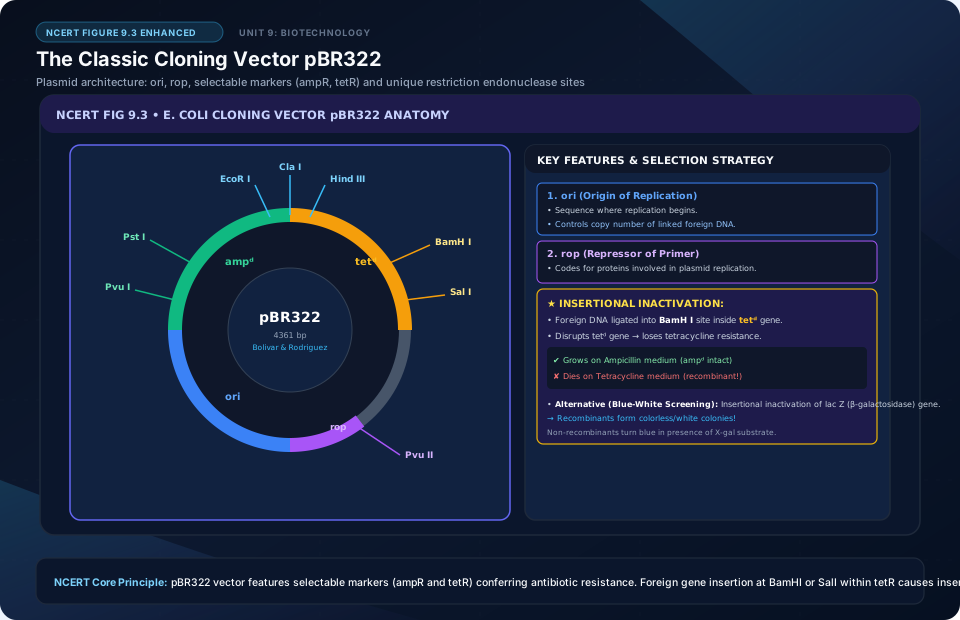
The Benchmark Plasmid Vector pBR322: Constructed by Bolivar and Rodriguez (1977), pBR322 is a widely used cloning vector in E. coli. It contains:
- An ori sequence and a rop gene (codes for proteins involved in the replication of the plasmid).
- Two antibiotic resistance selectable marker genes: ampR (ampicillin resistance) and tetR (tetracycline resistance).
- Unique restriction recognition sites: PstI and PvuI are located within the ampR gene; BamHI and SalI are located within the tetR gene; EcoRI, ClaI, and HindIII are located elsewhere.
Insertional Inactivation (Selection of Recombinants): If foreign DNA is ligated at the BamHI site of the tetR gene in pBR322, the recombinant plasmid loses tetracycline resistance due to insertion of foreign DNA—a phenomenon termed insertional inactivation. It can still grow on ampicillin medium, but cannot grow on tetracycline medium! Non-recombinants will grow on both ampicillin and tetracycline media. This replica plating technique is labor-intensive because it requires plating on two different antibiotic plates.
Blue-White Screening (Chromogenic Selection): To overcome dual-plating, modern vectors contain a selectable marker that differentiates recombinants from non-recombinants on the basis of their ability to produce color in the presence of a chromogenic substrate (X-gal). Here, recombinant DNA is inserted into the coding sequence of the enzyme β-galactosidase:
- If no foreign gene is inserted, active β-galactosidase is produced, breaking down X-gal to produce blue-colored colonies (Non-recombinant colonies).
- Insertion of foreign DNA inactivates the β-galactosidase gene (insertional inactivation); colonies do not produce color and appear as white colonies (Recombinant colonies)!
9.6 Vectors for Plants (Agrobacterium tumefaciens Ti Plasmid) & Animals (Disarmed Retroviruses) #
Nature has evolved natural genetic engineers that transfer genes into plant and animal cells:
- Agrobacterium tumefaciens (The Natural Plant Genetic Engineer): A soil pathogen of several dicotyledonous plants that delivers a piece of DNA called T-DNA (Transfer DNA) from its Ti-plasmid (Tumor-inducing plasmid) into plant cells, transforming normal plant cells into crown gall tumors that produce opines feeding the bacterium.
Geneticists have disarmed the Ti-plasmid by removing tumor-inducing genes while retaining the T-DNA transfer mechanism. The modified disarmed Ti-plasmid is now widely used as a vector to deliver desirable genes into plants.
- Retroviruses in Animals: Retroviruses in animals have the natural ability to transform normal cells into cancerous cells. By disarming retroviruses (removing oncogenes and inserting genes of interest), disarmed retroviruses are used as vectors to deliver beneficial therapeutic genes into animal cells.
9.7 Competent Host Cell Transformation: Divalent Cations (CaCl2), Heat Shock (42°C), Micro-Injection & Gene Gun (Biolistics with Gold/Tungsten) #
Since DNA is a hydrophilic molecule, it cannot pass through cell membranes. For bacterial cells to take up foreign plasmid DNA, the host cells must first be made competent to take up DNA:
- Chemical & Heat Shock Method (Bacteria): Bacterial cells (E. coli) are treated with a specific concentration of a divalent cation such as Calcium (Ca2+), which increases the permeability of the bacterial cell wall by creating transient pores. Recombinant DNA is incubated with competent cells on ice, followed by a brief heat shock at 42°C, and rapidly returned to ice. This forces the bacteria to take up the recombinant plasmid.
- Direct / Vectorless Gene Transfer Methods:
- Micro-Injection: Recombinant DNA is directly injected into the nucleus of an animal cell or zygote using a micro-needle under an inverted microscope.
- Biolistics / Gene Gun Method: Suitable for plant cells. Plant cells are bombarded with high-velocity micro-particles of gold or tungsten coated with recombinant DNA.
- Electroporation: Applying brief high-voltage electrical pulses creates transient pores in cell membranes through which foreign DNA enters.
9.8 Stepwise Processes of rDNA Technology: DNA Isolation, Agarose Gel Electrophoresis (Ethidium Bromide Staining & UV Transillumination), Polymerase Chain Reaction (PCR: Denaturation 94°C, Annealing 54°C, Extension 72°C using Taq Polymerase from Thermus aquaticus) #
Recombinant DNA technology involves several precise stepwise processes:
- Isolation of Genetic Material (DNA): Cells are lysed with specific enzymes: lysozyme for bacteria, cellulase for plant cells, and chitinase for fungi. RNA is removed by ribonuclease; proteins are removed by protease. Purified DNA is precipitated out by adding chilled ethanol, visualized as fine threads that are collected by spooling.
- Cutting of DNA & Agarose Gel Electrophoresis: DNA is cut with restriction enzymes. Because DNA fragments are negatively charged (due to phosphate groups), they can be separated by forcing them to move toward the positive electrode (anode) under an electric field through an agarose gel matrix. Smaller DNA fragments move faster and travel farther than larger ones (molecular sieving). The separated DNA bands are stained with Ethidium Bromide (EtBr) and exposed to UV light, appearing as bright orange-colored bands. The separated band of interest is cut out from the gel and extracted; this process is called Elution.
- Polymerase Chain Reaction (PCR): Developed by Kary Mullis (1983), PCR amplifies a single gene of interest into billions of copies (approx. 1 billion times) in vitro in three automated thermal cycles:
- Denaturation (94°C–96°C): High temperature melts and unwinds the double-stranded target DNA into single strands.
- Annealing (50°C–56°C): Two sets of synthetic oligonucleotide primers bind (anneal) to the complementary regions at the 3′-ends of the separated DNA strands.
- Extension (72°C): The thermostable enzyme Taq DNA Polymerase (isolated from the thermophilic bacterium Thermus aquaticus, active at 72°C and resistant to high heat denaturation) adds deoxynucleotides (dNTPs) to extend the primers in the 5’→3′ direction.
9.9 Bioreactors: Continuous Culture, Stirred-Tank vs Sparged Bioreactors & Downstream Processing (Separation, Purification & Quality Control) #
When the cloned gene of interest is expressed in a heterologous host, it produces a recombinant protein. To produce these recombinant proteins in commercially viable, massive quantities, cultures must be scaled up in specialized vessels called Bioreactors:
- Bioreactors: Large vessels (volumes of 100 to 1000 Liters) in which raw biological materials are converted into specific products, individual enzymes, or biomass by microbes, plant, or animal cells under optimal physical conditions (optimum temperature, pH, substrate, vitamins, oxygen, and salts).
- Types of Bioreactors:
- Simple Stirred-Tank Bioreactor: Usually cylindrical with a curved base to facilitate mixing of contents. The motorized stirrer provides even mixing and oxygen availability throughout the bioreactor. Equipped with an agitator system, oxygen delivery system, foam control system, temperature and pH control systems, and sampling ports to withdraw small volumes of culture periodically.
- Sparged Stirred-Tank Bioreactor: Sterile air bubbles are sparged (bubbled) through the reactor, dramatically increasing the surface area for oxygen transfer.
- Downstream Processing: After completion of the biosynthetic fermentation phase, the product must be separated and purified before it is ready for marketing. These processes are collectively called downstream processing:
- Separation of cellular biomass from liquid broth (filtration, centrifugation).
- Purification of the bioactive product (chromatography, solvent extraction).
- Formulation with suitable preservatives.
- Rigorous clinical trials (in case of drugs) and strict quality control testing for each batch.
The Classic Cloning Vector pBR322
🚨 Examiner Traps & Common Misconceptions
✅ Reality: DNA is negatively charged due to phosphate groups, so it migrates toward the POSITIVE ANODE! Smaller DNA fragments travel further than larger ones.
✅ Reality: Taq polymerase is extracted from the thermophilic bacterium Thermus aquaticus; it remains fully stable and active even at 95°C!
💡 Memory Hack & Mnemonic
PCR Thermal Cycling Steps: ‘DAE: Denature, Anneal, Extend’ (94°C -> 54°C -> 72°C).
⭐ 10/10 Active Recall Self-Check: Chapter 9
Test your mastery before closing this lecture note. Can you answer these without looking back?
- What are the core experimental proofs or physiological steps that define Biotechnology: Principles and Processes in the NCERT syllabus?
- How does the molecular mechanism or ecological interaction covered here operate under changing conditions?
- What are the high-frequency examiner traps or tricky numerical ratios associated with this chapter?
- Can you formulate the primary mnemonic or memory framework for remembering the key components above?
⭐ 10/10 Active Recall Self-Check: Chapter 9
Test your mastery before closing this lecture note. Can you answer these without looking back?
- What are the core experimental proofs or physiological steps that define Biotechnology: Principles and Processes in the NCERT syllabus?
- How does the molecular mechanism or ecological interaction covered here operate under changing conditions?
- What are the high-frequency examiner traps or tricky numerical ratios associated with this chapter?
- Can you formulate the primary mnemonic or memory framework for remembering the key components above?