
8.1 Microbes in Household Food Products: Lactic Acid Bacteria (LAB / Curd & Vitamin B12 Enrichment), Baker’s Yeast (Saccharomyces cerevisiae / Bread), Swiss Cheese (Propionibacterium shermanii / Large CO2 Holes) & Roquefort Cheese (Penicillium roqueforti) #
Microorganisms—including bacteria, fungi, protozoa, and microscopic plant viruses—are omnipresent in soil, water, air, inside our bodies, and in extreme thermal geysers (over 100°C). While many microbes cause disease, an immense number are profoundly beneficial to human welfare.
Microbes in Household Food Production:
- Curd Production & LAB: Microorganisms such as Lactobacillus and other Lactic Acid Bacteria (LAB) grow in milk and convert it into curd. A small amount of curd added to fresh milk acts as an inoculum or starter containing millions of LAB. LAB multiply at suitable temperatures, producing acids that coagulate and partially digest milk proteins. LAB improves nutritional quality by dramatically increasing Vitamin B12! In our stomach, LAB play a beneficial role in checking disease-causing microbes.
- Dough & Baker’s Yeast: The dough used for making foods like dosa and idli is fermented by bacteria, producing the puffed-up appearance caused by the release of CO2 gas. The dough used for making bread is fermented using Baker’s Yeast (Saccharomyces cerevisiae).
- Toddy: A traditional fermented beverage of parts of southern India made by fermenting sap from palms.
- Cheese: One of the oldest food items prepared by microbial fermentation:
- Swiss Cheese: Characterized by large holes produced by the release of large amounts of CO2 by the bacterium Propionibacterium shermanii.
- Roquefort Cheese: Ripened by growing a specific fungus, Penicillium roqueforti, on it, which imparts a distinct flavor.
8.2 Microbes in Industrial Products: Fermented Beverages (Brewer’s Yeast), Antibiotics (Alexander Fleming Discovery of Penicillin from Penicillium notatum; Chain & Florey Treatment) #
In industry, microbes are cultured in huge vessels called fermentors or bioreactors to manufacture valuable products:
- Fermented Beverages: Yeast, specifically Saccharomyces cerevisiae (commonly called Brewer’s Yeast), is used for fermenting malted cereals and fruit juices to produce ethanol. Depending on the raw material and type of processing:
- Without distillation: Wine and Beer (lower alcohol content).
- With distillation of fermented broth: Whisky, Brandy, and Rum (higher alcohol content).
- Antibiotics: Chemical substances produced by some microbes that can kill or retard the growth of other disease-causing microbes. Penicillin was the first antibiotic discovered by Alexander Fleming (1928) while working on Staphylococcus bacteria. He noticed a mould growing in an unwashed culture plate around which Staphylococcus could not grow; he isolated the compound produced by the mould Penicillium notatum. Its full potential as an effective antibiotic was established later by Ernest Chain and Howard Florey, saving thousands of wounded soldiers in World War II (Fleming, Chain, and Florey were awarded the Nobel Prize in 1945).
8.3 Chemicals, Enzymes & Bioactive Molecules: Citric Acid (Aspergillus niger), Acetic Acid (Acetobacter aceti), Clot-Buster Streptokinase (Streptococcus), Cyclosporin A (Trichoderma polysporum / Immunosuppressant) & Statins (Monascus purpureus / Cholesterol Lowering) #
Microbes are commercial industrial factories for valuable organic chemicals, enzymes, and bioactive compounds:
| Product / Bioactive Molecule | Producing Microbial Source | Commercial & Medical Significance |
|---|---|---|
| Citric Acid | Aspergillus niger (Fungus) | Food preservation and flavoring acidifier. |
| Acetic Acid (Vinegar) | Acetobacter aceti (Bacterium) | Industrial condiment and pickling agent. |
| Butyric Acid | Clostridium butylicum (Bacterium) | Chemical synthesis and ester production. |
| Lactic Acid | Lactobacillus (Bacterium) | Food processing and pharmaceutical production. |
| Lipases | Fungal / bacterial cultures | Used in detergent formulations for removing oily stains from laundry. |
| Pectinases & Proteases | Fungi | Clarifying bottled fruit juices (making commercial juices clearer than homemade juice). |
| Streptokinase | Streptococcus bacterium (modified by genetic engineering) | Used as a ‘clot-buster’ for dissolving intravascular blood clots in patients who have undergone myocardial infarction (heart attack). |
| Cyclosporin A | Trichoderma polysporum (Fungus) | Used as an indispensable immunosuppressive agent in organ transplant patients to prevent graft rejection. |
| Statins | Monascus purpureus (Yeast) | Commercial blood cholesterol-lowering agents; act by competitively inhibiting the enzyme responsible for cholesterol synthesis. |
8.4 Microbes in Sewage Treatment: Primary Physical Settling vs Secondary Biological Treatment (Aerobic Flocs, BOD Reduction & Anaerobic Sludge Digesters) #
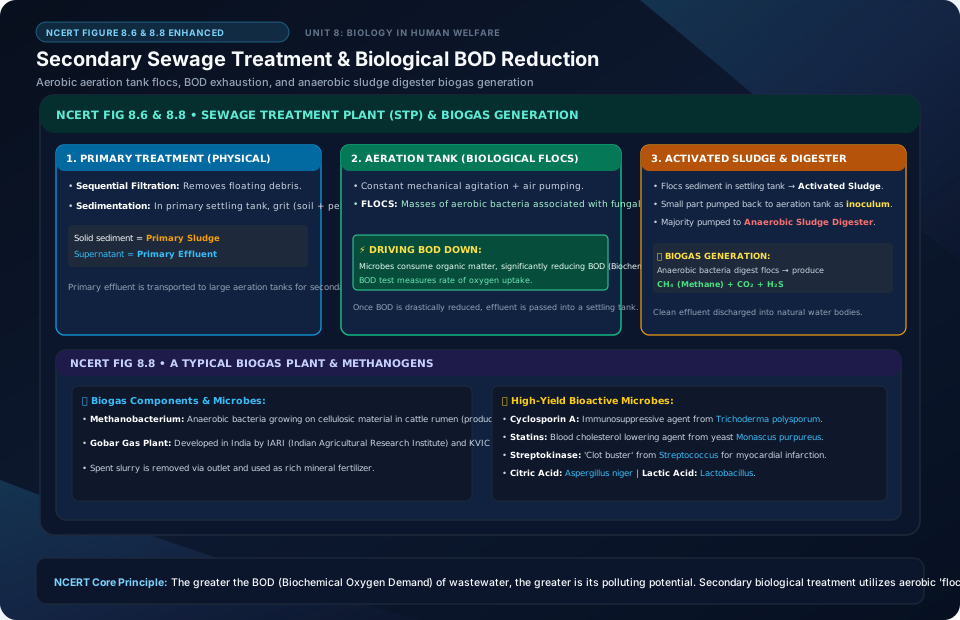
Municipal wastewater (sewage) contains large quantities of human excreta, organic matter, and pathogenic microbes. Untreated sewage cannot be discharged into natural rivers without causing environmental devastation and epidemics. Sewage is treated in Sewage Treatment Plants (STPs) through two sequential stages before discharge:
- Primary Treatment (Physical Treatment): Involves physical removal of large and small particles from sewage through filtration and sedimentation:
- Floating debris is removed by sequential filtration through wire screens.
- Grit (soil and small pebbles) is removed by sedimentation in settling tanks. All solids that settle form the primary sludge, and the supernatant forms the effluent.
- Secondary Treatment (Biological Treatment): The primary effluent is passed into large aeration tanks where it is constantly agitated mechanically and air is pumped into it:
- This allows vigorous growth of useful aerobic microbes into flocs (masses of bacteria associated with fungal filaments to form mesh-like networks).
- As they grow, these microbes consume the major part of organic matter in the effluent, significantly reducing the Biochemical Oxygen Demand (BOD).
- BOD Definition: The amount of oxygen required to oxidize all organic matter in one liter of water by bacteria. Greater BOD indicates higher pollution potential!
- Once BOD is drastically reduced, the effluent is passed into a settling tank where microbial flocs settle to form activated sludge. A small part of activated sludge is pumped back into the aeration tank to serve as the inoculum.
- The remaining major part is pumped into large closed tanks called anaerobic sludge digesters. Anaerobic bacteria digest the bacteria and fungi in the sludge, producing a mixture of gases: Methane (CH4), Hydrogen Sulfide (H2S), and Carbon Dioxide (CO2), which constitute Biogas (inflammable fuel).
The Ministry of Environment and Forests initiated the Ganga Action Plan (GAP) and Yamuna Action Plan (YAP) to save these major rivers by building sewage treatment plants.
8.5 Biogas Production: Methanogens (Methanobacterium) in Rumen of Cattle & Biogas Digester Architecture (Methane 50-70%, CO2, H2S) #
Biogas is a mixture of inflammable gases (predominantly Methane, 50–70%, along with CO2 and H2) produced by microbial anaerobic breakdown of biomass. The bacteria that grow anaerobically on cellulosic material and produce large amounts of methane are called methanogens, the most prominent being Methanobacterium.
Methanogens are naturally present in the rumen (a part of the stomach) of cattle, where they break down cellulosic food material. Thus, cattle dung (commonly called gobar) is exceptionally rich in these bacteria, making dung ideal for biogas production (commonly called Gobar Gas).
The Biogas Plant: Consists of a concrete tank (10–15 feet deep) into which bio-wastes and a slurry of dung and water (1:1 ratio) are fed. A floating gas holder cover is placed over the slurry, which rises as gas is produced by microbial activity. An outlet pipe connects the gas holder to supply biogas to nearby houses for cooking and lighting. The spent spent slurry is removed through another outlet and used as excellent nitrogen-rich fertilizer. Biogas technology was developed in India by the joint efforts of the Indian Agricultural Research Institute (IARI) and the Khadi and Village Industries Commission (KVIC).
8.6 Microbes as Biocontrol Agents: Bacillus thuringiensis (Bt Cotton Biopesticide), Trichoderma Fungus & Baculoviruses (Nucleopolyhedrovirus / Narrow Spectrum) #
Biocontrol refers to the use of biological methods for controlling plant diseases and agricultural pests, eliminating our dangerous reliance on toxic chemical pesticides and synthetic weedicides:
- Predator Insects: The familiar beetle with red and black markings—the Ladybird beetle—is used to eradicate destructive aphids, and Dragonflies are used to get rid of mosquitoes.
- Bacillus thuringiensis (Bt): A bacterium available in sachets as dried spores mixed with water and sprayed onto vulnerable crops (like brassicas and fruit trees). When ingested by insect larvae (caterpillars), the bacterial endotoxin is released in the insect’s alkaline gut, killing the larvae without harming other organisms. Genetic engineering has introduced Bt toxin genes directly into plants, creating pest-resistant crops like Bt Cotton!
- Trichoderma (Fungal Biocontrol): Free-living fungi that are very common in root ecosystems; highly effective biocontrol agents against several soil-borne plant pathogens.
- Baculoviruses (Genus Nucleopolyhedrovirus): Pathogens that attack insects and other arthropods. They are excellent candidates for species-specific, narrow-spectrum insecticidal applications. They have no negative impacts on plants, mammals, birds, fish, or non-target beneficial insects, making them invaluable in Integrated Pest Management (IPM) programs.
8.7 Microbes as Biofertilizers: Nitrogen-Fixing Bacteria (Rhizobium, Azotobacter, Azospirillum), Mycorrhiza Fungi (Glomus / Phosphorus Absorption) & Cyanobacteria (Anabaena, Nostoc in Paddy Fields) #
Excessive use of chemical fertilizers causes severe environmental pollution and soil degradation. Biofertilizers are living organisms that enrich the nutrient quality of the soil. The main sources of biofertilizers are bacteria, fungi, and cyanobacteria:
- Nitrogen-Fixing Bacteria:
- Symbiotic: Rhizobium forms root nodules in leguminous plants, fixing atmospheric nitrogen into organic forms.
- Free-Living in Soil: Azotobacter (aerobic) and Azospirillum enrich soil nitrogen content without plant hosts.
- Fungi (Mycorrhizae): Symbiotic associations between fungi and plant roots (mostly belonging to the genus Glomus). The fungal symbiont absorbs phosphorus from soil and passes it to the host plant. Plants with mycorrhizae show resistance to root-borne pathogens, increased tolerance to salinity and drought, and overall enhanced growth.
- Cyanobacteria (Blue-Green Algae): Autotrophic microbes widely distributed in aquatic and terrestrial environments: Anabaena, Nostoc, and Oscillatoria can fix atmospheric nitrogen. In paddy (rice) fields, cyanobacteria serve as an indispensable biofertilizer, while also adding organic matter to the soil.
Secondary Sewage Treatment & Biological BOD Reduction
🚨 Examiner Traps & Common Misconceptions
✅ Reality: Secondary sewage treatment is completely BIOLOGICAL! Heterotrophic aerobic microbes form flocs that consume organic waste, drastically lowering the Biochemical Oxygen Demand (BOD).
✅ Reality: Statins are produced by the YEAST Monascus purpureus; they act by competitively inhibiting the rate-limiting enzyme of cholesterol synthesis.
💡 Memory Hack & Mnemonic
Bioactive Molecules: ‘Statins Stop Sterols (Monascus yeast)’; ‘Cyclosporin Calms Cells (Trichoderma fungus immunosuppressant for organ transplants)’.
⭐ 10/10 Active Recall Self-Check: Chapter 8
Test your mastery before closing this lecture note. Can you answer these without looking back?
- What are the core experimental proofs or physiological steps that define Microbes in Human Welfare in the NCERT syllabus?
- How does the molecular mechanism or ecological interaction covered here operate under changing conditions?
- What are the high-frequency examiner traps or tricky numerical ratios associated with this chapter?
- Can you formulate the primary mnemonic or memory framework for remembering the key components above?
⭐ 10/10 Active Recall Self-Check: Chapter 8
Test your mastery before closing this lecture note. Can you answer these without looking back?
- What are the core experimental proofs or physiological steps that define Microbes in Human Welfare in the NCERT syllabus?
- How does the molecular mechanism or ecological interaction covered here operate under changing conditions?
- What are the high-frequency examiner traps or tricky numerical ratios associated with this chapter?
- Can you formulate the primary mnemonic or memory framework for remembering the key components above?