
6.1 Origin of Life Theories: Panspermia, Spontaneous Generation Refutation (Pasteur) & Chemical Evolution (Oparin-Haldane) #
Evolutionary Biology is the study of the history of life forms on Earth. The universe is ancient—almost 20 billion years old. Huge clusters of galaxies contain stars and clouds of gas and dust. The Big Bang Theory attempts to explain the origin of the universe as a singular huge thermonuclear explosion that expanded the universe, cooling it down.
Earth was formed about 4.5 billion years ago in the solar system. There was no atmosphere on early Earth; water vapor, methane (CH4), carbon dioxide (CO2), and ammonia (NH3) released from molten masses covered the surface. UV rays from the sun broke down water into hydrogen and oxygen; light H2 gas escaped into space. Oxygen combined with ammonia and methane to form water, CO2, and others. The ozone layer formed. As the planet cooled, water vapor condensed into torrential rains filling depressions to form oceans. Life appeared 500 million years after the formation of Earth (about 4 billion years ago).
Theories of Origin of Life: Early Greek thinkers believed units of life called spores were transferred to different planets (Panspermia). Louis Pasteur disproved the theory of Spontaneous Generation (abiogenesis) by demonstrating that in pre-sterilized, swan-neck flasks, life did not come from killed yeast; life comes only from pre-existing life (biogenesis).
Oparin-Haldane Hypothesis of Chemical Evolution: Oparin of Russia and Haldane of England proposed that the first form of life arose from non-living organic molecules (chemical evolution: formation of RNA, proteins) in a reducing atmosphere.
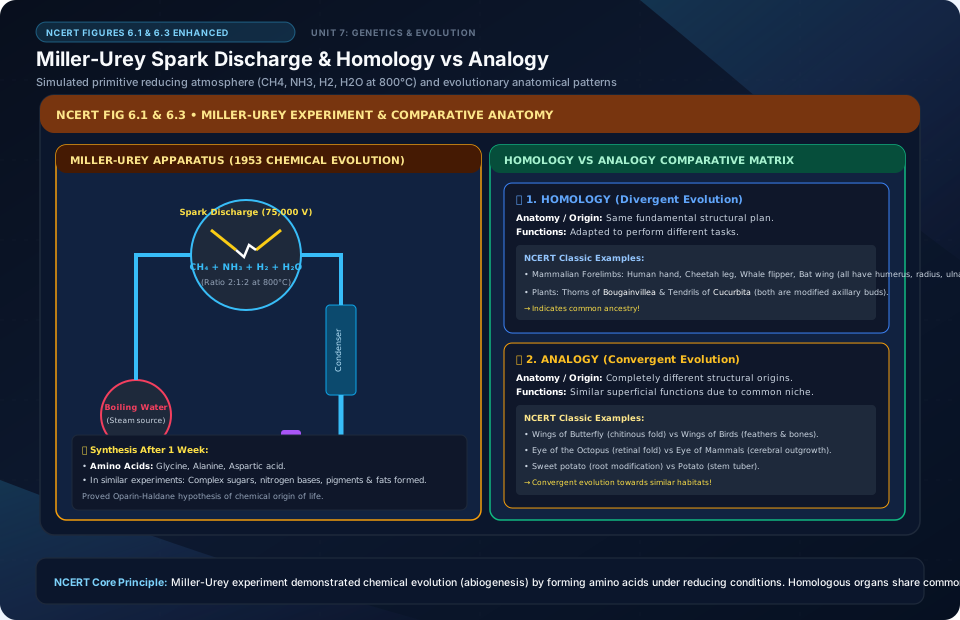
The Miller-Urey Experiment (1953): S.L. Miller, an American scientist, created conditions similar to primitive Earth in a closed laboratory flask: an electric spark discharge at 800°C in a gas mixture of methane (CH4), ammonia (NH3), hydrogen (H2) [ratio 2:1:2], and water vapor. After one week, he observed the synthesis of several amino acids (glycine, alanine, aspartic acid)! Other scientists observed formation of sugars, nitrogen bases, pigments, and fats. The first non-cellular forms of life originated 3 billion years ago (giant biopolymer capsules); the first cellular forms of life originated about 2 billion years ago.
6.2 The Miller-Urey Experiment (1953): Electric Spark Discharge Simulating Reducing Atmosphere (CH4, NH3, H2, H2O) Synthesizing Amino Acids #
Evidence that biological evolution has taken place comes from multiple scientific disciplines:
- Paleontological Evidence (Fossils): Fossils are the preserved remains of hard parts of life forms found in sedimentary rocks. A study of fossils in different sedimentary layers reveals the geological time period in which they existed, proving that life forms varied over time and certain forms were restricted to specific geological epochs.
- Homologous Organs & Divergent Evolution: Organs that share the same fundamental anatomical structure and embryonic origin, but perform different functions adapted to different ecological needs.
- Classic examples: The forelimbs of Whale (flipper), Bat (wing), Cheetah (running limb), and Human (hand) all share the same skeletal pattern (humerus, radius, ulna, carpals, metacarpals, phalanges), yet perform different functions!
- In plants: Thorns of Bougainvillea and tendrils of Cucurbita are homologous (both are modified axillary buds).
- Homology indicates Divergent Evolution and common evolutionary ancestry.
- Analogous Organs & Convergent Evolution: Organs that are anatomically different and have different evolutionary origins, but perform similar functions due to similar selective pressures.
- Examples: Wings of butterfly and wings of bird; Eye of octopus and eye of mammal; Flippers of penguins and dolphins.
- In plants: Sweet potato (root modification) and potato (stem tuber) both store starch.
- Analogy indicates Convergent Evolution.
6.3 Evidences for Evolution: Paleontological (Fossils), Comparative Anatomy (Homologous Divergent vs Analogous Convergent Organs) & Biochemical #
During his historic voyage on HMS Beagle, Charles Darwin visited the isolated Galapagos Islands. There, he observed an incredible diversity of small black birds, now celebrated as Darwin’s Finches.
Darwin realized that all varieties of finches evolved on the island itself from an original ancestral seed-eating finch. From original seed-eaters, diverse forms arose with altered beaks adapted for eating insects, cactus nectar, and fruits. This process of evolution of different species in a given geographical area starting from a point and literally radiating to other geographical areas (habitats) is called Adaptive Radiation.
Another classic example of adaptive radiation is Australian Marsupials: a number of marsupials (Tasmanian wolf, sugar glider, marsupial mole, banded anteater, kangaroo) each evolved from an ancestral stock within the isolated Australian continent. When more than one adaptive radiation occurs in an isolated geographical area (representing different ecological niches), it results in convergent evolution (e.g., Placental mammals in North America match corresponding Australian marsupials: Placental Wolf matches Tasmanian Wolf!).
6.4 Adaptive Radiation: Darwin’s Galápagos Finches & Australian Marsupial Convergent Radiation #
The primary mechanisms and historical theories of biological evolution include:
- Lamarckism: Proposed by French naturalist Jean-Baptiste Lamarck, stating that evolution of life forms occurred by the use and disuse of organs. He cited giraffes, which elongated their necks by stretching to forage leaves on tall trees, passing this acquired character to progeny. This theory was rejected by August Weismann’s germplasm theory.
- Darwinism (Theory of Natural Selection): Proposed jointly by Charles Darwin and Alfred Russel Wallace (who worked in the Malay Archipelago). Darwinism is based on two key concepts: Branching Descent (common ancestry) and Natural Selection. Natural resources are limited, and populations have stable sizes; individuals exhibit phenotypic variations. Those with variations that confer better reproductive adaptation to their environment survive and reproduce in greater numbers (differential reproduction). Over generations, natural selection preserves adaptive variations, giving rise to new species.
- Mutation Theory of Hugo de Vries (1901): Based on his breeding experiments on the evening primrose (Oenothera lamarckiana), de Vries proposed that evolution occurs by large, sudden, discontinuous genetic variations called mutations. While Darwinian variations are small, slow, continuous, and directional, de Vriesian mutations are random and directionless. De Vries believed that mutation causes speciation in a single step, termed Saltation (single-step large mutation).
6.5 Biological Evolution & Natural Selection: Industrial Melanism (Biston betularia), Antibiotic/Pesticide Resistance #
In 1908, British mathematician G.H. Hardy and German physician W. Weinberg independently formulated the Hardy-Weinberg Principle: “Allele frequencies in a large, randomly mating population remain constant from generation to generation in the absence of evolutionary disturbing factors.”
The gene pool (total genes and their alleles in a population) remains constant; this is called genetic equilibrium or Hardy-Weinberg equilibrium. In a diploid population with two alleles p and q (where p is the frequency of dominant allele A and q is the frequency of recessive allele a):
Where p2 is the frequency of homozygous dominant individuals (AA), 2pq is the frequency of heterozygous individuals (Aa), and q2 is the frequency of homozygous recessive individuals (aa). Any deviation from this equilibrium indicates that evolutionary change is occurring. Five factors disrupt Hardy-Weinberg equilibrium:
- Gene Migration / Gene Flow: Movement of individuals into (immigration) or out of (emigration) a population adds or removes alleles.
- Genetic Drift: Random changes in allele frequencies occurring purely by chance in small populations. If a small group colonizes a new habitat, the original drifted population becomes founders, and the effect is called the Founder Effect.
- Mutation: Introduces new alleles into the gene pool.
- Genetic Recombination: Crossing over during meiosis in sexual reproduction produces new allele combinations.
- Natural Selection: Differential reproductive success of genotypes.
6.6 Mechanism of Evolution: Hugo de Vries Mutation Theory (Saltation: Single-Step Large Mutation) vs Darwinian Gradualism #
Natural selection can operate on population traits in three distinct patterns:
- Stabilizing Selection: Favors intermediate phenotypic variants over extremes. The bell-shaped curve becomes narrower and taller (e.g., human birth weight: babies of average weight have higher survival than very low or very high birth weights).
- Directional Selection: Favors individuals at one extreme of the phenotypic distribution. The entire curve shifts in one direction.
Classic Example – Industrial Melanism in the Peppered Moth (Biston betularia): In pre-industrial Britain (before 1850), white-winged moths were abundant because tree trunks were covered with thick, white lichens, camouflaging them from predatory birds. After industrialization (1920), soot and smoke darkened tree trunks, and lichens disappeared. White-winged moths were easily spotted and predated, while mutant dark (melanic) moths survived and multiplied. This shifted the population toward the dark phenotype.
Other directional examples: Evolution of antibiotic-resistant bacteria and DDT-resistant mosquitoes due to anthropogenic (human) selective pressures!
- Disruptive Selection: Favors individuals at both phenotypic extremes over intermediate types. The single peak splits into two distinct peaks.
6.7 Hardy-Weinberg Principle: Genetic Equilibrium Equation (p^2 + 2pq + q^2 = 1) & Factors Disrupting It (Gene Flow, Drift, Mutation, Recombination, Selection) #
The evolutionary history of life on Earth across the Geological Time Scale:
- About 2000 million years ago (mya): First cellular forms of life appeared on Earth.
- About 500 mya: Invertebrates were formed and active.
- About 350 mya: Jawless fishes evolved. First organisms that invaded land were plants (they covered land before animals moved out of oceans).
- Coelacanth (Lobefin, 350 mya): In 1938, a fish caught in South Africa was identified as a Coelacanth, previously thought extinct. Lobefins were stout, fleshy-finned fishes that could move on land and go back to water—the direct ancestors of the first amphibians.
- Amphibians evolved into reptiles with thick-shelled eggs. Giant reptiles (dinosaurs like Tyrannosaurus rex, standing 20 feet high with dagger-like teeth) dominated Earth during the Mesozoic era. Dinosaurs suddenly disappeared from Earth about 65 million years ago.
- The first mammals were shrew-like, small, intelligent, and viviparous. When reptiles declined, mammals diversified and dominated the continents.
6.8 A Brief Account of Evolution & Human Evolution Stages: Dryopithecus -> Ramapithecus -> Australopithecus -> Homo habilis -> Homo erectus -> Neanderthal -> Homo sapiens #
The evolutionary lineage of modern humans (Homo sapiens):
| Hominid Ancestor | Time Period & Discovery Location | Cranial Capacity | Diagnostic Behavioral & Physical Hallmarks |
|---|---|---|---|
| Dryopithecus & Ramapithecus | ~15 million years ago (mya). | Small (~350–400 cc) | Hairy and walked like gorillas/chimpanzees. Dryopithecus was more ape-like; Ramapithecus was distinctly more man-like with human-like dentition. |
| Australopithecines | ~2 mya; East African grasslands (Taung baby, Lucy). | ~450–500 cc | Walked bipedally and upright; hunted with stone weapons but essentially ate fruit. |
| Homo habilis (‘Handy Man’ / First Human) | ~2 mya; East Africa. | 650–800 cc | First hominid (human-like being); made stone tools; did not eat meat. |
| Homo erectus (Java Man) | ~1.5 mya; fossils discovered in Java in 1891. | 900 cc | Fully erect posture, walked upright; used fire; ate meat. |
| Neanderthal Man (Homo neanderthalensis) | 100,000 to 40,000 years ago; near east and central Asia. | 1400 cc | Used animal hides to protect their bodies; buried their dead with rituals; heavy brow ridges. |
| Homo sapiens (Modern Man) | Arose in Africa ~75,000 to 10,000 years ago during Ice Age. | ~1350–1450 cc | Pre-historic cave art developed ~18,000 years ago (Bhimbetka rock shelters in MP); agriculture started ~10,000 years ago, leading to human civilization. |
Miller-Urey Spark Discharge & Homology vs Analogy
🚨 Examiner Traps & Common Misconceptions
✅ Reality: Homologous organs share the SAME ANATOMICAL ORIGIN but have adapted to DIFFERENT functions via divergent evolution (e.g., thorn of Bougainvillea and tendril of Cucurbita, human arm and bat wing).
✅ Reality: Genetic drift (Sewall Wright effect) causes random changes in allele frequencies specifically in SMALL, ISOLATED populations!
💡 Memory Hack & Mnemonic
Human Evolutionary Cranial Capacities: ‘Habilis = 650-800 cc, Erectus = 900 cc, Neanderthal = 1400 cc, Sapiens = 1400-1450 cc’.
⭐ 10/10 Active Recall Self-Check: Chapter 6
Test your mastery before closing this lecture note. Can you answer these without looking back?
- What are the core experimental proofs or physiological steps that define Evolution in the NCERT syllabus?
- How does the molecular mechanism or ecological interaction covered here operate under changing conditions?
- What are the high-frequency examiner traps or tricky numerical ratios associated with this chapter?
- Can you formulate the primary mnemonic or memory framework for remembering the key components above?
⭐ 10/10 Active Recall Self-Check: Chapter 6
Test your mastery before closing this lecture note. Can you answer these without looking back?
- What are the core experimental proofs or physiological steps that define Evolution in the NCERT syllabus?
- How does the molecular mechanism or ecological interaction covered here operate under changing conditions?
- What are the high-frequency examiner traps or tricky numerical ratios associated with this chapter?
- Can you formulate the primary mnemonic or memory framework for remembering the key components above?