
4.1 Mendel’s Landmark Experiments on Garden Pea (Pisum sativum): 7 Contrasting Character Traits #
Genetics is the branch of biology that deals with inheritance (the process by which characters are passed from parent to progeny) and variation (the degree by which progeny differ from their parents). Humans knew as early as 8000–1000 B.C. that variation was linked to sexual reproduction, but they had minimal understanding of the underlying scientific mechanisms.
The scientific foundation of genetics was laid by Gregor Johann Mendel, an Austrian monk who conducted hybridization experiments on the common garden pea (Pisum sativum) for seven years (1856–1863) and proposed the universal laws of inheritance.
Mendel’s choice of the garden pea was brilliant because the plant was easy to cultivate, had a short annual life cycle, possessed naturally self-pollinating bisexual flowers that could be easily cross-pollinated manually by emasculation and bagging, and produced large numbers of seeds. Most importantly, garden peas exhibited sharply distinct, mutually exclusive contrasting traits. Mendel investigated seven pairs of contrasting traits:
| Character Investigated | Dominant Trait | Recessive Trait |
|---|---|---|
| 1. Stem Height | Tall (T) | Dwarf (t) |
| 2. Flower Color | Violet / Purple | White |
| 3. Flower Position | Axial | Terminal |
| 4. Pod Shape | Inflated (Full) | Constricted |
| 5. Pod Color | Green | Yellow |
| 6. Seed Shape | Round (R) | Wrinkled (r) |
| 7. Seed (Cotyledon) Color | Yellow (Y) | Green (y) |
4.2 Monohybrid Cross & Principles: Law of Dominance (3:1 Phenotype) & Law of Segregation (1:2:1 Genotype) #
Mendel crossed true-breeding tall pea plants (TT) with true-breeding dwarf pea plants (tt). A cross involving a single pair of contrasting characters is called a Monohybrid Cross:
- In the F1 (First Filial) Generation, all plants were Tall (Tt). There were no dwarf plants or intermediate heights.
- When Mendel self-pollinated the tall F1 plants (Tt × Tt), in the F2 (Second Filial) Generation, dwarf plants reappeared! The phenotypic ratio was 3 Tall : 1 Dwarf, and the genotypic ratio was 1 TT : 2 Tt : 1 tt (1:2:1).
Based on these monohybrid observations, Mendel formulated two fundamental principles of inheritance:
- Law of Dominance: Characters are controlled by discrete units called factors (now called genes). Factors occur in pairs. In a dissimilar pair of factors, one member of the pair dominates (dominant trait) over the other (recessive trait).
- Law of Segregation (Purity of Gametes): Although the alleles of a pair reside together in an individual, they do not blend or contaminate each other. During gamete formation, the two alleles of a gene segregate (separate) from each other so that each gamete receives only one allele. Segregation is a universal biological law with zero exceptions.
The Test Cross: To determine whether an individual showing a dominant phenotype is homozygous (TT) or heterozygous (Tt), Mendel devised the test cross: crossing the unknown dominant individual with a homozygous recessive parent (tt). If the progeny are 100% dominant, the unknown was homozygous (TT); if the progeny show a 1:1 ratio (50% dominant : 50% recessive), the unknown was heterozygous (Tt).
4.3 Deviations from Mendelian Dominance: Incomplete Dominance (Snapdragon 1:2:1), Codominance & Multiple Alleles (ABO Blood Groups) #
After Mendel’s rediscovery in 1900 (by de Vries, Correns, and von Tschermak), geneticists discovered patterns of inheritance that deviated from strict Mendelian dominance:
- Incomplete Dominance: When neither of the two alleles is completely dominant, resulting in an intermediate blending phenotype in the heterozygote. Classic example: Snapdragon (Antirrhinum majus) or 4 o’clock plant (Mirabilis jalapa):
- True-breeding Red flower (RR) × White flower (rr) → F1 plants are all Pink (Rr)!
- Selfing F1 Pink plants (Rr × Rr) produces an F2 ratio of 1 Red (RR) : 2 Pink (Rr) : 1 White (rr). Notice: Both the phenotypic ratio and genotypic ratio are identical (1:2:1)!
- Codominance: Both alleles express themselves equally and simultaneously in the heterozygous state without any blending. Classic example: ABO Blood Groups in Humans:
- Controlled by gene I, which has three alleles in the human population: IA, IB, and i.
- Alleles IA and IB produce slightly different forms of surface sugar antigens on RBCs, while allele i produces no antigen.
- When IA and IB are present together in an individual (genotype IAIB), both sugars are expressed on RBCs, producing Blood Group AB (Codominance).
- Multiple Allelism: The presence of more than two alternate forms of a gene governing the same character across a population (e.g., three alleles IA, IB, i controlling ABO blood groups; producing 6 possible genotypes: IAIA, IAi, IBIB, IBi, IAIB, ii). Multiple alleles can be detected only in population studies, because an individual diploid organism can possess only two alleles!
- Pleiotropy: A single gene can influence multiple, seemingly unrelated phenotypic traits (e.g., Phenylketonuria [PKU] caused by mutation in the phenylalanine hydroxylase gene manifests as mental retardation, reduction in hair, and skin depigmentation).
4.4 Dihybrid Cross & Law of Independent Assortment (9:3:3:1 Phenotypic Ratio) #
Mendel also crossed pea plants that differed in two characters (a Dihybrid Cross): a plant with yellow round seeds (YYRR) crossed with a plant with green wrinkled seeds (yyrr):
- The F1 generation produced plants with Yellow Round seeds (YyRr).
- Self-pollination of F1 plants produced four phenotypic categories in the F2 generation:
- Yellow Round: 9/16 (parental combination)
- Yellow Wrinkled: 3/16 (new recombinant combination)
- Green Round: 3/16 (new recombinant combination)
- Green Wrinkled: 1/16 (parental combination)
Based on this dihybrid cross, Mendel proposed the Law of Independent Assortment: “When two pairs of traits are combined in a hybrid, segregation of one pair of characters is completely independent of the other pair of characters during gamete formation.”
4.5 Chromosomal Theory of Inheritance (Sutton & Boveri 1902) #
Mendel published his work on inheritance of characters in 1865, but for several reasons, it remained unacknowledged until 1900 (poor scientific communication, use of mathematics in biology which was unfamiliar to biologists of his time, and inability to provide physical proof for what factors were made of).
In 1900, three scientists—Hugo de Vries, Carl Correns, and Erich von Tschermak—independently rediscovered Mendel’s principles. With advances in microscopy, biologists observed the behavior of chromosomes during cell division.
In 1902, Walter Sutton and Theodor Boveri noted that the behavior of chromosomes was parallel to the behavior of genes and used chromosome movement during meiosis to explain Mendel’s laws. This is known as the Chromosomal Theory of Inheritance:
- Chromosomes, like genes, occur in pairs.
- The two alleles of a gene pair are located on homologous sites on homologous chromosomes.
- Homologous chromosomes separate during anaphase I of meiosis, just as alleles segregate during gamete formation.
- The independent orientation and separation of bivalents during meiosis explains Mendel’s independent assortment of genes located on different chromosomes.
4.6 Morgan’s Experimental Proof in Drosophila melanogaster: Linkage, Recombination & Alfred Sturtevant’s Genetic Maps #
Thomas Hunt Morgan and his colleagues provided experimental verification of the Chromosomal Theory of Inheritance through extensive breeding experiments on the fruit fly, Drosophila melanogaster. Morgan chose Drosophila because:
- They could be easily grown on simple synthetic medium in the laboratory.
- They complete their entire life cycle in about two weeks.
- A single mating produces hundreds of progeny flies.
- Clear sexual dimorphism (females are distinctly larger than males).
- Possess many types of hereditary variations visible under low-power microscopes.
Linkage and Recombination: When Morgan crossed yellow-bodied, white-eyed females to brown-bodied, red-eyed males and intercrossed the F1 progeny, he observed that the two genes did not segregate independently of each other, and the F2 ratio deviated significantly from the expected 9:3:3:1 ratio!
Morgan attributed this to Linkage: the physical association of genes on the same chromosome. When two genes are situated on the same chromosome, parental gene combinations are much more frequent than non-parental (recombinant) types:
- Genes that are situated very close to each other show tight linkage with very low recombination frequency (e.g., yellow body and white eye showed only 1.3% recombination).
- Genes situated further apart show loose linkage with higher recombination frequency (e.g., white eye and miniature wing showed 37.2% recombination).
Morgan’s student, Alfred Sturtevant, utilized the frequency of recombination between gene pairs on the same chromosome as a measure of the physical distance between genes and mapped their positions on the chromosome. Today, genetic mapping forms the backbone of genome sequencing projects (including the Human Genome Project).
4.7 Sex Determination Systems: XX-XY (Humans, Drosophila), ZZ-ZW (Birds) & Haplodiploidy (Honeybees) #
The mechanism of sex determination varies across species:
- Male Heterogamety: The male produces two morphologically or genetically different types of gametes (sperms):
- XX-XY Mechanism (Humans & Drosophila): Females have 22 pairs of autosomes and one pair of homomorphic sex chromosomes (XX). Males have 22 pairs of autosomes and one pair of heteromorphic sex chromosomes (XY). In humans, 50% of sperms carry an X chromosome, and 50% carry a Y chromosome. All ova carry an X chromosome. Fertilization with an X-sperm produces a female child (XX); fertilization with a Y-sperm produces a male child (XY). Hence, the father determines the genetic sex of the child.
- XX-XO Mechanism (Insects like Grasshoppers): Females have XX chromosomes, while males have only one sex chromosome (XO). Sperms carry either an X chromosome or no sex chromosome (O).
- Female Heterogamety (ZZ-ZW Mechanism in Birds): The female produces two different types of eggs: 50% with a Z chromosome and 50% with a W chromosome. Males are homogametic, producing sperms that all carry a Z chromosome (ZZ). Hence, in birds, the female determines the sex of the offspring.
- Haplodiploidy in Honeybees: Males (drones) develop from unfertilized eggs by parthenogenesis and are haploid (n = 16); they produce sperms by mitosis! Females (queens and worker bees) develop from fertilized eggs and are diploid (2n = 32). Consequently, male honeybees have no father and cannot have sons, but have a grandfather and can have grandsons!
4.8 Pedigree Analysis & Human Genetic Disorders: Mendelian (Haemophilia, Sickle-Cell Anemia, Phenylketonuria, Thalassemia) vs Chromosomal (Down’s 21-Trisomy, Klinefelter’s XXY, Turner’s XO) #
Mutation: A sudden heritable change in genetic material (DNA sequence). Mutations are the raw material for evolution. They can be chromosomal aberrations (deletions, duplications, inversions, translocations) or gene mutations:
- Point Mutation: A change in a single base pair of DNA. Classic example: Sickle-cell anemia, where a single point mutation replaces glutamic acid (GAG) with valine (GUG) at the 6th position of the β-globin chain.
- Frameshift Mutation: Deletion or insertion of one or two base pairs alters the entire reading frame of the genetic code downstream. Chemical or physical agents that induce mutations are called mutagens (e.g., UV radiation, nitrous acid).
Pedigree Analysis: Because controlled experimental crosses cannot be performed in humans, geneticists analyze the inheritance of human traits across generations using pedigree charts. Standard symbols: Square = Male; Circle = Female; Solid/Filled symbol = Affected individual; Diamond = Sex unspecified; Horizontal mating line between male and female.
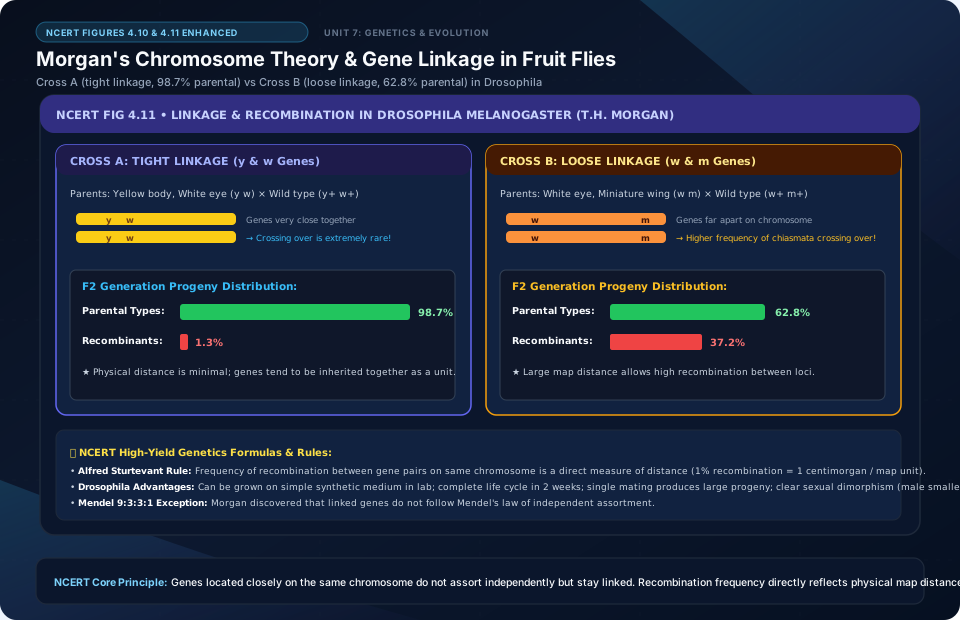
Morgan’s Chromosome Theory & Gene Linkage in Fruit Flies
🚨 Examiner Traps & Common Misconceptions
✅ Reality: Genes DO NOT blend! In F2 generation of snapdragon (Antirrhinum), the original pure red and white parental phenotypes reappear untouched in 1:2:1 ratio alongside pink heterozygotes.
✅ Reality: It is caused by a SINGLE BASE POINT MUTATION: GAG codon is replaced by GUG at the 6th position of the beta-globin chain, substituting Glutamic acid with Valine.
💡 Memory Hack & Mnemonic
Mendelian Autosomal Recessive Disorders: ‘Sick People Take Pills’ (Sickle-cell anemia, Phenylketonuria, Thalassemia are all Autosomal Recessive).
⭐ 10/10 Active Recall Self-Check: Chapter 4
Test your mastery before closing this lecture note. Can you answer these without looking back?
- What are the core experimental proofs or physiological steps that define Principles of Inheritance and Variation in the NCERT syllabus?
- How does the molecular mechanism or ecological interaction covered here operate under changing conditions?
- What are the high-frequency examiner traps or tricky numerical ratios associated with this chapter?
- Can you formulate the primary mnemonic or memory framework for remembering the key components above?
⭐ 10/10 Active Recall Self-Check: Chapter 4
Test your mastery before closing this lecture note. Can you answer these without looking back?
- What are the core experimental proofs or physiological steps that define Principles of Inheritance and Variation in the NCERT syllabus?
- How does the molecular mechanism or ecological interaction covered here operate under changing conditions?
- What are the high-frequency examiner traps or tricky numerical ratios associated with this chapter?
- Can you formulate the primary mnemonic or memory framework for remembering the key components above?