
3.1 Reproductive Health Programs & Family Planning: Reproductive & Child Health Care (RCH) #
According to the World Health Organization (WHO), Reproductive Health means total well-being in all aspects of reproduction—namely, physical, emotional, behavioral, and social. A society with people having physically and functionally normal reproductive organs and normal emotional and behavioral interactions in all sex-related aspects is called reproductively healthy.
India was the very first country in the world to initiate action plans and nationwide programs at a national level to attain total reproductive health as a social goal. These programs, named Family Planning, were initiated in 1951 and are periodically assessed. Today, comprehensive expanded programs operate under the popular name: Reproductive and Child Health Care (RCH) Programs.
Major goals of RCH programs include creating awareness about reproduction, maternal and infant nutrition, prevention of Sexually Transmitted Infections (STIs), promoting institutional deliveries, and curbing population growth. Amniocentesis (prenatal chromosomal diagnosis of fetal amniotic fluid) was banned for sex determination to stop female foeticide.
3.2 Population Stabilization & Contraceptive Methods: Natural, Barrier (Condoms, Diaphragms), IUDs (Copper-T, LNG-20), Oral Pills (Saheli – Centchroman) & Surgical Sterilization (Vasectomy, Tubectomy) #
In the 20th century, global and national human populations exploded at an alarming rate. India’s population was approximately 350 million at independence (1947), crossed 1 billion by May 2000, and reached 1.2 billion in 2011. The primary causes of this population explosion were:
- Rapid decline in the death rate.
- Dramatic decline in Maternal Mortality Rate (MMR) and Infant Mortality Rate (IMR) due to modern medical healthcare.
- Increase in the number of people in reproducible age groups.
To control population growth and motivate couples to adopt smaller families, modern contraceptives are promoted. An ideal contraceptive should be user-friendly, easily available, highly effective, reversible with no or minimal side effects, and should not interfere with the sexual drive or act of the user.
3.3 Medical Termination of Pregnancy (MTP Act) & Safe Gestation Trimesters #
Contraceptive methods are grouped into several broad physiological categories:
- Natural / Traditional Methods: Work on the principle of avoiding chances of sperm and ovum meeting:
- Periodic Abstinence (Rhythm Method): Couples avoid or abstain from coitus from day 10 to 17 of the menstrual cycle (the fertile window), when ovulation is most likely to occur.
- Coitus Interruptus (Withdrawal): The male partner withdraws his penis from the vagina just before ejaculation to avoid insemination.
- Lactational Amenorrhea: Based on the fact that ovulation and menstrual cycle do not occur during the period of intense lactation following parturition (high prolactin suppresses GnRH/LH). Effective only up to a maximum period of 6 months post-delivery.
- Barrier Methods: Prevent physical meeting of sperm and ovum using mechanical barriers:
- Condoms: Barriers made of thin rubber/latex sheath used to cover the penis in males or vagina/cervix in females. Popular brand: Nirodh. Condoms provide the crucial additional benefit of protecting against STIs and AIDS.
- Diaphragms, Cervical Caps, and Vaults: Rubber barriers inserted into the female reproductive tract to cover the cervix during coitus. They are reusable and their contraceptive efficiency is enhanced when used with spermicidal creams, jellies, and foams.
3.4 Sexually Transmitted Infections (STIs / RTIs): Prevention, Symptoms & Incurable Infections (HIV, Hepatitis B, Genital Herpes) #
Advanced contraceptive options widely utilized in family planning include:
- Intrauterine Devices (IUDs): Inserted by doctors or trained nurses into the uterus through the vagina. IUDs are the most widely accepted method of contraception in India for spacing children:
- Non-Medicated IUDs: Phagocytize sperms inside the uterus (e.g., Lippes loop).
- Copper-Releasing IUDs: Release Cu2+ ions that suppress sperm motility and fertilizing capacity (e.g., CuT, Cu7, Multiload 375).
- Hormone-Releasing IUDs: Make the uterus unsuitable for implantation and cervix hostile to sperms (e.g., Progestasert, LNG-20).
- Oral Contraceptive Pills: Small doses of progestogens or progestogen-estrogen combinations taken daily for 21 days starting within the first five days of the menstrual cycle. They inhibit ovulation and implantation, and alter cervical mucus quality to retard sperm entry.
‘Saheli’: A revolutionary oral contraceptive pill developed by the Central Drug Research Institute (CDRI) in Lucknow, India. It is a non-steroidal, once-a-week pill with very high contraceptive value and negligible side effects.
- Surgical Methods (Sterilization / Terminal Methods): Permanent, highly effective methods that block gamete transport, but have very poor reversibility:
- Vasectomy: In males, a small part of the vas deferens is removed or tied up through a small incision on the scrotum.
- Tubectomy: In females, a small part of the fallopian tube is removed or tied up through a small incision in the abdomen or through the vagina.
3.5 Infertility & Assisted Reproductive Technologies (ART): IVF-ET (In Vitro Fertilization & Embryo Transfer) #
Medical Termination of Pregnancy (MTP) or induced abortion is the intentional or voluntary termination of pregnancy before full term. Globally, nearly 45 to 50 million MTPs are performed every year, accounting for 1/5th of total conceived pregnancies.
The Government of India legalized MTP in 1971 with strict conditions to prevent misuse (such as illegal female foeticide). Under the MTP (Amendment) Act 2017, a pregnancy may be terminated within the first 12 weeks on the opinion of one registered medical practitioner, and up to 20 weeks on the opinion of two practitioners, if continuation involves risk to the mother’s life or severe physical/mental abnormalities in the child.
MTPs are considered relatively safe during the first trimester (up to 12 weeks of pregnancy). Second-trimester abortions are significantly riskier.
3.6 Advanced ART Methods: ZIFT (Zygote Intra-Fallopian Transfer <8 blastomeres), GIFT, IUT (>8 blastomeres), ICSI (Intra-Cytoplasmic Sperm Injection) & AI / IUI #
Sexually Transmitted Infections (STIs) / Venereal Diseases (VD): Infections transmitted through sexual intercourse. Common STIs include Gonorrhea, Syphilis, Genital herpes, Chlamydiasis, Genital warts, Trichomoniasis, Hepatitis-B, and HIV/AIDS. Except for hepatitis-B, genital herpes, and HIV infections (which are currently incurable), other STIs are completely curable if detected early and treated properly.
Infertility and Assisted Reproductive Technologies (ART): When a couple is unable to conceive despite two years of unprotected coitus, specialized medical technologies called ART assist them in having children:
- In Vitro Fertilization (IVF) & Embryo Transfer (ET) – ‘Test Tube Baby’: Ova from female and sperms from male are collected and induced to form a zygote under simulated laboratory conditions.
- ZIFT (Zygote Intra-Fallopian Transfer): Zygote or early embryo up to 8 blastomeres is transferred into the fallopian tube.
- IUT (Intra-Uterine Transfer): Embryo with more than 8 blastomeres is transferred directly into the uterus.
- GIFT (Gamete Intra-Fallopian Transfer): Transfer of an unfertilized ovum collected from a donor into the fallopian tube of another female who cannot produce one but can provide a suitable environment for fertilization and development.
- ICSI (Intra-Cytoplasmic Sperm Injection): A specialized laboratory procedure in which a single sperm is directly micro-injected into the cytoplasm of an ovum.
- Artificial Insemination (AI) / IUI: Used when the male partner cannot inseminate or has very low sperm counts (oligospermia); semen is collected from husband or donor and artificially introduced into the vagina or uterus (Intra-Uterine Insemination – IUI).
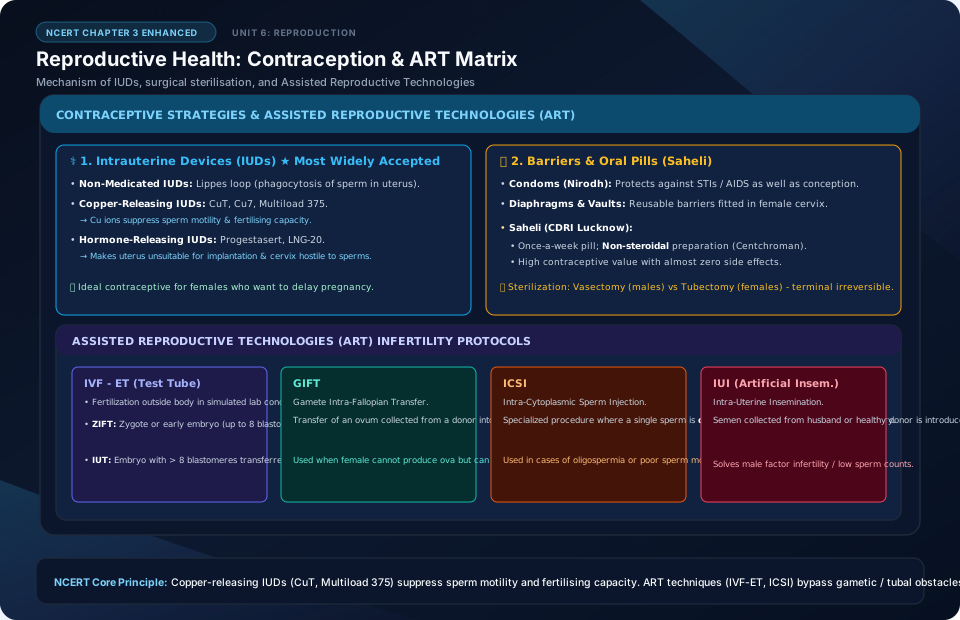
Reproductive Health: Contraception & ART Matrix
🚨 Examiner Traps & Common Misconceptions
✅ Reality: Copper-T does not block sperm physically; released copper ions suppress sperm motility and fertilizing capacity while stimulating phagocytosis of sperm within the uterus!
✅ Reality: Saheli is a NON-STEROIDAL selective estrogen receptor modulator (Centchroman) taken ONCE A WEEK, developed by CDRI Lucknow with minimal side effects.
💡 Memory Hack & Mnemonic
Incurable STIs: ‘The 3 Triple-H Viruses’ (HIV, Hepatitis B, Herpes Simplex cannot be cured by antibiotics).
⭐ 10/10 Active Recall Self-Check: Chapter 3
Test your mastery before closing this lecture note. Can you answer these without looking back?
- What are the core experimental proofs or physiological steps that define Reproductive Health in the NCERT syllabus?
- How does the molecular mechanism or ecological interaction covered here operate under changing conditions?
- What are the high-frequency examiner traps or tricky numerical ratios associated with this chapter?
- Can you formulate the primary mnemonic or memory framework for remembering the key components above?
⭐ 10/10 Active Recall Self-Check: Chapter 3
Test your mastery before closing this lecture note. Can you answer these without looking back?
- What are the core experimental proofs or physiological steps that define Reproductive Health in the NCERT syllabus?
- How does the molecular mechanism or ecological interaction covered here operate under changing conditions?
- What are the high-frequency examiner traps or tricky numerical ratios associated with this chapter?
- Can you formulate the primary mnemonic or memory framework for remembering the key components above?