
13.1 Levels of Biodiversity: Genetic Diversity (Rauwolfia reserpine, 50,000 rice strains), Species Diversity (Western Ghats amphibians > Eastern Ghats) & Ecological Diversity #
If an alien from a distant galaxy were to visit our planet Earth, the first thing that would amaze him would be the enormous diversity of life that he would encounter. Biodiversity is the term popularized by the sociobiologist Edward Wilson to describe the combined diversity at all the levels of biological organization:
- 1. Genetic Diversity: A single species might show high diversity at the genetic level over its distributional range.
- The medicinal plant Rauwolfia vomitoria growing in different Himalayan ranges shows substantial genetic variation in the potency and concentration of the active chemical reserpine.
- India has more than 50,000 genetically different strains of rice and over 1,000 varieties of mango!
- 2. Species Diversity: The diversity at the species level. For example, the Western Ghats have a greater amphibian species diversity than the Eastern Ghats.
- 3. Ecological Diversity: At the ecosystem level, India, with its deserts, rainforests, mangroves, coral reefs, wetlands, and alpine meadows, has a greater ecosystem diversity than a Scandinavian country like Norway.
13.2 Global Biodiversity Estimates: Robert May’s Global Estimate of 7 Million Species (~22% Currently Named) #
According to the International Union for Conservation of Nature and Natural Resources (IUCN, 2004), the total number of plant and animal species described so far is slightly more than 1.5 million.
However, species inventories are far from complete, particularly in the tropical regions. A scientifically sound global estimate made by Robert May places the global species diversity at approximately 7 million species. Out of these, only about 22% of total species on Earth have been recorded so far!
NCERT Global Biodiversity Proportions:
- More than 70% of all recorded species are Animals, while plants (including algae, fungi, bryophytes, gymnosperms, and angiosperms) comprise no more than 22%.
- Among animals, Insects are the most species-rich taxonomic group, making up more than 70% of total animals (out of every 10 animals on this planet, 7 are insects!).
- The number of fungi species in the world is more than the combined total of the species of fishes, amphibians, reptiles, and mammals!
- Although India has only 2.4% of the world’s land area, its share of the global species diversity is an impressive 8.1%. This makes India one of the 12 mega-diversity countries of the world.
13.3 Patterns of Biodiversity: Latitudinal Gradients (Highest in Tropical Amazon Rainforest, Decreasing Toward Poles) & Alexander von Humboldt’s Species-Area Relationship (log S = log C + Z log A) #
Biodiversity is not uniformly distributed throughout the globe; it shows distinct spatial patterns:
- 1. Latitudinal Gradients: Species diversity decreases as we move away from the equator toward the poles. Tropics (latitudinal range of 23.5°N to 23.5°S) harbor more species than temperate or polar areas. Colombia, located near the equator, has nearly 1,400 species of birds, while New York (41°N) has 105 species, and Greenland (71°N) has only 56 species.
The largely tropical Amazonian Rain Forest in South America has the greatest biodiversity on Earth: home to more than 40,000 species of plants, 3,000 of fishes, 1,300 of birds, 427 of mammals, 427 of amphibians, 378 of reptiles, and over 125,000 invertebrates!
Why do the tropics have greater biodiversity?
- Speciation is generally a function of time. Unlike temperate regions subjected to frequent glaciations in the past, tropical latitudes have remained relatively undisturbed for millions of years, allowing prolonged evolutionary diversification.
- Tropical environments are less seasonal, relatively more constant and predictable, promoting niche specialization.
- There is more solar energy available in the tropics, contributing to higher productivity.
- 2. Species-Area Relationship: German naturalist and geographer Alexander von Humboldt observed that within a region, species richness increases with increasing explored area, but only up to a limit. On a logarithmic scale, the relationship is a straight line described by the equation:log S = log C + Z log AWhere S = Species richness, A = Area, C = Y-intercept, and Z = Slope of the line (regression coefficient). Ecologists have discovered that the value of Z generally lies in the range of 0.1 to 0.2 regardless of taxonomic group or region. However, for very large areas like entire continents, the slope of the line is much steeper, with Z values ranging from 0.6 to 1.2 (e.g., for frugivorous birds and mammals in tropical forests of different continents, Z = 1.15).
13.4 Importance of Species Diversity: David Tilman’s Long-Term Field Plots & Paul Ehrlich’s ‘Rivet Popper’ Hypothesis #
Does the number of species in a community really matter to the functioning of an ecosystem?
- David Tilman’s Long-Term Ecosystem Experiments: Tilman used outdoor experimental plots to demonstrate that plots with more species showed less year-to-year variation in total biomass. He also proved that increased diversity contributed to higher overall ecosystem productivity.
- Paul Ehrlich’s ‘Rivet Popper’ Hypothesis: Stanford ecologist Paul Ehrlich proposed an analogy to understand species loss:
Imagine an airplane (ecosystem) where all parts are joined together using thousands of rivets (species). If every passenger traveling in it starts popping a rivet to take home (causing a species to become extinct), it may not affect flight safety initially. But as more rivets are removed, the plane becomes dangerously weak over time. Furthermore, which rivet is removed is critical: loss of rivets on the wings (keystone species that drive major ecosystem functions) poses a far more serious threat to flight safety than loss of rivets on seats or windows inside the cabin!
13.5 Loss of Biodiversity & The ‘Evil Quartet’: Habitat Loss and Fragmentation (Primary Driver), Over-Exploitation (Steller’s Sea Cow, Passenger Pigeon), Alien Species Invasions (Nile Perch in Lake Victoria, Parthenium, Eichhornia / Water Hyacinth, Clarias gariepinus) & Co-Extinctions #
The colonization of tropical Pacific Islands by humans led to the extinction of more than 2,000 species of native birds. The IUCN Red List (2004) documents the extinction of 784 species (including 338 vertebrates, 359 invertebrates, and 87 plants) in the last 500 years. Recent extinctions include the Dodo (Mauritius), Quagga (Africa), Thylacine (Australia), Steller’s Sea Cow (Russia), and three subspecies of tiger (Bali, Javan, Caspian).
The accelerated rates of species extinction that the world is facing today are largely due to human activities. There are four major causes, famously referred to as The ‘Evil Quartet’:
- 1. Habitat Loss and Fragmentation (The Most Important Cause): The tropical rainforests, once covering more than 14% of the Earth’s land surface, now cover no more than 6%! The Amazon rainforest (‘lungs of the planet’) is being cleared for cultivating soybeans or converted to pasture for beef cattle. When large habitats are broken into small fragments due to roads and urbanization, animals requiring large territories (mammals, birds) decline severely.
- 2. Over-Exploitation: When human ‘need’ turns into ‘greed’, it leads to over-exploitation. Many species extinctions in the last 500 years (Steller’s sea cow, Passenger pigeon) were due to commercial over-hunting. Today, many marine fish populations are over-harvested.
- 3. Alien (Invasive) Species Invasions: When alien species are introduced unintentionally or deliberately, some become invasive and cause the decline or extinction of indigenous species:
- The introduction of the Nile Perch into Lake Victoria in East Africa led to the extinction of an ecologically unique assemblage of over 200 species of cichlid fish in the lake.
- Invasive weeds like Carrot grass (Parthenium), Lantana, and Water Hyacinth (Eichhornia / ‘Terror of Bengal’) have devastated native flora.
- The illegal introduction of the African catfish Clarias gariepinus for aquaculture is posing a grave threat to indigenous catfishes in Indian rivers.
- 4. Co-Extinctions: When a species becomes extinct, the plant and animal species associated with it in an obligate way also become extinct. When a host fish species becomes extinct, its unique parasites face extinction. In plant-pollinator mutualisms, extinction of one leads to the extinction of the other.
13.6 Biodiversity Conservation Strategies: In-Situ Conservation (Biosphere Reserves 14, National Parks 90, Wildlife Sanctuaries 448, Sacred Groves of Khasi/Jaintia) vs Ex-Situ Conservation (Zoological Parks, Botanical Gardens, Cryopreservation -196°C Liquid N2, Seed Banks) #
Biodiversity conservation strategies are broadly classified into two categories:
- 1. In-Situ Conservation (On-Site Conservation): The conservation of endangered species within their natural habitats, protecting the whole ecosystem:
- Biodiversity Hotspots: Regions with very high levels of species richness and high degree of endemism (species confined to that region and not found anywhere else). Initially 25 hotspots were identified; today there are 36 hotspots in the world. Three cover India’s exceptional biodiversity: Western Ghats and Sri Lanka, Indo-Burma, and Himalaya. Although hotspots cover less than 2% of Earth’s land surface, strict protection could reduce mass extinction rates by almost 30%!
- Protected Area Network in India: India has 14 Biosphere Reserves, 90 National Parks, and 448 Wildlife Sanctuaries.
- Sacred Groves: Tracts of forest set aside where all trees and wildlife are venerated and given total protection due to religious traditions (e.g., Khasi and Jaintia Hills in Meghalaya, Aravalli Hills of Rajasthan, Western Ghat regions of Karnataka and Maharashtra, and Sarguja, Chanda, and Bastar areas of Madhya Pradesh). In Meghalaya, sacred groves are the last refuges for rare and threatened plants!
- 2. Ex-Situ Conservation (Off-Site Conservation): Threatened animals and plants are taken out of their natural habitat and placed in special settings where they can be protected and given special care:
- Zoological Parks, Botanical Gardens, and Wildlife Safari Parks.
- Cryopreservation: Advanced biotechnological preservation of gametes of threatened species in viable and fertile condition for long periods at ultra-low temperatures (−196°C using liquid nitrogen).
- In vitro tissue culture propagation and Seed Banks storing seeds of different genetic strains for decades.
13.7 International Conventions: The Earth Summit (Rio de Janeiro 1992) & World Summit on Sustainable Development (Johannesburg 2002) #
Biodiversity knows no political boundaries, and its conservation is a collective global responsibility of all nations. Two historic international conventions detailed in NCERT include:
- The Earth Summit (United Nations Conference on Environment and Development – UNCED): Held in Rio de Janeiro, Brazil in 1992. Called upon all nations to take appropriate measures for the conservation of biodiversity and sustainable utilization of its biological benefits.
- The World Summit on Sustainable Development: Held ten years later in Johannesburg, South Africa in 2002. In this summit, 190 countries pledged their commitment to achieve by 2010 a significant reduction in the current rate of biodiversity loss at global, regional, and local levels.
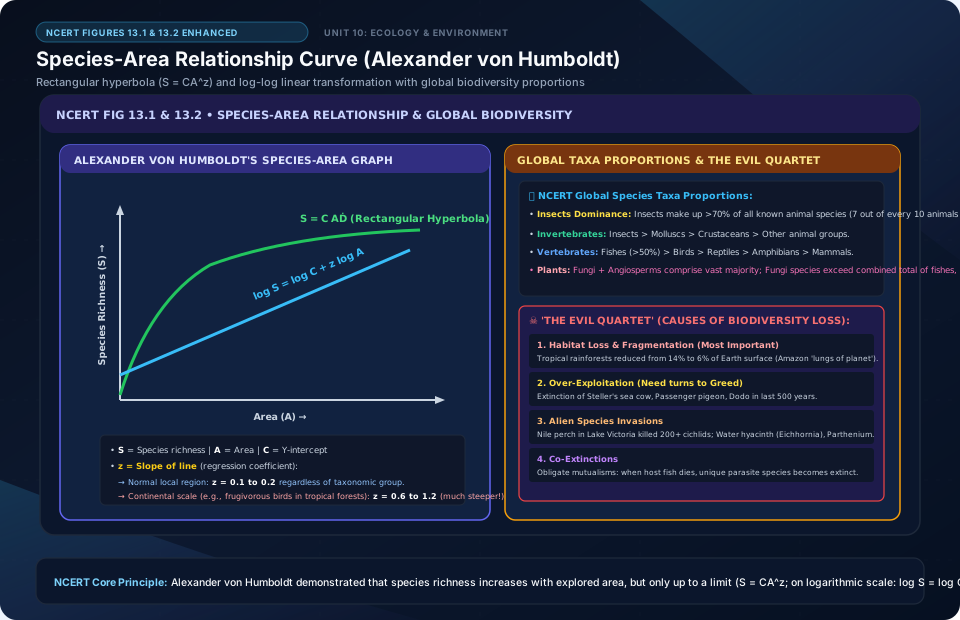
Species-Area Relationship Curve (Alexander von Humboldt)
🚨 Examiner Traps & Common Misconceptions
✅ Reality: They are EX-SITU (off-site) conservation! Animals and plants are removed from natural habitats and cared for in protected human-managed facilities.
✅ Reality: Species diversity decreases towards the poles! The tropics harbor the highest diversity due to evolutionary age, unglaciated stability, and abundant solar energy.
💡 Memory Hack & Mnemonic
The Evil Quartet Drivers of Extinction: ‘HOAC’ (Habitat loss, Over-exploitation, Alien species invasions, Co-extinctions).
⭐ 10/10 Active Recall Self-Check: Chapter 13
Test your mastery before closing this lecture note. Can you answer these without looking back?
- What are the core experimental proofs or physiological steps that define Biodiversity and its Conservation in the NCERT syllabus?
- How does the molecular mechanism or ecological interaction covered here operate under changing conditions?
- What are the high-frequency examiner traps or tricky numerical ratios associated with this chapter?
- Can you formulate the primary mnemonic or memory framework for remembering the key components above?
⭐ 10/10 Active Recall Self-Check: Chapter 13
Test your mastery before closing this lecture note. Can you answer these without looking back?
- What are the core experimental proofs or physiological steps that define Biodiversity and its Conservation in the NCERT syllabus?
- How does the molecular mechanism or ecological interaction covered here operate under changing conditions?
- What are the high-frequency examiner traps or tricky numerical ratios associated with this chapter?
- Can you formulate the primary mnemonic or memory framework for remembering the key components above?