
12.1 Ecosystem Structure and Function: Abiotic-Biotic Components, Stratification & Trophic Levels #
An Ecosystem can be visualized as a functional unit of nature, where living organisms interact among themselves and also with the surrounding physical environment. Ecosystems vary greatly in size from a small pond to a large forest or the entire biosphere.
The two basic structural components of an ecosystem are Abiotic components (non-living factors: light, temperature, water, minerals) and Biotic components (producers, consumers, decomposers). The interaction between biotic and abiotic factors results in a physical structure characteristic of each ecosystem:
- Stratification: The vertical distribution of different species occupying different levels in an ecosystem. For example, in a forest, trees occupy the top vertical strata or layer, shrubs the second, and herbs and grasses occupy the bottom layer.
- Four Core Ecosystem Functions:
- Productivity: Rate of biomass production.
- Decomposition: Breakdown of complex organic matter into inorganic minerals.
- Energy Flow: Unidirectional flow of energy from sun to producers and consumers.
- Nutrient Cycling: Storage and cyclic transfer of biogenetic elements.
12.2 Productivity: Gross Primary Productivity (GPP) vs Net Primary Productivity (NPP = GPP – R); Secondary Productivity #
A constant input of solar energy is the basic requirement for any ecosystem to function and sustain. Primary Production is defined as the amount of biomass or organic matter produced per unit area over a time period by plants during photosynthesis, expressed in g/m2 or kcal/m2. The rate of biomass production is called Productivity (expressed in g/m2/year or kcal/m2/year):
- Gross Primary Productivity (GPP): The total rate of production of organic matter during photosynthesis. A considerable amount of GPP is utilized by plants in cellular respiration (R).
- Net Primary Productivity (NPP): The available biomass for the consumption to heterotrophs (herbivores and decomposers). Defined by the fundamental equation:NPP = GPP − R (where R = Respiration Loss)
- Secondary Productivity: Defined as the rate of formation of new organic matter by consumers (heterotrophs).
- Global Biosphere Productivity (NCERT Benchmark): The annual net primary productivity of the entire biosphere is approximately 170 billion tons (dry weight) of organic matter. Of this, despite occupying about 70% of the Earth’s surface, the productivity of the oceans is only 55 billion tons! The remaining 115 billion tons is produced on land.
12.3 Decomposition Process: Detritus Breakdown through Fragmentation (Earthworms), Leaching, Catabolism (Fungi/Bacteria), Humification & Mineralization #
Decomposers break down complex organic matter into inorganic substances like carbon dioxide, water, and nutrients. The raw material for decomposition is called Detritus, consisting of dead plant remains (leaves, bark, flowers) and dead remains of animals including fecal matter.
Decomposition is largely an oxygen-requiring process progressing through five simultaneous steps:
- Fragmentation: Detritivores (e.g., earthworms) break down detritus into smaller particles.
- Leaching: Water-soluble inorganic nutrients percolate down into the soil horizon and get precipitated as unavailable salts.
- Catabolism: Bacterial and fungal enzymes degrade detritus into simpler inorganic substances.
- Humification: Leads to the accumulation of a dark-colored, amorphous substance called Humus that is highly resistant to microbial action and undergoes decomposition at an extremely slow rate. Humus serves as a reservoir of nutrients and is colloidal in nature.
- Mineralization: The humus is further degraded by some microbes, releasing inorganic mineral nutrients back into the soil.
Factors Regulating Decomposition: Decomposition rate is slower if detritus is rich in lignin and chitin, and quicker if detritus is rich in nitrogen and water-soluble substances like sugars. Warm and moist environments promote decomposition, whereas low temperature and anaerobiosis inhibit it.
12.4 Energy Flow: Lindeman’s 10 Percent Law of Energy Transfer across Trophic Levels; Grazing Food Chain (GFC) vs Detritus Food Chain (DFC) #
Except for deep sea hydrothermal vents, the Sun is the only source of energy for all ecosystems on Earth. Of the incident solar radiation, less than 50% is Photosynthetically Active Radiation (PAR). Plants capture only 2 to 10% of the PAR, and this small amount of energy sustains the entire living world!
Energy transfer across ecosystems obeys the laws of thermodynamics: energy flow is strictly unidirectional (from producers to consumers). Energy moves through food chains:
- Grazing Food Chain (GFC): Begins with living photosynthetic autotrophs (Producers):
Grass → Deer → Tiger. In an aquatic ecosystem, GFC is the major conduit for energy flow. - Detritus Food Chain (DFC): Begins with dead organic matter (detritus), made up of decomposers (saprotrophic fungi and bacteria):
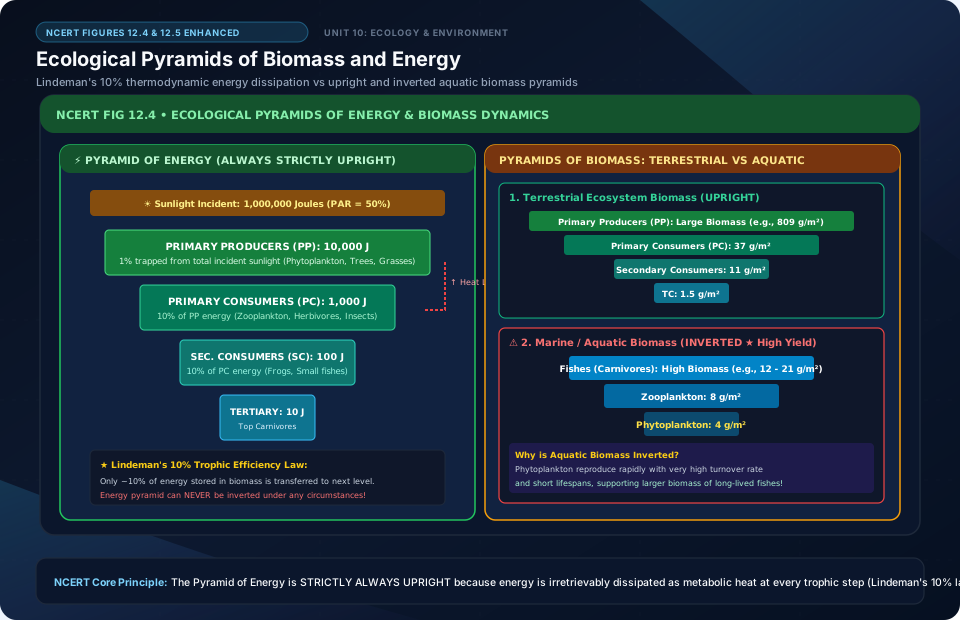
Fallen Leaves → Woodlice → Blackbird. In a terrestrial ecosystem, a much larger fraction of energy flows through the DFC than through the GFC! - Lindeman’s 10 Percent Law (Raymond Lindeman 1942): Only about 10% of the energy is transferred from one trophic level to the next higher trophic level; the remaining 90% is lost as metabolic heat during respiration. This severe thermodynamic limitation restricts the number of trophic levels in a food chain to typically 4 or 5.
12.5 Ecological Pyramids: Pyramid of Number, Pyramid of Biomass (Inverted in Aquatic Sea: Small Phytoplankton supporting large Zooplankton/Fishes) & Pyramid of Energy (Always Upright!) #
An Ecological Pyramid is a graphical representation of the trophic structure and function of an ecosystem, with producers forming the base and top carnivores at the apex:
- Pyramid of Numbers: Shows the number of individual organisms at each trophic level. Usually upright (e.g., grassland ecosystem: millions of grasses supporting thousands of rabbits supporting a few eagles).
Inverted Exception: A single giant oak tree (producer = 1) supporting hundreds of herbivorous birds supporting thousands of hyperparasitic lice/mites produces an inverted pyramid of numbers!
- Pyramid of Biomass: Shows the total dry weight of living matter at each trophic level. In most terrestrial ecosystems, it is upright.
Inverted Exception (Crucial NCERT Fact): The pyramid of biomass in a sea / aquatic ecosystem is generally inverted! Why? Because the standing crop biomass of tiny, short-lived microscopic phytoplankton is very small at any given time, yet their high turnover rate supports a much larger standing biomass of long-lived zooplankton and predatory fishes!
- Pyramid of Energy: Shows the total energy flow through each trophic level per unit area per unit time. The pyramid of energy is ALWAYS UPRIGHT and CAN NEVER BE INVERTED! Why? Because energy is inevitably lost as metabolic heat (governed by the 10% law) at each successive trophic step.
12.6 Ecological Succession: Primary vs Secondary Succession; Hydrarch (Hydric to Mesic) vs Xerarch (Xeric to Mesic) Pioneer and Climax Communities #
An important characteristic of all biological communities is that their composition and structure change constantly in response to changing environmental conditions. This sequential, predictable change in species composition in a given area is called Ecological Succession:
- The community that is in near equilibrium with the environment is called a Climax Community (e.g., stable mesic forest).
- The entire sequence of communities that successively change in a given area are called Sere(s), and individual transitional communities are called seral stages.
- Primary Succession: Begins in areas where no living organisms ever existed before—such as bare rock, newly cooled lava, or sand dunes. Soil formation is extremely slow, taking hundreds to thousands of years.
- Secondary Succession: Begins in areas where natural biotic communities have been destroyed—such as abandoned farmland, burned or cut forests, flooded lands. Because some soil or sediment is already present, secondary succession is much faster.
- Hydrarch vs Xerarch Succession:
- Hydrarch Succession: Takes place in wet areas (water bodies); progresses from hydric (aquatic) conditions to mesic conditions:
Phytoplankton (Pioneer) → Submerged plant stage → Submerged free-floating → Reed-swamp → Marsh-meadow → Scrub → Forest (Climax). - Xerarch Succession: Takes place in dry, arid areas (bare rock); progresses from xeric (dry) conditions to mesic conditions:
Crustose Lichens (Pioneer, secreting acids to dissolve rock) → Foliose Lichens → Mosses → Annual Herbs → Perennial Grasses → Shrubs → Forest (Climax). - Notice: Both hydrarch and xerarch successions lead to medium water (mesic) conditions!
- Hydrarch Succession: Takes place in wet areas (water bodies); progresses from hydric (aquatic) conditions to mesic conditions:
Ecological Pyramids of Biomass and Energy
🚨 Examiner Traps & Common Misconceptions
✅ Reality: The pyramid of energy is ALWAYS UPRIGHT without any exceptions! Energy is inexorably lost as metabolic heat at every trophic step according to the Second Law of Thermodynamics.
✅ Reality: Primary succession begins on sterile bare rock or cooled lava and takes thousands of years to build soil; Secondary succession starts where soil already exists (burnt forest) and is vastly faster!
💡 Memory Hack & Mnemonic
Decomposition Steps: ‘Friendly Lions Can Hunt Monkeys’ (Fragmentation, Leaching, Catabolism, Humification, Mineralization).
⭐ 10/10 Active Recall Self-Check: Chapter 12
Test your mastery before closing this lecture note. Can you answer these without looking back?
- What are the core experimental proofs or physiological steps that define Ecosystem in the NCERT syllabus?
- How does the molecular mechanism or ecological interaction covered here operate under changing conditions?
- What are the high-frequency examiner traps or tricky numerical ratios associated with this chapter?
- Can you formulate the primary mnemonic or memory framework for remembering the key components above?
⭐ 10/10 Active Recall Self-Check: Chapter 12
Test your mastery before closing this lecture note. Can you answer these without looking back?
- What are the core experimental proofs or physiological steps that define Ecosystem in the NCERT syllabus?
- How does the molecular mechanism or ecological interaction covered here operate under changing conditions?
- What are the high-frequency examiner traps or tricky numerical ratios associated with this chapter?
- Can you formulate the primary mnemonic or memory framework for remembering the key components above?