
11.1 Organism and Environment: Major Abiotic Factors (Temperature: Eurythermal vs Stenothermal; Water: Euryhaline vs Stenohaline; Light; Soil) #
Ecology is a subject which studies the interactions among organisms and between the organism and its physical (abiotic) environment. Ecology is basically concerned with four levels of biological organization: Organisms, Populations, Communities, and Biomes.
Major Abiotic Environmental Factors:
- Temperature: The most ecologically relevant environmental factor. It ranges from subzero levels in polar regions to >50°C in tropical deserts and >100°C in deep-sea hydrothermal vents. Temperature dictates the geographical distribution of species through its effect on enzyme kinetics and basal metabolism:
- Eurythermal Organisms: Can tolerate and thrive in a wide range of temperatures (e.g., mammals, birds).
- Stenothermal Organisms: Restricted to a narrow range of temperatures (e.g., polar bears, amphibians, reptiles).
- Water: Next to temperature, water is the most important factor influencing the life of organisms. For aquatic organisms, chemical composition and pH are critical, along with salinity (measured in parts per thousand, ppt): <5 ppt in freshwater, 30–35 ppt in sea, and >100 ppt in hypersaline lagoons:
- Euryhaline Organisms: Can tolerate a wide range of salinities (e.g., salmon, bull shark).
- Stenohaline Organisms: Restricted to a narrow range of salinity (most freshwater organisms die in marine water due to osmotic shock!).
- Light: Plants need light for photosynthesis; photoperiod triggers flowering and seasonal migration/breeding in birds.
- Soil: The nature and properties of soil depend on climate, weathering, and whether soil is transported or sedimentary. Soil composition, grain size, and aggregation determine percolation and water-holding capacity, dictating the vegetation and animals that can thrive.
11.2 Responses to Abiotic Factors: Regulate (Homeostasis), Conform (99% of animals), Migrate (Siberian cranes to Keoladeo) & Suspend (Hibernation, Aestivation, Diapause in Zooplankton) #
Over evolutionary time, organisms have developed adaptations to manage abiotic stresses to maintain a constant internal environment (Homeostasis):
- Regulate: Some organisms maintain homeostasis by physiological or behavioral means that ensure constant body temperature and constant osmotic concentration. All birds and mammals, and a very few lower vertebrates and invertebrates, are regulators (thermoregulation and osmoregulation). In summer, humans sweat profusely; evaporation cools the body. In winter, shivering generates heat.
- Conform: An overwhelming majority (99%) of animals and nearly all plants cannot maintain a constant internal environment. Their body temperature changes with ambient temperature (poikilotherms). Why have conformers not evolved to become regulators? Thermoregulation is energetically expensive, especially for small animals (shrews and hummingbirds) which have a large surface area relative to their volume and lose body heat very fast in the cold!
- Migrate: The organism can move away temporarily from the stressful habitat to a more hospitable area and return when the stressful period is over. Every winter, the famous Keoladeo National Park (Bharatpur) in Rajasthan hosts thousands of migratory birds coming from Siberia and other extremely cold northern regions.
- Suspend: Organisms that cannot migrate avoid stress by escaping in time:
- Hibernation (Winter sleep): Bears escape winter cold.
- Aestivation (Summer sleep): Snails and frogs escape summer heat and desiccation.
- Diapause: Under unfavorable conditions, many zooplankton species in lakes and ponds enter a stage of suspended metabolic development called diapause.
- Fungi, bacteria, and lower plants produce thick-walled resistant spores, while higher plant seeds enter dormancy.
11.3 Adaptations: Kangaroo Rat (Internal metabolic water oxidation & hyper-concentrated urine), Desert Plants (Thick cuticle, Sunken stomata, CAM pathway, Opuntia phylloclade), Allen’s Rule in Cold Climates #
An adaptation is any morphological, physiological, or behavioral attribute of an organism that enables it to survive and reproduce in its habitat:
- Kangaroo Rat (North American Deserts): Capable of meeting all its water requirements through internal metabolic oxidation of fats (where water is a byproduct). It has the ability to concentrate its urine to an extreme degree so that minimal volume of water is used to excrete wastes.
- Desert Plants (Xerophytic Adaptations): Thick waxy cuticle on leaf surfaces, sunken stomata arranged in deep pits to minimize transpiration, and a specialized photosynthetic pathway: Crassulacean Acid Metabolism (CAM) that allows stomata to remain closed during daytime! In Opuntia, leaves are reduced to defensive spines, and the flattened green stem (phylloclade) performs photosynthesis.
- Cold Climate Adaptations:
- Allen’s Rule: Mammals from colder climates generally have shorter ears and shorter limbs to minimize heat loss.
- In polar seas, aquatic mammals like seals have a thick layer of fat called blubber below their skin that acts as an insulator, reducing heat loss.
- Physiological & Biochemical Adaptations:
- Altitude Sickness: At high altitudes (>3500 m, e.g., Rohtang Pass, Leh), the body experiences low atmospheric pressure and hypoxia, causing nausea, fatigue, and heart palpitations. The body acclimatizes by increasing RBC production, decreasing the binding affinity of hemoglobin, and increasing breathing rate!
- Archaebacteria thrive in hydrothermal vents at temperatures exceeding 100°C due to thermostable branched-chain ether-linked membrane enzymes. Deep-sea fishes withstand crushing hydrostatic pressures hundreds of times atmospheric pressure.
11.4 Population Attributes: Natality, Mortality, Sex Ratio & Age Pyramids (Expanding, Stable, Declining) #
A population is a group of individuals of the same species living in a well-defined geographical area, sharing or competing for similar resources, and potentially interbreeding. A population has specific collective attributes that an individual organism does not possess:
- Birth Rate (Natality) & Death Rate (Mortality): Expressed as number of births or deaths per capita (per individual) per unit time (e.g., if in a pond there were 20 lotus plants last year and through reproduction 8 new plants are added, birth rate = 8/20 = 0.4 offspring per lotus per year).
- Sex Ratio: An individual is either a male or female, but a population has a sex ratio (e.g., 60% females and 40% males).
- Age Pyramids: A population at any given time is composed of individuals of different ages: pre-reproductive, reproductive, and post-reproductive. A graphical representation of age distribution is an Age Pyramid:
- Expanding Population (Triangular Pyramid): High proportion of pre-reproductive individuals; population is growing rapidly (developing countries).
- Stable Population (Bell-Shaped Pyramid): Pre-reproductive and reproductive individuals are almost equal; population size remains constant.
- Declining Population (Urn-Shaped Pyramid): Pre-reproductive individuals are fewer than reproductive ones; population is shrinking over time.
11.5 Population Growth Models: Exponential Growth (dN/dt = rN, J-shaped curve) vs Logistic Growth (Verhulst-Pearl: dN/dt = rN[(K-N)/K], Sigmoid S-shaped curve) #
The size of a population (Population Density, N) fluctuates continuously in response to four basic processes:
Where B = Natality (births), I = Immigration (inward movement), D = Mortality (deaths), and E = Emigration (outward movement).
- Exponential (Geometric) Growth: Occurs when resources (food and space) in the habitat are unlimited. Population grows unchecked at its intrinsic rate of natural increase (r):dN/dt = rN or Nt = N0ertProduces a classic J-shaped growth curve. Since natural resources on Earth are finite, exponential growth cannot be sustained indefinitely.
- Logistic Growth (Verhulst-Pearl Logistic Growth): A population growing in a habitat with limited resources initially shows a lag phase, followed by phases of acceleration and deceleration, and finally an asymptote when the population reaches the Carrying Capacity (K):dN/dt = rN [ (K − N) / K ]Produces a realistic Sigmoid (S-shaped) curve. The term
(K − N)/Krepresents environmental resistance. Since resources for growth for most animal populations are finite and become limiting, the logistic growth model is considered far more biologically realistic!
11.6 Life History Variation & Population Interactions: Mutualism (+/+ Lichens, Mycorrhizae, Fig-Wasp), Competition (-/- Gause’s Competitive Exclusion Principle), Predation (+/- Prickly pear cactus & Cactoblastis moth), Parasitism (+/- Brood parasitism in Cuckoo/Crow), Commensalism (+/0 Epiphytic Orchid, Cattle Egret & Grazing Cattle), Amensalism (-/0 Penicillium & Bacteria) #
In nature, biological populations do not exist in isolation; they interact continuously in ecological communities. Population Interactions are classified by their net fitness effects:
| Interaction Type | Species A / B Effects | NCERT Ecological Examples & Principles |
|---|---|---|
| Mutualism | + / + (Both benefit) | 1. Lichens (Algae + Fungi). 2. Mycorrhizae (Fungi + Roots of higher plants). 3. Fig tree and Fig wasp (tight one-to-one co-evolution where wasp pollinates fig while laying eggs in ovaries). 4. Mediterranean orchid Ophrys employs ‘sexual deceit’: one petal resembles female bee in color, size, and markings; male bee ‘pseudocopulates’ with the flower, carrying pollen! |
| Competition | − / − (Both harmed) | 1. Abingdon tortoise in Galapagos became extinct within a decade after goats were introduced on the island due to the greater browsing efficiency of goats. 2. Gause’s Competitive Exclusion Principle: Two closely related species competing for the exact same limiting resources cannot coexist indefinitely; the competitively inferior one will eventually be eliminated. 3. Resource Partitioning (MacArthur): Five closely related species of warblers coexisted on the same spruce tree by foraging at different heights and times. |
| Predation | + / − (Predator benefits, prey harmed) | Acts as a conduit for energy transfer and keeps prey populations under check. Prickly pear cactus introduced in Australia in 1920 caused havoc by spreading over millions of hectares; brought under control only after introducing a cactus-feeding predator moth (Cactoblastis). Prey evolve defenses (camouflage in insects/frogs; cardiac glycosides in Calotropis). |
| Parasitism | + / − (Parasite benefits, host harmed) | 1. Ectoparasites: Lice on humans, ticks on dogs, marine copepods on fish, Cuscuta (non-green plant lacking chlorophyll parasitic on hedge plants). 2. Endoparasites: Liver fluke, tapeworm. 3. Brood Parasitism: The parasitic cuckoo (koel) lays its eggs in the nest of the crow, letting the foster host incubate them. The cuckoo eggs have evolved to resemble the host’s eggs in size and color. |
| Commensalism | + / 0 (One benefits, other neutral) | 1. Orchid growing as an epiphyte on a mango branch. 2. Barnacles growing on the back of a whale. 3. Cattle egret foraging close to grazing cattle (flushes out insects). 4. Sea anemone and clownfish (clownfish gets protection among stinging tentacles; anemone unaffected). |
| Amensalism | − / 0 (One harmed, other neutral) | 1. Penicillium mould secreting penicillin antibiotic that inhibits bacterial growth without gaining or losing direct nutritional benefit. 2. Large tree canopy blocking light for seedling germination underneath. |
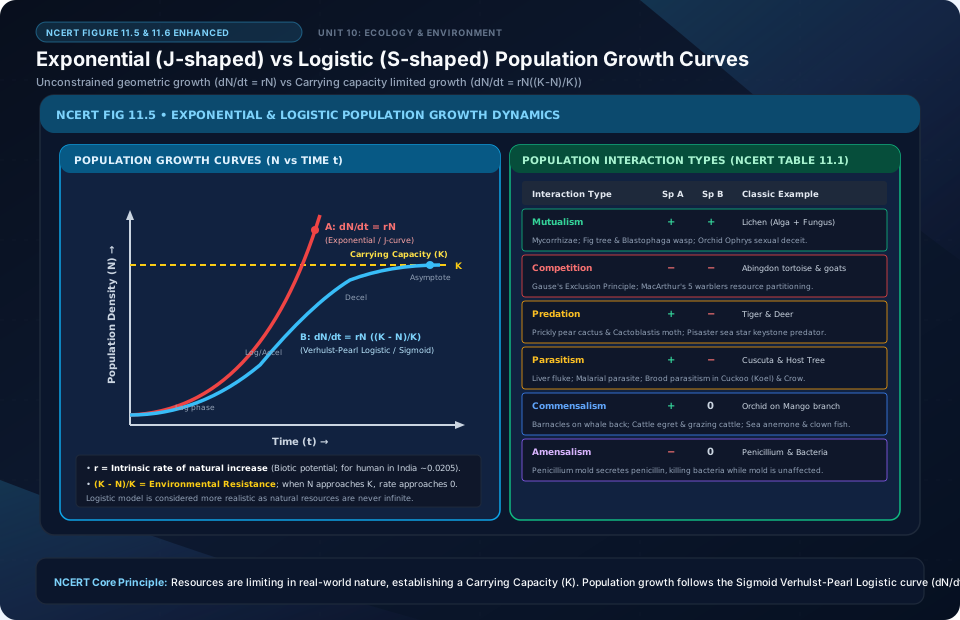
Exponential (J-shaped) vs Logistic (S-shaped) Population Growth Curves
🚨 Examiner Traps & Common Misconceptions
✅ Reality: Thermoregulation is energetically extremely expensive! Small animals (shrews, hummingbirds) have high surface-area-to-volume ratios and lose heat rapidly, so conforming is an energy-saving strategy.
✅ Reality: In nature, competing species often evolve resource partitioning (e.g., MacArthur’s warblers feeding on different zones of the same tree) to coexist stably!
💡 Memory Hack & Mnemonic
Population Interaction Signs: ‘Mutualism (+/+), Commensalism (+/0), Amensalism (-/0), Predation & Parasitism (+/-), Competition (-/-)’.
⭐ 10/10 Active Recall Self-Check: Chapter 11
Test your mastery before closing this lecture note. Can you answer these without looking back?
- What are the core experimental proofs or physiological steps that define Organisms and Populations in the NCERT syllabus?
- How does the molecular mechanism or ecological interaction covered here operate under changing conditions?
- What are the high-frequency examiner traps or tricky numerical ratios associated with this chapter?
- Can you formulate the primary mnemonic or memory framework for remembering the key components above?
⭐ 10/10 Active Recall Self-Check: Chapter 11
Test your mastery before closing this lecture note. Can you answer these without looking back?
- What are the core experimental proofs or physiological steps that define Organisms and Populations in the NCERT syllabus?
- How does the molecular mechanism or ecological interaction covered here operate under changing conditions?
- What are the high-frequency examiner traps or tricky numerical ratios associated with this chapter?
- Can you formulate the primary mnemonic or memory framework for remembering the key components above?