
1.1 Flower Architecture & Pre-Fertilization Events: Stamen, Microsporangium & Pollen Grain Development #
Flowers are the fascinating reproductive organs of angiosperms. Morphologically and embryologically, a flower is a modified shoot condensed for sexual reproduction. Long before a flower appears on a plant, the decision that the plant will flower takes place through hormonal and structural changes initiated by photoperiodic cues.
In a flower, the male reproductive whorl is the androecium, consisting of stamens, and the female reproductive whorl is the gynoecium, consisting of carpels or pistils. Pre-fertilization events encompass the development of male and female reproductive structures, microsporogenesis, megasporogenesis, and pollination.
1.2 The Pistil, Megasporangium (Ovule) & Female Gametophyte (7-Celled, 8-Nucleate Embryo Sac) #
The Stamen, Microsporangium, and Pollen Grain: A stamen consists of a long, slender stalk called the filament and a terminal, generally bilobed structure called the anther. A typical angiosperm anther is bilobed and dithecous (each lobe has two thecae separated by a longitudinal groove), containing four microsporangia located at the corners (tetrasporangiate).
In transverse section, a typical microsporangium is surrounded by four protective wall layers (from outside to inside):
- Epidermis: Outermost single-cell protective boundary.
- Endothecium: Cells with α-cellulosic fibrous bands on tangential walls that absorb moisture and assist in anther dehiscence.
- Middle Layers: 1 to 3 short-lived parenchymatous layers that degenerate at maturity.
- Tapetum: The innermost glandular wall layer that surrounds the sporogenous tissue. Hallmark: Tapetal cells possess dense cytoplasm and are generally binucleate or multinucleate (due to endomitosis). The tapetum nourishes the developing pollen grains and secretes the enzyme callase and precursors for sporopollenin.
Microsporogenesis: As the anther develops, each diploid cell of the sporogenous tissue acts as a Pollen Mother Cell (PMC) or microspore mother cell. The PMC undergoes meiosis to form a microspore tetrad (four haploid microspores). As the anthers mature and dehydrate, the microspores dissociate from each other and develop into pollen grains.
Pollen Grain (Male Gametophyte): Typically spherical (25–50 µm diameter) with a two-layered wall:
- Exine: Hard outer layer composed of sporopollenin—the most resistant organic biological material known! Sporopollenin can withstand high temperatures, strong acids, and alkalis, and no known enzyme degrades it. This enables pollen grains to be preserved for millions of years as fossils. The exine has prominent apertures called germ pores where sporopollenin is completely absent (allowing pollen tube emergence).
- Intine: Thin, continuous inner layer composed of cellulose and pectin.
A mature pollen grain contains two cells: a large Vegetative Cell (with abundant food reserves and an irregular nucleus) and a small spindle-shaped Generative Cell that floats in the vegetative cytoplasm. In over 60% of angiosperms, pollen is shed at this 2-celled stage; in the remaining species, the generative cell divides mitotically to form two male gametes before shedding (3-celled stage).
1.3 Pollination Mechanisms: Autogamy, Geitonogamy, Xenogamy (Cross-Pollination) & Outbreeding Devices #
The Pistil, Megasporangium (Ovule), and Embryo Sac: The gynoecium may be monocarpellary (one pistil) or multicarpellary (syncarpous when fused, as in Papaver; apocarpous when free, as in Michelia). Each pistil has three parts: the stigma (landing platform for pollen), the elongated slender style, and the basal swollen ovary containing an ovarian cavity (locule) with ovules attached to the placenta.
A typical angiosperm ovule (anatropous ovule) is attached to the placenta by a stalk called the funicle. The point of attachment where the body of the ovule fuses with the funicle is the hilum. The ovule is surrounded by one or two protective envelopes called integuments, which encircle the ovule except at the tip where a small opening called the micropyle is left. Opposite the micropylar end is the chalaza (the basal part of the ovule). Enclosed within integuments is a mass of nutritive cells called the nucellus.
Megasporogenesis & Development of Female Gametophyte: A single cell of the nucellus at the micropylar end differentiates into a Megaspore Mother Cell (MMC). The MMC undergoes meiosis to produce four haploid megaspores. In majority of angiosperms, three megaspores degenerate, and only one functional megaspore develops into the female gametophyte (Embryo Sac). This method of embryo sac development from a single megaspore is termed monosporic development.
The functional megaspore nucleus divides by three successive free-nuclear mitotic divisions to produce an 8-nucleate stage. Cell walls are laid down, organizing into the classic 7-celled, 8-nucleate mature embryo sac:
- Egg Apparatus (Micropylar End, 3 cells): Consists of two synergids and one egg cell. The synergids possess special cellular finger-like thickenings at their micropylar tip called the filiform apparatus, which guides the entry of the pollen tube into the synergid.
- Antipodal Cells (Chalazal End, 3 cells): Three cells at the chalazal pole that perform vegetative and nutritive support.
- Central Cell (1 large cell, 2 nuclei): The large central cell contains two polar nuclei that fuse to form a diploid secondary nucleus prior to fertilization.
1.4 Pollen-Pistil Interaction & Double Fertilization (Syngamy + Triple Fusion -> 3n PEN) #
Pollen grains are immotile; similarly, the female gamete (egg cell) is trapped inside the embryo sac. Therefore, pollination is the essential biological mechanism that brings them together. Pollination is the transfer of pollen grains shed from the anther to the receptive stigma of a pistil.
Depending on the source of pollen, pollination is divided into three types:
- Autogamy (Self-Pollination): Transfer of pollen grains from anther to stigma of the same flower. Requires synchronized anther dehiscence and stigma receptivity, and close physical proximity of anther and stigma.
- Chasmogamous Flowers: Open flowers with exposed anthers and stigmas.
- Cleistogamous Flowers: Flowers that never open at all (e.g., Viola [common pansy], Oxalis, and Commelina). Anthers dehisce inside the closed flower bud; hence, cleistogamous flowers guarantee 100% seed-set even in the complete absence of pollinators!
- Geitonogamy: Transfer of pollen grains from the anther to the stigma of another flower of the same plant. Genetically, geitonogamy is equivalent to autogamy because the pollen comes from the same individual, but ecologically and functionally, it is cross-pollination requiring a pollinator agent.
- Xenogamy (Allogamy / True Cross-Pollination): Transfer of pollen grains from anther to the stigma of a flower on a genetically different plant. This is the only type of pollination that brings genetically different types of pollen grains to the stigma.
1.5 Post-Fertilization Development: Endosperm (Free-Nuclear vs Cellular), Embryogenesis & Seed Formation #
Plants use abiotic (wind and water) and biotic (animals) agents to achieve pollination:
- Anemophily (Wind Pollination): Most common abiotic pollination. Pollen grains are light, non-sticky, and dry so they can be transported by air currents. Flowers possess well-exposed stamens with versatile anthers, large feathery stigmas to easily trap airborne pollen, a single ovule per ovary, and numerous flowers packed into an inflorescence (e.g., Corn cob tassels, Grasses).
- Hydrophily (Water Pollination): Quite rare, limited to about 30 genera, mostly monocots. In Vallisneria, the female flower reaches the surface of water by a long stalk; male flowers release pollen on the water surface, carried passively by water currents to stigmas (epihydrophily). In seagrasses like Zostera, female flowers remain submerged, and long, ribbon-like mucilage-covered pollen grains drift underwater (hypohydrophily). Notice: Aquatic plants like water hyacinth (Eichhornia) and water lily produce flowers above water level that are pollinated by insects or wind!
- Entomophily (Biotic Pollination by Animals): Bees, butterflies, beetles, wasps, ants, moths, birds (sunbirds and hummingbirds), and bats. Bees are the dominant biotic pollinators. Flowers are large, colorful, fragrant, and rich in nectar. To sustain animal visits, flowers provide floral rewards: nectar, edible pollen, and safe sites to lay eggs (e.g., the 6-foot tall flower of Amorphophallus, and the obligate symbiotic relationship between the Yucca plant and the moth Pronuba).
- Outbreeding Devices (Mechanisms to prevent inbreeding depression):
- Dichogamy: Non-synchronization of pollen release and stigma receptivity (Protandry: anthers mature first; Protogyny: stigma matures first).
- Herkogamy: Anther and stigma placed at different spatial positions.
- Self-Incompatibility: A genetic mechanism that prevents self-pollen from fertilizing the ovules by inhibiting pollen germination or pollen tube growth in the pistil.
- Production of Unisexual Flowers (Dioecy): Male and female flowers on different plants (e.g., Papaya) prevents both autogamy and geitonogamy.
1.6 Specialized Reproductive Adaptations: Apomixis (Asexual Seeds) & Polyembryony #
Pollination does not guarantee the transfer of the right type of pollen (compatible pollen of the same species). The pistil has the remarkable ability to recognize pollen—whether it is compatible (right type) or incompatible (wrong type).
This recognition is the result of continuous chemical dialogue mediated by chemical components of the pollen interacting with those of the pistil. If compatible, the pistil accepts the pollen and promotes post-pollination events: the pollen grain germinates on the stigma to produce a pollen tube through one of the germ pores. The contents of the pollen grain move into the pollen tube, which grows through the tissues of the stigma and style via hydrolytic pectinases, guided by chemotropic calcium-boron gradients toward the ovary.
The pollen tube enters the ovule through the micropyle and penetrates into one of the synergids through the filiform apparatus, which guides its entry. Once inside, the tip of the pollen tube ruptures, discharging its two male gametes into the cytoplasm of the synergid.
- Emasculation: Removal of anthers from bisexual flower buds before anther dehiscence using forceps, preventing accidental self-pollination.
- Bagging: Covering the emasculated flower with a bag of suitable size (made of butter paper) to prevent contamination of its stigma with unwanted pollen. When stigma becomes receptive, mature compatible pollen is dusted and rebagged for fruit development.
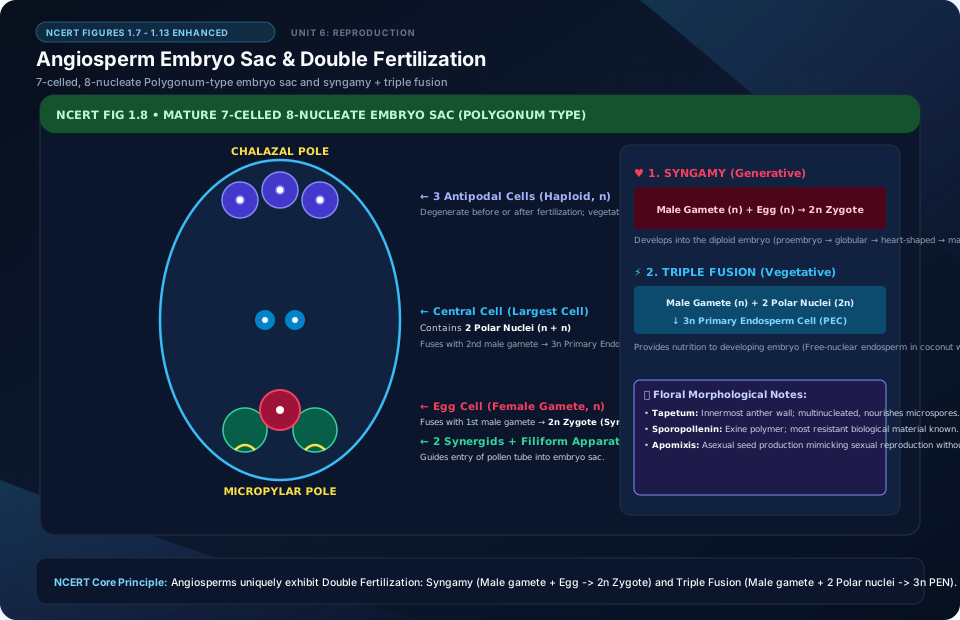
Angiosperm Embryo Sac & Double Fertilization
🚨 Examiner Traps & Common Misconceptions
✅ Reality: Ecologically geitonogamy involves a pollinating agent (looks like cross-pollination), but genetically it is completely AUTOGAMOUS because pollen comes from the exact same plant!
✅ Reality: In gymnosperms the endosperm is haploid (n) formed before fertilization. In angiosperms it is TRIPLOID (3n) formed by triple fusion after fertilization!
💡 Memory Hack & Mnemonic
7-Celled 8-Nucleate Embryo Sac Organization: ‘3 Antipodals at Chalaza, 2 Synergids + 1 Egg at Micropyle, 1 Central Cell with 2 Polar Nuclei’ = 7 cells, 8 nuclei.
⭐ 10/10 Active Recall Self-Check: Chapter 1
Test your mastery before closing this lecture note. Can you answer these without looking back?
- What are the core experimental proofs or physiological steps that define Sexual Reproduction in Flowering Plants in the NCERT syllabus?
- How does the molecular mechanism or ecological interaction covered here operate under changing conditions?
- What are the high-frequency examiner traps or tricky numerical ratios associated with this chapter?
- Can you formulate the primary mnemonic or memory framework for remembering the key components above?
⭐ 10/10 Active Recall Self-Check: Chapter 1
Test your mastery before closing this lecture note. Can you answer these without looking back?
- What are the core experimental proofs or physiological steps that define Sexual Reproduction in Flowering Plants in the NCERT syllabus?
- How does the molecular mechanism or ecological interaction covered here operate under changing conditions?
- What are the high-frequency examiner traps or tricky numerical ratios associated with this chapter?
- Can you formulate the primary mnemonic or memory framework for remembering the key components above?